


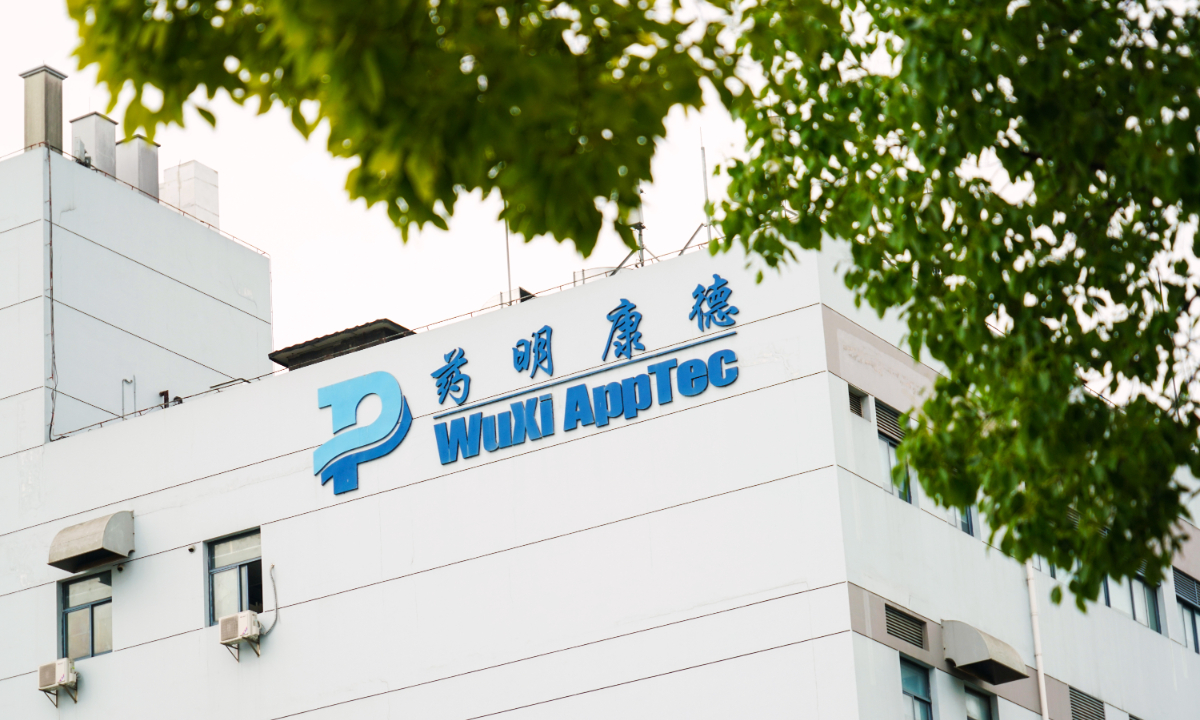
A photo shows WuXi AppTec in the Waigaoqiao Bonded Area of the Shanghai Free Trade Zone. (Photo: VCG)
A US federal judge on Friday temporarily "barred the Pentagon from including Chinese biotechnology group WuXi AppTec on a list of companies believed to support Beijing's military," according to Reuters. Chinese experts said the ruling sends a positive signal for Chinese companies operating in the US, showing that Washington's arbitrary, fact-deficient national security blacklists are not beyond challenge and that firms should make greater use of legal means to defend their legitimate rights.
US District Judge James Boasberg issued an order blocking enforcement of the designation of WuXi in June after the company filed suit. WuXi in a statement welcomed the court's ruling, saying it "relieves us from the immediate adverse consequences" of the Defense Department's designation during the litigation. "We believe that the facts, as demonstrated in our court filings, will prevail after an objective and fair judicial review," a WuXi spokesperson said, according to the report.
A South China Morning Post report noted that the ruling represents an early legal victory for one of China's largest pharmaceutical research and manufacturing service providers and a setback for Washington's expanding use of national-security restrictions against major Chinese commercial companies.
Gao Lingyun, a research fellow at the Chinese Academy of Social Sciences, told the Global Times that the Pentagon's controversial "list-first, evidence-later" approach has bred massive operational uncertainty for Chinese enterprises conducting legitimate business in the US. By arbitrarily imposing restrictive labels before presenting credible proof, Washington creates an opaque and unpredictable regulatory environment that disrupts normal commercial expectations.
The US Department of Defense released its updated Section 1260H list on June 8, marking the first time WuXi AppTec was formally included, alongside Alibaba, Baidu, BYD and Unitree Robotics, among others.
On June 12, WuXi AppTec announced it had filed suit against the Department of Defense in the US District Court for the District of Columbia. The company said the department's decision was erroneous and lacked factual basis or support under applicable statutes and case law.
He Weiwen, a senior fellow at the Center for China and Globalization, noted that when Chinese companies face unfair and unjustified suppression in the US, they cannot rely solely on corporate statements or diplomatic representations; they must also protect themselves through legal means. Filing suit in federal court is entirely necessary and correct, he said.
"In the past, quite a few Chinese companies had nothing to do with so-called military matters but were hit with US countervailing and anti-dumping measures. Many won their cases after appealing to the Court of International Trade. Legal recourse is an indispensable tool and one we need to take more seriously," he said.
In January 2021, Xiaomi was placed on a similar Pentagon list. The Chinese company later announced on May 26, 2021 that a US court has removed the company's designation as a military-related company and lifted all restrictions on US persons buying or holding its stock, Reuters reported.
The designation has so far had little impact on WuXi AppTec's business. The company reported on August 3 that first-half revenue rose 38.9 percent year-on-year to 28.9 billion yuan, while net profit attributable to shareholders climbed 29.4 percent to 11.08 billion yuan — its first half-year profit above the 10-billion-yuan mark, said media reports.
When asked about US placing several Chinese technology companies including Alibaba, Tencent, BYD, on a list of firms that it says aid China's military, Chinese Foreign Ministry spokesperson Lin Jian said that China firmly opposes the US overstretching the concept of national security and formulating various types of discriminatory lists to go after Chinese businesses. "We urge the US to correct its wrongdoings, and stop the unwarranted suppression of Chinese businesses. China will do what is necessary to firmly protect their legitimate and lawful rights and interests," said Lin.