


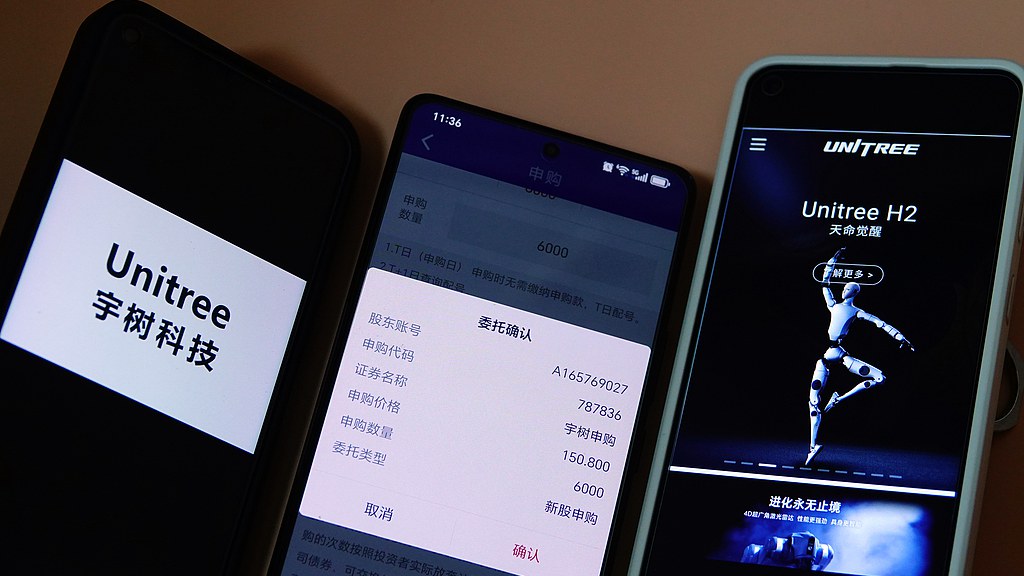
Unitree Robotics stock subscription webpage (C). (Photo: VCG)
Unitree Robotics, one of China's leading robotics companies, officially launched the subscription process for its listing on the Shanghai Stock Exchange's sci-tech innovation board on Monday.
The company set its offering price at 150.80 yuan (about $22.35) per share, giving it an estimated market capitalization of around 60.99 billion yuan. The initial public offering (IPO) is expected to raise 6.1 billion yuan.
If successfully completed, Unitree will become the first A-share-listed company focused on humanoid robot manufacturing, marking a major milestone for China's rapidly expanding robotics industry.
Who is Unitree?
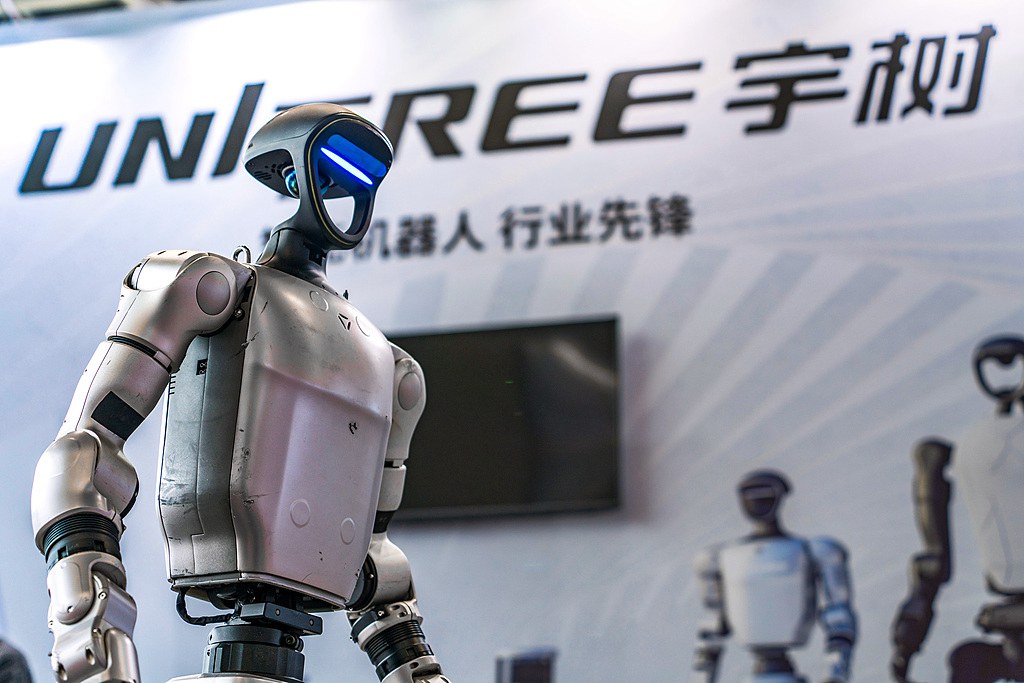
Unitree's humanoid robot G1. (Photo: VCG)
Founded in 2016 and headquartered in Hangzhou, Unitree Robotics specializes in the research, development, manufacturing and sales of high-performance humanoid robots, quadruped robots, robotic components and embodied intelligence models.
Unitree shipped more than 5,500 humanoid robots in 2025, accounting for about 32.4% of the global humanoid robot market and ranking first worldwide. Between 2023 and 2025, the company sold more than 33,000 quadruped robots, placing it among the global leaders in the sector.
The company first gained international recognition through its relatively affordable robot dogs. In recent years, its humanoid robots, including the G1, H1 and R1 models, have attracted global attention through demonstrations featuring running, dancing and martial arts. Unitree competes with international players such as Tesla and Boston Dynamics, as well as a growing number of Chinese robotics startups seeking to develop machines capable of working in factories, commercial environments and, eventually, homes.
Why has Unitree gained widespread attention?
Unlike many humanoid startups that are still operating at a loss, Unitree has achieved large-scale commercial growth and profitability.
The prospectus shows that from 2023 to 2025, the company's revenue increased from 159 million yuan to 1.699 billion yuan, representing a compound annual growth rate of 226.78%. During the same period, adjusted net profit attributable to shareholders rose from a loss of 18 million yuan in 2023 to 591 million yuan in 2025. Its gross profit margin for core businesses also improved significantly, rising from 44.22% to 60.13%.
Its overseas revenue accounted for more than 40% of sales during each of the reporting periods disclosed in its prospectus, highlighting strong global demand for its robotic products.
Industry observers believe Unitree's listing could become an important valuation reference for the humanoid robot sector, helping investors better assess the commercial potential of the industry.
What are the challenges ahead?
Despite its strong growth, Unitree still faces significant challenges.
According to its IPO disclosures, Unitree achieved revenue of 420 million yuan in the first quarter of 2026, up 68.49% year-on-year, but adjusted net profit declined by 52.55%.
The decline was mainly caused by rapidly increasing research and development expenses. Of the funds raised through the IPO, about 85% will be invested into R&D projects, with about 20.22 billion yuan allocated specifically to the development of intelligence robot models.
Unitree founder Wang Xingxing has said that humanoid robots and embodied intelligence have not yet reached a technological turning point. While hardware capabilities are becoming more mature, the biggest challenge lies in improving the generalization capabilities of embodied intelligence models.
Also, the company's current customer structure shows that large-scale industrial adoption is still in its early stages.
In the first three quarters of 2025, the revenue from the research and education field accounted for 73.6% of Unitree's humanoid robot revenue, commercial consumer applications contributed 17.39%, while industrial applications accounted for only 9.01%.
The humanoid robot market is becoming increasingly competitive. Tesla's Optimus Gen 3 has entered small-scale production, with the company targeting a long-term annual production capacity of 1 million units at its Fremont facility. Tesla CEO Elon Musk has described Chinese companies as "by far the biggest competitor in the humanoid robot market."
Why are robot makers seeking listings?
Developing humanoids requires heavy spending on engineers, robot-training data, AI models and manufacturing capacity – years before demand from factories or households is certain.
Therefore, public markets offer companies the capital to keep developing their technology while government support and investor interest remain strong.
Leju Robotics, which makes the Kuavo humanoid robot, filed an application in May to list on Shenzhen's ChiNext market. Hangzhou-based Deep Robotics filed for an IPO on the Shanghai Stock Exchange's STAR Market. Shanghai-based AgiBot, another leading humanoid robot producer, began preparations for a Hong Kong IPO in July.
(With input from Reuters)