


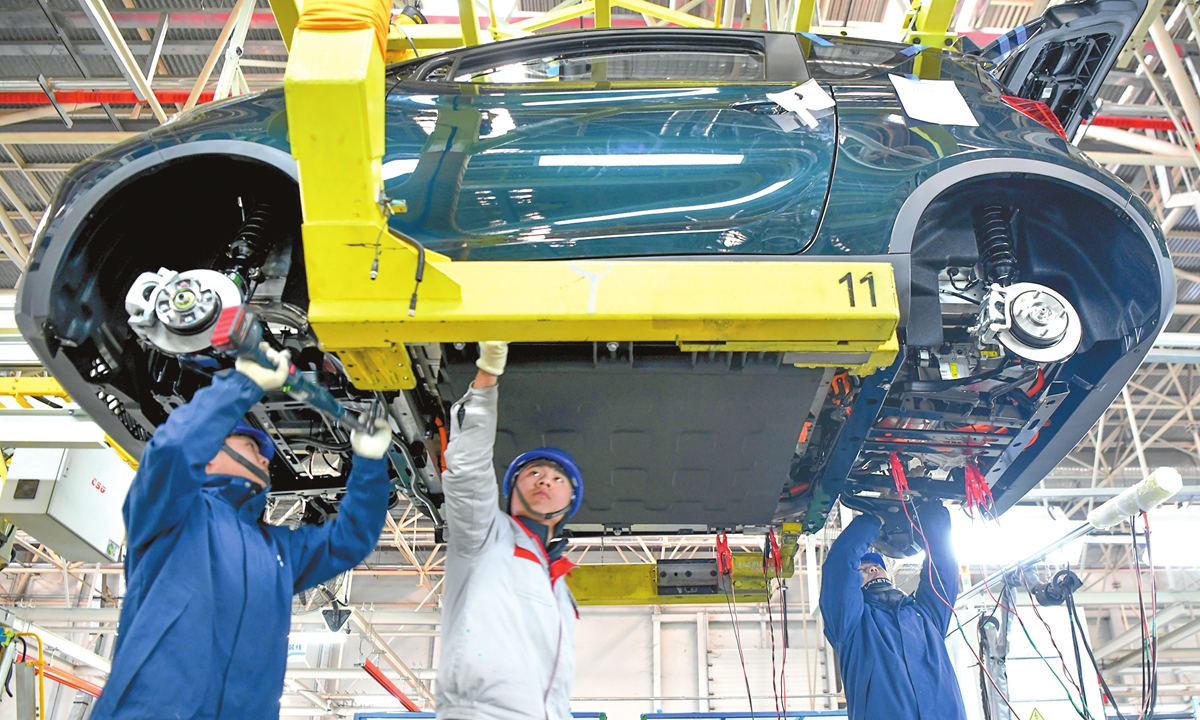
Workers assemble a new-energy vehicle at a manufacturing plant in Shijiazhuang, North China's Hebei Province, on December 24, 2025. (Photo: VCG)
The joint ventures (JVs) of General Motors (GM) will continue to build Chevrolet products in China and explore opportunities in non-US overseas markets, General Motors China confirmed to the Global Times on Monday, in response to media reports claiming that the US brand is ending new car sales in China and retreating from the Chinese market.
"We believe that Cadillac and Buick are well positioned to compete in the segments we are targeting in China to support sustainable growth, while our JVs' Chevrolet portfolio is best positioned for our export markets," GM China said.
"We continue to stand by our existing 7 million-plus Chevrolet customers in China with aftersales support," it said.
Zhang Xiang, secretary-general of the International Intelligent Vehicle Engineering Association, told the Global Times on Monday that Chevrolet's business adjustment in China may be out of a combination of factors including the rapid development of new energy vehicles (NEVs) in the market and the complete auto industrial chains that empower auto production.
"Chevrolet has long been anchored in fuel-powered vehicles. As China's NEV penetration rate deepens, the domestic fuel-car segment keeps shrinking. On the other side, many US automakers have fallen well behind their Chinese rivals on electrification and smart-driving technology. Against this backdrop, some foreign carmakers are proactively reshaping their China strategies," Zhang said.
China's automotive supply chain is exceptionally complete, with cost advantages in aspects including raw materials, parts sourcing, and labor. For a company like GM, using its Chinese operations as an export base is therefore a very natural choice, Zhang said.
The Chevrolet brand, in particular, has already executed a strategic pivot toward export business. Data from the China Passenger Car Association shows that Chevrolet's exports reached 17,159 units in 2024 and 15,917 units in 2025 - both figures surpassing its retail sales in China, China National Radio reported.
Many global automakers are forging deeper and longer-term ties with China, as the country's role evolves beyond a key market into an increasingly important hub for automotive research and development and innovation.
Recently, SAIC Motor and GM signed an agreement to extend their JV partnership by 20 years to 2047. A month earlier, Honda Motor and GAC Group signed a strategic agreement to renew their JV partnership in GAC Honda, extending their cooperation to 2038 while keeping the existing equity structure unchanged.