


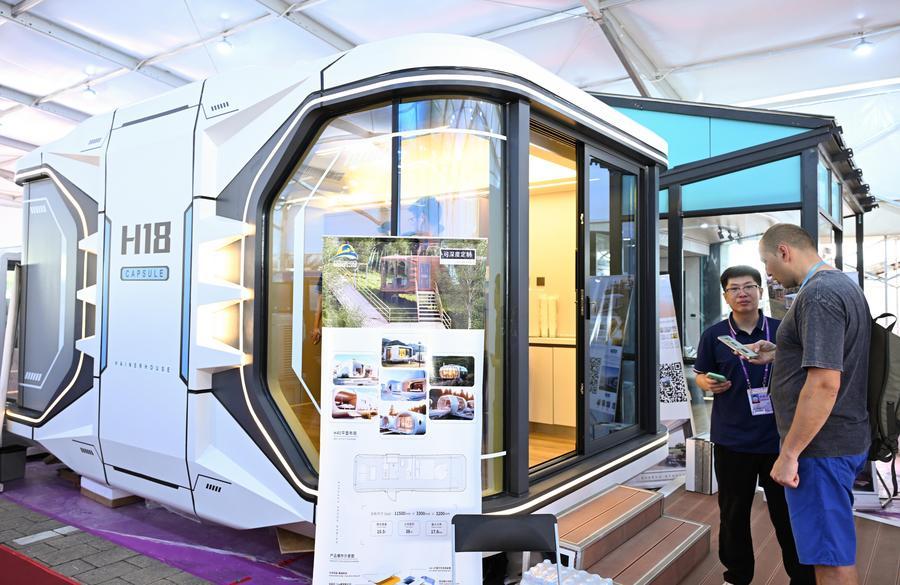
An overseas buyer talks with an exhibitor at an area featuring integrated housing products at the 137th edition of the Canton Fair in Guangzhou, south China's Guangdong Province, April 23, 2025. (Xinhua/Deng Hua)
At Dongguan Port in south China's Guangdong Province, gantry cranes hoist container-like units onto ocean-going vessels bound for Australia, North America and the Middle East. Each unit is, in fact, a complete room, ready to be assembled like building blocks into hotels, apartments and hospitals overseas.
In Huiyang district, Huizhou, Guangdong Province, a fully automated production line spanning more than 400 meters runs around the clock at the smart factory of CSCEC Science and Industry, a subsidiary of Chinese construction giant CSCEC, where steel-structure modular products are manufactured. Robotic arms move in sync with automated guided vehicles on what is China's first smart production line for modular steel-structure buildings.
At the factory, a room is broken down into six components: a floor, a ceiling and four walls. These are manufactured in parallel before being assembled into a complete module at the end of the production line.
"This line can produce 50 units a day, 10 times the output of comparable factories in North America," said Li Huakun, chief engineer at a subsidiary of CSCEC Science and Industry.
"In our smart digital workshops, precision can now be controlled to within 1 to 2 millimeters," Li said. That precision comes from robots following digital instructions rather than relying on manual skills.
At a smart construction industrial park operated by China State Construction Hailong Technology Company Limited in Longgang district, Shenzhen, Guangdong Province, a fully integrated module rolls off the line every 20 minutes.
"Sand and concrete go in one end; a house comes out the other," said Wang Qiong, the company's chief engineer.
The company built the world's first flexible, intelligent modular integrated construction (MiC) manufacturing line for concrete. Robots can finish plastering 70 square meters of walls in 20 minutes, a task that takes a human worker a full day. Each module carries a unique QR code that serves as its ID, allowing full production data to be traced with a single scan.
"More than 70 percent of the construction process has shifted to the factory, cutting project timelines by more than 60 percent," Wang said. The production line has an annual delivery capacity of 20,000 to 30,000 precast concrete modules.
China's prefabricated housing sector centers on steel and concrete structures. Steel is favored for its light weight and suitability for overseas shipping and high-rise buildings, while concrete better aligns with traditional Chinese living preferences and is therefore more readily accepted in the domestic market.
In New South Wales, Australia, an apartment project using Chinese-made modules is being built with less than half the labor typically required, cutting construction time to a few months compared with about two and a half years for conventional construction.
In Australia, labor typically accounts for 30 to 40 percent of total construction costs under conventional methods. The advantage of modular construction lies in shifting most of the work to factories in China, cutting on-site labor and construction timelines by more than half.
"Overall construction costs can drop by over 10 percent," Li said.
In Dubai, China State Construction Hailong Technology Company Limited obtained Dubai Municipality's first in-principle pre-approval permit for multistory MiC buildings in 2025, a milestone Wang described as proof that Chinese construction technology is shifting "from meeting international standards to becoming part of them."
"Overseas clients care most about three things: delivery quality, delivery speed and delivery cost," said Jiang Li, deputy general manager of CSCEC Science and Industry.
With the support of robotics, digital factories and eco-friendly materials, Chinese construction firms are able to meet all three demands at the same time. A clear trend is emerging: these companies are evolving into providers of integrated solutions that combine products, standards and branding.
Behind this shift lies the world's most complete construction supply chain. From steel and concrete to bathroom fixtures and appliances, every component can be quickly sourced in China. Chinese firms also design each module to withstand the stresses of ocean shipping.
"Modular construction represents a new quality productive force for the building industry," Wang said. As a first step, China State Construction Hailong Technology Company Limited has achieved industrialized production and data-driven management throughout the entire process. Looking ahead, the company is confident that it can help make China's modular construction technology a major driving force behind the industrialization of the global construction sector.