


In the first quarter of this year, US retail giant Walmart reported $8 billion in net sales from its China operations — a 22.3 percent increase year-over-year. Both Walmart stores and Sam's Club locations achieved double-digit growth, while e-commerce net sales rose 31 percent, with online channels now accounting for 50 percent of total sales.
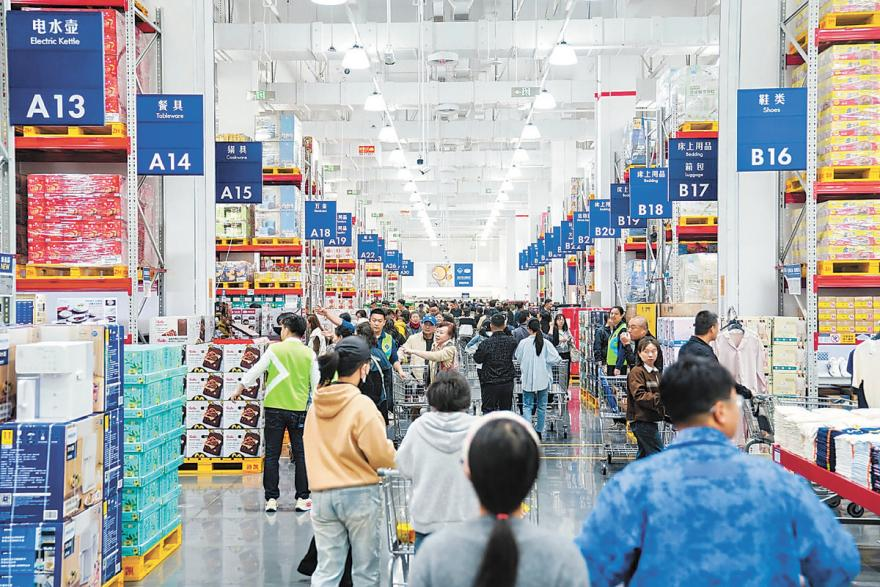
Consumers shop at a Sam's Club store in Wuxi, East China's Jiangsu Province. (Photo courtesy of Walmart China)
"This fully demonstrates the vitality of China's business environment, as consumers' pursuit of higher-quality lifestyles continues to unlock new market potential," said Christina Zhu, president and CEO of Walmart China.
Since entering the Chinese market in 1996, Walmart has served Chinese consumers for three decades. It currently operates across over 100 cities, with hundreds of physical stores and more than 20 standardized distribution centers nationwide.
Over the past three decades, China's per capita GDP has increased nearly 33-fold, and the country has grown into the world's second-largest consumer market, Zhu said.
"Keeping in step with China's consumption upgrade and the transformation of its retail industry, we have witnessed and deeply participated in the modernization of China's retail sector, from traditional offline supermarkets to an integrated online-and-offline, dual-format business strategy," she added.
China's push to build a unified national market, combined with the world's largest and most comprehensive manufacturing system, is creating unique opportunities for Walmart's continued growth both in China and globally.
"A unified national market helps reduce logistics and circulation costs while eliminating regional market fragmentation, making omnichannel networks more efficient and better connected. China's strong manufacturing capabilities and resilient supply chains provide the strongest foundation for our long-term development in the Chinese market," Zhu said.
She believes that China's expanding consumption base and continuously upgrading demand offer broad opportunities for Walmart to introduce high-quality products from around the world and enrich its differentiated product offerings.
Leveraging China's complete and flexible domestic manufacturing ecosystem, Walmart has maintained high-quality standards and built its own brands, such as Marketside grocery, through strict quality control systems and differentiated product strategies, delivering higher-quality products and better service to Chinese consumers.
At the same time, Walmart has worked with top-tier Chinese suppliers to bring locally developed, high-standard products to consumers across China and even global markets.
China has introduced a steady stream of measures to stabilize foreign investment, fostering an increasingly transparent and predictable business environment, Zhu told People's Daily, adding that the country's policy focus is shifting from offering preferential incentives to building a sound institutional environment and unlocking market vitality.
By lowering market entry barriers, safeguarding fair competition and driving innovation through high-standard opening-up, China has emboldened foreign enterprises including Walmart to continuously scale up their investment in the country, she noted.
Zhu reaffirmed Walmart's full confidence in the Chinese market. The retailer will continue deepening its local engagement, supporting the development of local industrial and supply chains, and helping improve the quality of life for Chinese consumers.