


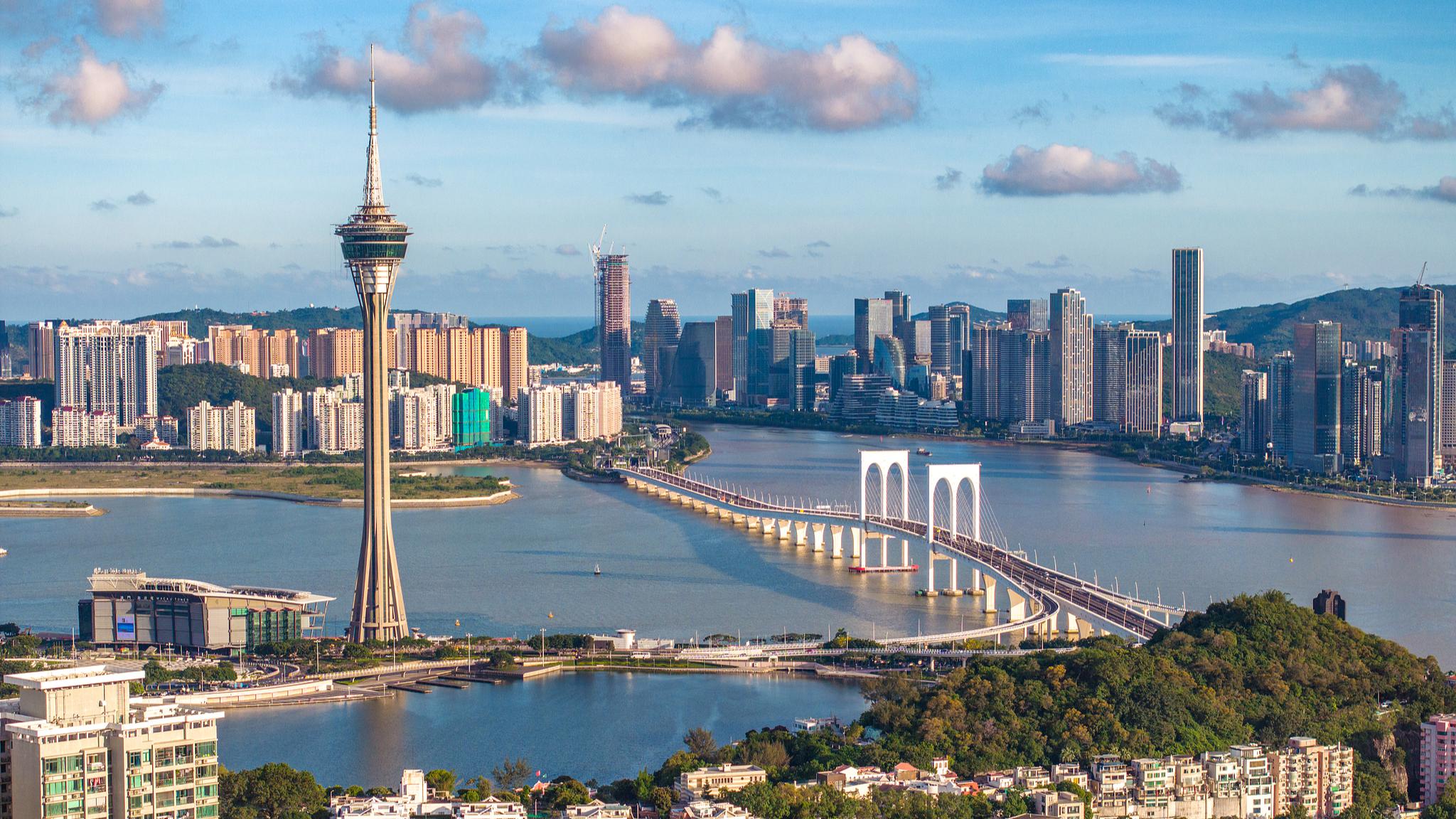
A view of south China's Macao Special Administrative Region. /VCG
On August 18, the much-anticipated Third Five-Year Plan for the Economic and Social Development of the Macao Special Administrative Region (2026-2030) was officially unveiled. It signals that under its new administration, the Macao SAR is moving swiftly to align with China's 15th Five-Year Plan (2026-2030), charting a blueprint for the region's development over the next five years.
As the 15th Five-Year Plan period marks a critical phase for consolidating foundations and pursuing comprehensive progress, Macao's third five-year plan is not merely an outline for territorial governance, it is a strategic guide for Macao to break new ground and embrace transformation at the intersection of global shifts and China's national strategies.
Looking back at Macao's second five-year plan, Hengqin was largely perceived as an extension of Macao's industrial diversification. Under the third five-year plan, however, the Guangdong-Macao In-Depth Cooperation Zone in Hengqin has unmistakably become the linchpin for Macao's appropriately diversified economic development. The new plan explicitly calls for deepening Macao-Hengqin integrated development, driven by technology and education. This signals that Macao no longer views the cooperation zone merely as a supplementary land, but as a full-fledged "industrial engine" with complete value chains. Initiatives such as the Macao-Hengqin International Education (University) Town, the manufacturing model of "Macao registration + Hengqin production + global market," and the push for "hard connectivity" by light-rail between Macao and Hengqin – all aim to dissolve physical boundaries and achieve synergistic effects where "1+1>2."
High-quality development of the Hengqin Cooperation Zone is central to Macao's efforts to diversify its economy and break its over-reliance on a single industry.
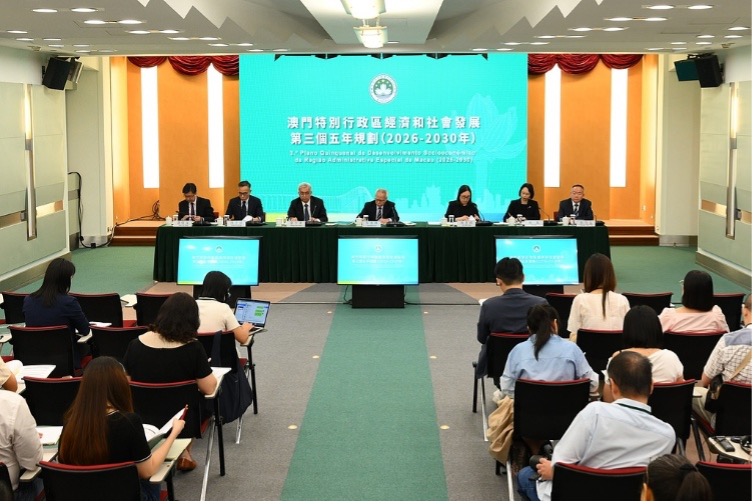
Chief Executive of the Macao SAR Sam Hou Fai attends a press briefing on the region's third five-year plan. Macao SAR, China, August 18, 2026. /VCG
But is a five-year horizon sufficient to deliver a genuine breakthrough?
Leong Hong Sai, member of the Legislative Assembly of the Macao SAR, said that high-quality development of the Guangdong-Macao In-Depth Cooperation Zone in Hengqin is the core key to resolving Macao's over-reliance on a single industry and achieving appropriately diversified development.
Regarding the five-year cycle of the third five-year plan, He believes that five years are sufficient to achieve phased breakthroughs, but cannot accomplish a fundamental, complete transformation. This period should be regarded as a foundation-building phase for industrial diversification, he noted.
Five years are enough to reach significant milestones. The key drivers are the alignment of rules and regulations, the establishment of industrial carriers, and growth in population and enterprise clusters. The Hengqin Cooperation Zone enjoys national-level institutional advantages that fundamentally address Macao's perennial constraints of land scarcity and limited industrial capacity, facilitating an industrial framework of "R&D in Macao, transformation in Hengqin." Within five years, preliminary industrial clusters can be formed, customs clearance and commercial rule alignment can be achieved, and cross-border livelihood facilities can be put in place – all of which mark a transition from concept to substance.
However, due to industry characteristics and institutional barriers, a thorough breakthrough is unlikely within just five years. Biopharmaceuticals, high-tech industries, and others typically have development cycles longer than five years. Meanwhile, deep-seated institutional alignment — covering legal systems, regulation, and capital flows — presents enormous challenges that cannot be fully resolved in the short term.
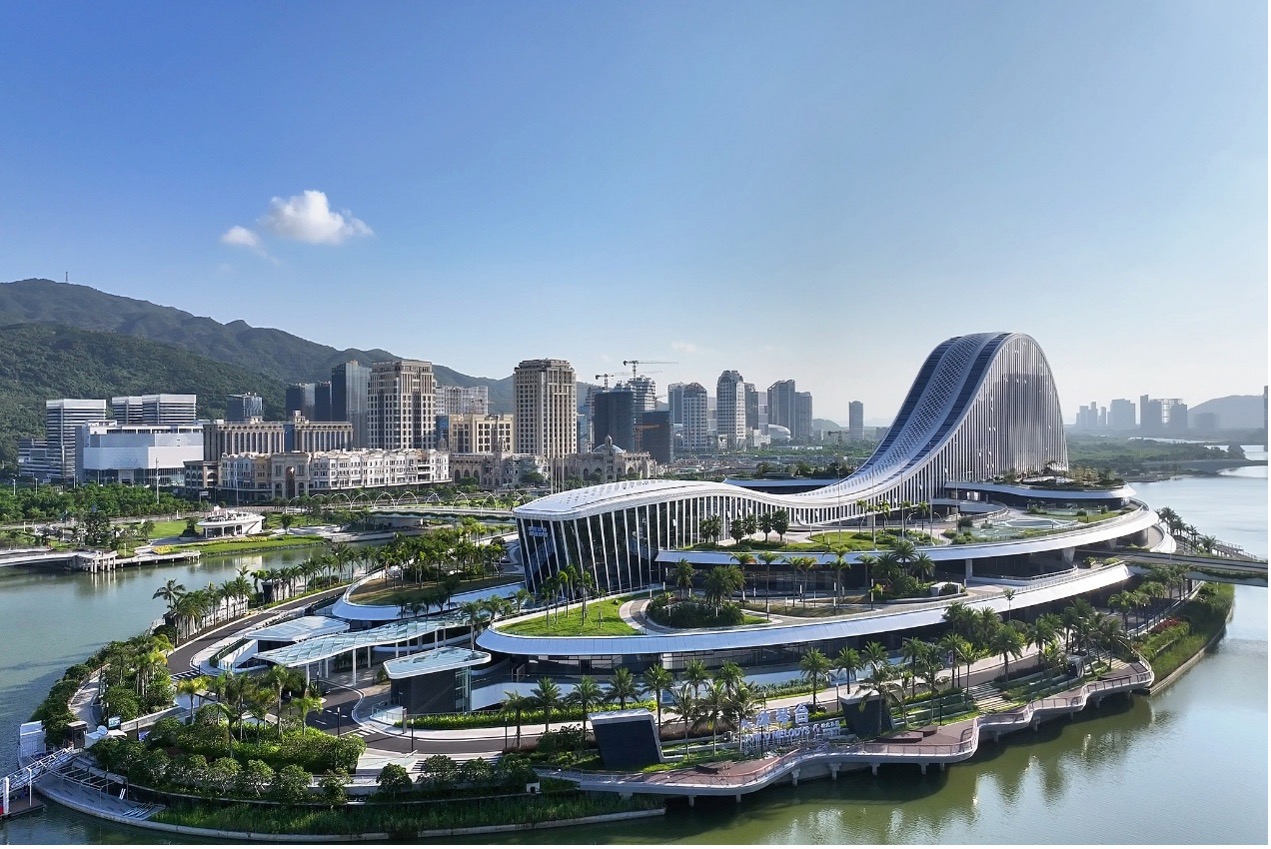
Tianmu Qintai, a landmark development in the Guangdong-Macao In-Depth Cooperation Zone in Hengqin, Zhuhai, Guangdong Province, China, July 23, 2026. /VCG
Liu Yue, secretary‑general of the Macao Regional Economic Research Association, added that on a positive note, a five-year plan can lay the essential institutional and infrastructure groundwork, making phased breakthroughs feasible.
Firstly, institutional barriers can be systematically addressed. Within five years, we can implement a range of innovative mechanisms covering cross-border factor flows, mutual professional recognition, and streamlined administrative procedures — establishing a division of labor where "Macao serves as the headquarter, and Hengqin hosts industrial implementation," breaking the spatial and regulatory constraints that have long hindered diversification.
Secondly, key industries can complete their value-chain layouts. The four major clusters — traditional Chinese medicine, high technology, cross-border finance, and cultural tourism — can achieve initial closed-loop operations spanning R&D, production, and sales, nurturing a cohort of Macao-based industry leaders and young entrepreneurs, and changing the incremental structure of an otherwise monolithic economy.
Thirdly, a cross-border integrated living system can be basically completed, with education, medical care, social security, and housing facilities operational to address the limited development space and talent bottlenecks that have long constrained Macao. These foundational conditions can all be realized within five years, signaling that Macao's diversification is entering a sustainable phase of operation and achieving a phased breakthrough.
From an objective perspective, however, industry cultivation takes time. Technological iteration, market-channel development, and brand building in high-tech and TCM R&D require at least a decade of sustained effort. Connecting with Portuguese-speaking country markets and maturing cross-border financial systems will also require ongoing institutional coordination and market cultivation. At the same time, cross-border regulatory alignment, mutual social welfare recognition, and data-governance frameworks will proceed gradually and cannot be accomplished overnight.
On balance, the five-year cycle of the third five-year plan is tasked with "building platforms, establishing value chains, fostering a critical mass of enterprises, and facilitating integrated livelihoods." It is well positioned to deliver a phased breakthrough in Macao's appropriately diversified development. To achieve a fundamental restructuring of the industrial landscape — one in which diversified sectors achieve dominant shares —the results of the third five-year plan will serve as a foundation for sustained industry cultivation and institutional innovation in future planning cycles, ensuring policy continuity.