


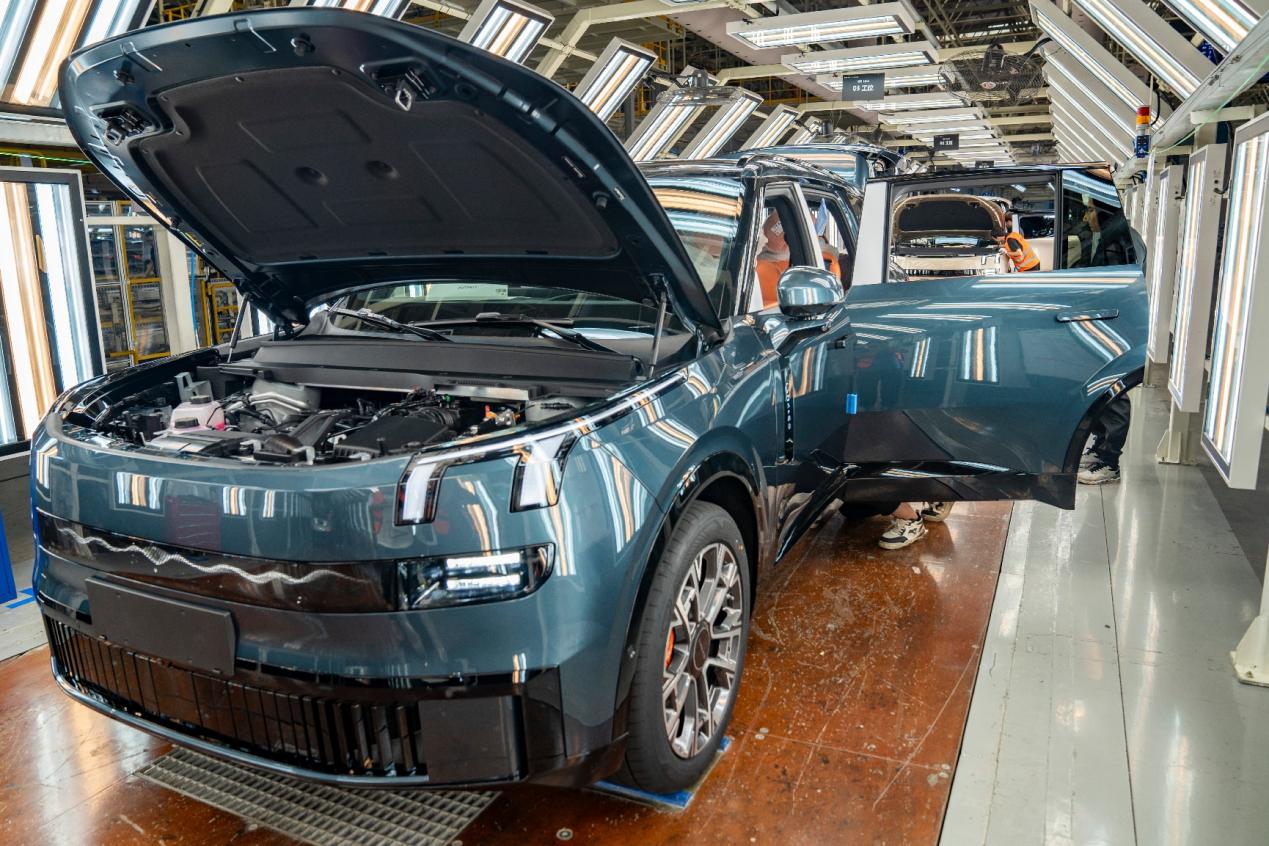
Technicians carry out quality inspections in the general assembly workshop of an auto factory of Chinese automobile manufacturer Lynk & Co. in Yiwu, east China's Zhejiang province. (Photo/Chen Ye)
In July, new energy vehicles (NEVs) accounted for more than 60 percent of monthly new vehicle sales in China for the first time, while their share of cumulative sales surpassed 50 percent for the first time. These two milestones, highlighted in the latest data from the China Association of Automobile Manufacturers (CAAM), have drawn particular attention.
To grasp the significance of these achievements, it is useful to consider two recent rankings that made headlines. In July, NEV models occupied nine of the top 10 best-selling passenger vehicle models in China's retail market. In the first half of the year, three Chinese automakers, leveraging their strengths in NEV technologies, entered the global top 10 automotive brands for the first time, collectively joining the industry's first tier.
These figures show that, after years of development, NEVs have crossed the critical threshold of accounting for more than half of the market and have become a mainstream choice for consumers. As an essential path for China to move from a major automobile producer to a global automotive powerhouse, this landmark shift in market structure represents another step toward that goal.
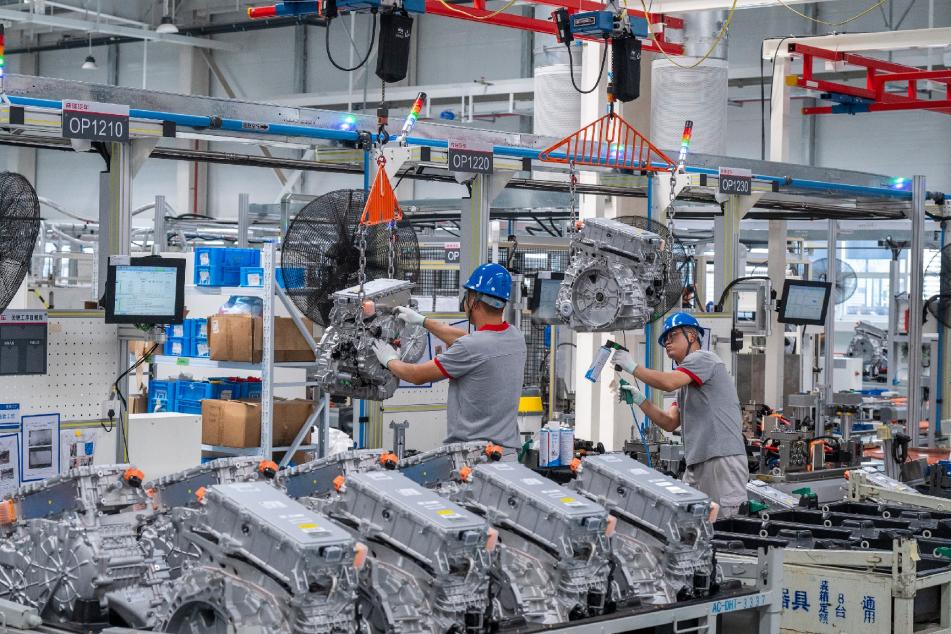
Gear boxes for new energy vehicles are manufactured on a smart production line at a factory of ACTECO Powertrain in Wuhu, east China's Anhui province. (Photo/Xiao Benxiang)
How did these two milestones come about?
First, products have become increasingly competitive. Advances in power batteries, smart cabins and driver-assistance systems, combined with continued improvements in cost-effectiveness, intelligent features and safety, have further strengthened the appeal of NEVs.
In the first year of the 15th Five-Year Plan period (2026-2030), many domestic brands have leveraged their strong technological capabilities to expand into new market segments while moving up the value chain, breaking into the high-end market and gaining a firm foothold.
Second, market demand remains strong. NEVs accounted for more than half of China's vehicle exports for two consecutive months, with export growth outpacing that of conventional fuel-powered vehicles.
Since the beginning of this year, NEV exports have become a key driver of the overall auto industry and an important engine driving export growth. Many analysts believe the momentum will continue, with full-year NEV exports expected to exceed four million units.
Third, relevant infrastructure has continued to improve. As of the end of June, China had 23.057 million electric vehicle charging points, up 43.2 percent year on year, with charging facilities covering 98.61 percent of counties nationwide.
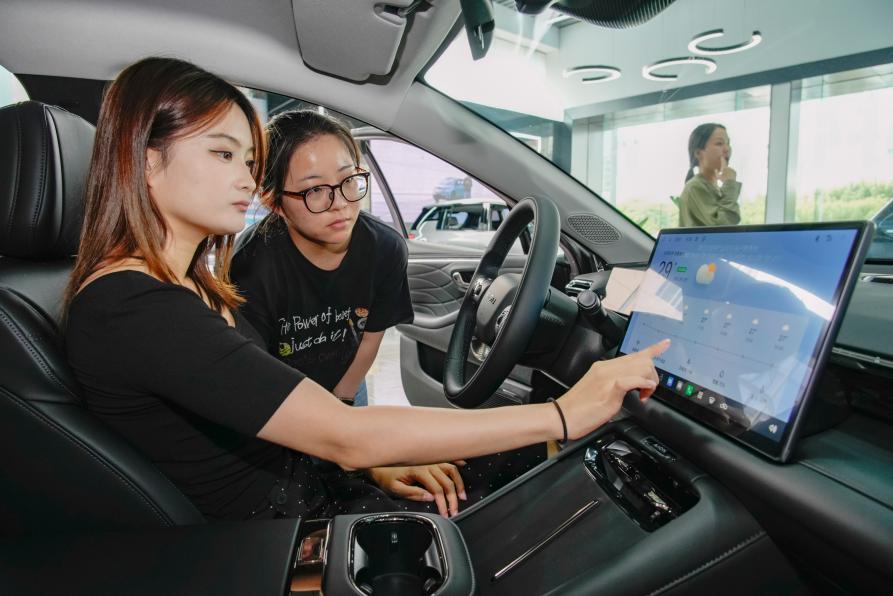
A consumer tries out a new energy vehicle at a car dealership in Zhangjiagang, east China's Jiangsu province. (Photo/Xing Bin)
The world's largest vehicle charging network and the most complete NEV industrial chain have become increasingly interconnected and mutually reinforcing, providing strong support and resilience for the continued growth of the NEV industry.
The two milestones also mark a new starting point.
The development of NEVs has become a common priority in industrial planning across many regions. A review of the 15th Five-Year Plan outlines of all 31 provincial-level regions shows that intelligent connected NEVs have been identified as an important area for cultivating new quality productive forces. Over the next five years, localities are expected to build on their respective strengths and pursue differentiated development, creating further room for China's NEV industry to grow.
As the domestic market landscape becomes increasingly clear, the global automotive industry is also undergoing an accelerated transformation. By staying committed to innovation, improving product quality and strengthening brands, China has established a modern automotive industry system that is self-reliant, controllable, safe, efficient, green, intelligent, and globally competitive.
The momentum is already building, and further growth is within reach. Chinese cars are expected to achieve futher breakthroughs.