


Chinese green construction machinery gains traction in overseas markets
As the global construction machinery industry accelerates its transition toward greener and smarter operation, Chinese manufacturers are strengthening their presence in international markets.
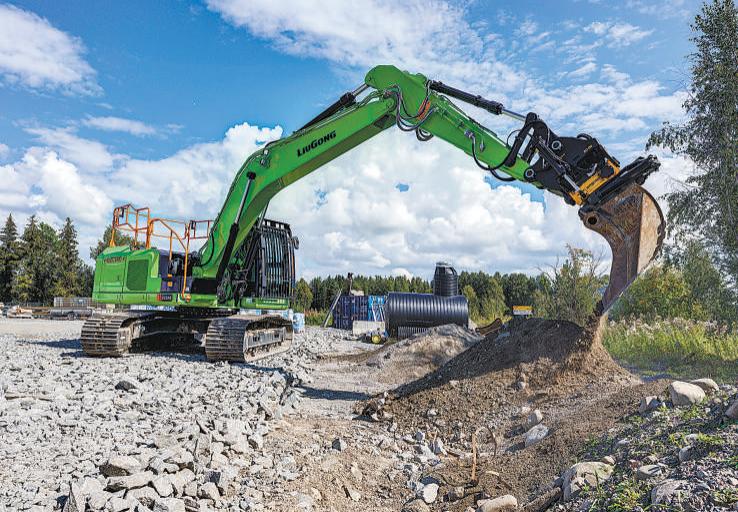
An electric excavator manufactured by Guangxi Liugong Machinery Co., Ltd. works at a construction site in Europe. (Photo courtesy of Guangxi Liugong Machinery Co., Ltd.)
From electric excavators and mining trucks to smart fleet management systems, these companies are now offering not just individual machines, but integrated solutions tailored to the needs of customers in different countries.
A mine in Vietnam offers a glimpse of this trend. More than 120 pieces of construction machinery are operating on-site, ranging from excavators and wheel loaders to bulldozers and mining trucks. All of them are electric.
"Using China's electric construction machinery has cut our mining costs per ton by 50 percent," said the mine operator.
Since the beginning of this year, amid the global energy crisis and an accelerating push for green transition, developing green mines has become a shared priority across the mining industry.
"China's construction machinery industry is a global leader in electrification. Almost every internationally leading mining company has set up a procurement center in China," said Li Kailiang, deputy chief engineer of Guangxi Liugong Machinery Co., Ltd. (LiuGong), a leading enterprise in China's construction machinery industry.
What gives Chinese manufacturers such confidence?
High-performance equipment. To withstand the high-temperature, high-humidity conditions at Vietnamese mines, LiuGong's excavators and wheel loaders are equipped with high-capacity, highly reliable battery systems specifically designed for such environments. Combined with fast-charging technology, the batteries can be fully charged in just 45 minutes and provide eight to 10 hours of operation on a single charge.
A mature supporting ecosystem. Some overseas markets require every battery to be tracked throughout its entire life cycle, from deployment to retirement. Batteries must be registered when put into service, and manufacturers are responsible for recycling them at the end of their service life.
"With China's well-developed new energy industrial chain, Chinese companies have accumulated extensive experience in full life-cycle battery management and can provide comprehensive services to overseas customers," Li said.
Comprehensive solutions. Most mines are located in remote regions with fragile public power infrastructure. Chinese construction machinery manufacturers deliver integrated solutions underpinned by a model of "photovoltaics + energy storage + charging + mobile power supply." They build microgrids that combine power generation, grid connection, loads, and energy storage around mining sites, enabling electric equipment to function stably in remote mines without access to the conventional power grid.
"Any production stoppage at a mine can result in huge losses. Compared with overseas competitors, we can integrate high-quality resources from across China and provide a complete set of solutions, ensuring that electrification projects can be successfully implemented," Li said.
Chinese construction machinery companies are also taking their expertise in smart technologies overseas. Mature domestic mine management and fleet dispatch systems are now deeply integrated with hardware, helping overseas mines move away from labor-intensive operations toward intelligent, digitally driven management.
Tangible cost savings are the strongest driver behind continued orders from overseas customers. Energy consumption typically accounts for 40 to 50 percent of a mine's operating costs, while electric construction machinery consumes only about 1/3 as much energy as fuel-powered equipment. Electrification also greatly simplifies powertrain systems, substantially reducing maintenance costs.
For multinational mining companies, Chinese construction machinery is not only green in operation but also designed with sustainability in mind.
At a smart excavator factory of LiuGong, the full range of products from 13 to 200 tons is manufactured on flexible shared production lines, while an AI-powered vision system monitors assembly deviations in real time. In March this year, the factory produced more than 1,500 excavators, up 77.5 percent year on year, setting a new monthly record.
"With our smart factory, we use a large amount of green electricity in the manufacturing process. This directly helps our downstream customers achieve better scores in environmental, social and governance (ESG) assessments," Li said, adding that LiuGong's electric construction machinery exports performed strongly in the first half of this year.
China has become the world's largest producer and seller of construction machinery. From 2020 to 2025, the industry's exports nearly tripled.
Chinese construction machinery companies are no longer simply "selling equipment" or "selling electrification solutions." They are now also taking their smart technologies global, offering overseas customers new pathways toward intelligent operations.
"This year, our autonomous wheel loaders will begin operating in the UK and Australia, bringing customers a safer and more efficient experience in smart construction," Li said.
Autonomous electric rigid wide-body trucks can operate across a full range of scenarios and run alongside manned vehicles. Even in rain, fog or dusty conditions with visibility as low as 20 meters, they can maintain stable autonomous operation. An upgraded 5G remote-control driving system allows operators to precisely control 135-ton ultra-large excavators from a distance.
According to the China Construction Machinery Association, China's construction machinery exports totaled $34.373 billion in the first half of this year, up 21.7 percent year on year. Exports to the European Union reached $3.626 billion, up 28.9 percent, while exports to ASEAN countries totaled $5.561 billion, up 23.6 percent.
Machinery industries, including construction machinery, recorded $559.33 billion in merchandise exports, up 20 percent year on year and accounting for 26.3 percent of China's total merchandise trade.