


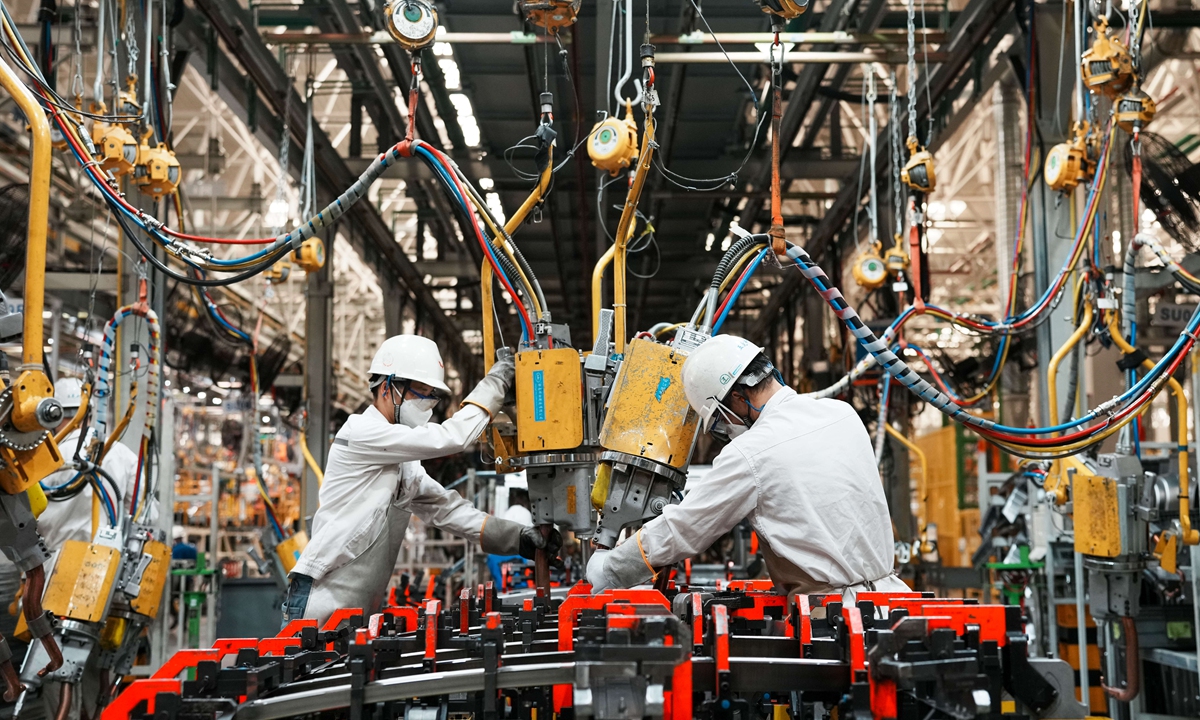
Workers assemble NEVs in Liuzhou, South China's Guangxi Zhuang Autonomous Region, on July 8, 2026. (Photo: VCG)
Editor's Note:
China's new-energy vehicle (NEV) industry has made striking progress in recent years, changing not only the cars themselves but also how they are developed, sold, and taken to global markets. The sector is also helping set new industry standards, making NEVs one of the most visible symbols of Chinese manufacturing.
As China enters the 15th Five-Year Plan period (2026-30) and moves toward its goal of basically realizing socialist modernization by 2035, a research team from People's Daily and China Automotive News examined how the country can sustain high-quality growth in the NEV sector and strengthen its competitive edge in the global market. This is the third installment of the series.
China's auto market today is more dynamic - and more fiercely competitive - than ever before.
The pace of new-model launches has broken industry records. In the first half of this year, more than 100 all-new models built on new platforms or featuring major generational upgrades entered the market, alongside hundreds of modified and upgraded models. Gasoline-powered vehicles made up less than 20 percent of the all-new models.
This is an unprecedented intensity of supply and an unprecedented speed of product iteration in the history of global automotive development.
Historically, at the peak of Germany's auto industry, the number of newly developed production models launched in a full year was around 100. China introduced more all-new models in just six months than major European and US markets typically do in a full year. Compared with China's own gasoline-car sales peak in 2016-17, the annual number of all-new models launched at the time was less than one-third of the comparable total in the first half of this year.
Such breakneck iteration is possible only in the intelligent era. As China enters the opening year of the 15th Five-Year Plan period (2026-30), its auto market is undergoing profound changes.
Profound changes
On the demand side, NEVs have become the mainstream choice for new-car buyers, fundamentally reversing the previous balance between gasoline-powered and electric vehicles.
After monthly NEV retail penetration surpassed 50 percent at the end of 2025, the retail penetration rate of new-energy passenger vehicles remained above 60 percent from April through July 2026, reaching 65.1 percent in July.
For consumers, NEVs are increasingly the preferred choice. Even steep price cuts on gasoline-powered vehicles have failed to reverse this shift in purchasing behavior. Research shows that more than 80 percent of gasoline-car owners choose an NEV when replacing their vehicles. Meanwhile, intelligent in-car technologies are moving from premium options to standard features, with competition increasingly shifting toward an era of "AI-defined vehicles."
On the supply side, China has built a largely self-sufficient domestic industrial chain, reshaping the traditional global division of labor in the auto industry.
China has achieved a high degree of self-reliance in batteries, electric motors and electronic controls, as well as silicon carbide power modules and electric-drive systems, reducing its dependence on powertrain technologies long dominated by overseas suppliers. Chinese companies now occupy seven of the world's top 10 places in installed power-battery capacity, with a combined market share of more than 72 percent. China's national battery safety standards are also beginning to be introduced overseas.
More telling is the rise of "reverse joint ventures," with joint-venture brands increasingly turning to Chinese technologies. On March 13, the ID. UNYX 08 - the first model jointly developed by Volkswagen and XPeng - rolled off the production line at Volkswagen Anhui's plant. Audi, meanwhile, has teamed up with SAIC Motor to create the China-focused AUDI brand, which makes extensive use of Chinese-developed platforms and intelligent technologies.
The rules formed in the gasoline-car era are losing relevance, while new dynamics are rapidly taking shape in the NEV era. The much-discussed problem of excessive competition, or "involution," therefore needs to be examined through a new market logic.
First, just how "new" are all these new models?
Of the hundreds of models launched in the first half, most were facelifts, configuration tweaks or niche variants, leaving some models facing refreshed rivals almost as soon as they hit the market.
This reflects a fundamental change in supply capacity made possible by technology in the intelligent era.
Gasoline-powered vehicles are constrained by complex mechanical architectures, making major hardware changes costly. Developing a new model typically takes 36 to 48 months, while a basic model may remain in use for five to 10 years. NEVs, by contrast, use modular electric platforms, software and over-the-air (OTA) updates, allowing derivative models to be developed in just six to 12 months - closer to the pace of consumer electronics. The logic of auto production has fundamentally changed.
Growth curve
The next question is: What has happened to the market's growth curve?
From January to July 2026, China produced 9.014 million NEVs and sold 9.007 million, up 9.5 percent and 9.6 percent year-on-year, respectively. But the market has become increasingly differentiated, with a large number of Chinese brands posting double-digit growth. The 10 fastest-growing brands were concentrated in the mid- to high-end pure-electric segment, with Chinese brands overwhelmingly dominating the list. Tesla China was the only foreign brand among the top 10.
More notably, sales of NEVs priced above 400,000 yuan rose 46 percent year-on-year in the first half, with Chinese brands taking nearly 60 percent of the segment. Their growth has been driven not by low prices, but by technology, intelligent features and stronger brands. Those losing ground, by contrast, are mainly joint-venture brands slow to transform, low-end micro-EVs and highly similar models.
This changing growth curve points to an important trend: upgrading and vehicle replacement are becoming the dominant forces driving demand.
China now has 371 million vehicles on the road, the world's largest fleet and nearly one-quarter of the global total. Gasoline-powered vehicles account for 86.81 percent of the fleet and are 8.2 years old on average, while many first-generation NEVs are nearing the end of their warranty periods. This is setting the stage for the world's largest vehicle-replacement cycle, with the 15th Five-Year Plan period becoming a key window for replacement demand and mid- to high-end consumption.
Half-year earnings announcements released in July showed a sharp contrast between weaker profits at some automakers and strong earnings at leading supply-chain companies. This shift in profits should be viewed in the broader context of industrial evolution.
For decades, key auto components and advanced technologies were dominated by overseas companies, with nearly all of the substantial profits they generated flowing abroad. Today, Chinese supply-chain companies increasingly master key technologies through in-house R&D, allowing healthy profits to support long-term investment in frontier technologies.
New trends
Taken together, the new trends emerging in models, sales and profitability in China's NEV industry in the first half of 2026 offer important insights into where the market is heading.
One conclusion is becoming increasingly clear: China's auto market is both the world's largest arena for vehicle replacement and a bellwether for the next round of NEV upgrading and iteration, helping determine the cycle and pace of transformation across the global auto industry.
Unprecedented market potential, rapid innovation and fierce competition are converging in the same market, creating a uniquely powerful draw for global automakers. In an open market, some companies gaining ground while others lose - it is a natural outcome of competition, not a zero-sum game.
"You only get stronger by getting into the thick of competition," BYD Executive Vice President He Zhiqi wrote recently on social media, capturing a sentiment shared by many Chinese entrepreneurs.
Geely Holding Group founder Li Shufu has said that the auto industry should not fight price wars, but instead compete on technology, services, quality and brands.
Price wars are unsustainable, and destructive "involution" should be avoided. Vigorous competition, however, is what defines a major market.
A growing consensus is taking shape among both Chinese and foreign automakers: competition must shift from price to value and move onto a new track of high-quality development, with companies engaging in healthy competition through diverse technological pathways, stronger core capabilities and continuous improvements in user experience.
For Chinese consumers - particularly younger buyers who grew up with smartphones, this kind of vibrant, innovative market with an abundance of choice is precisely what they want.
This was excerpted from an article originally published on the front page of the People's Daily on August 28, 2026. The article was written by the research team members Xu Lijing, Xie Rongbin, Du Haitao, Gui Junsong, Wang Zheng, Shen Qian, Ge Mengchao and Feng Yingjie.
(Source: Global Times)