


Editor's Note:
China's new-energy vehicle (NEV) industry has made striking progress in recent years, changing not only the cars themselves but also how they are developed, sold, and taken to global markets. The sector is also helping set new industry standards, making NEVs one of the most visible symbols of Chinese manufacturing.
As China enters the 15th Five-Year Plan period (2026-30) and moves toward its goal of basically realizing socialist modernization by 2035, a research team from People's Daily and China Automotive News examined how the country can sustain high-quality growth in the NEV sector and strengthen its competitive edge in the global market. This is the fifth installment of the series.
Why has China's NEV industry been able to succeed? It benefits from a unique institutional advantage.
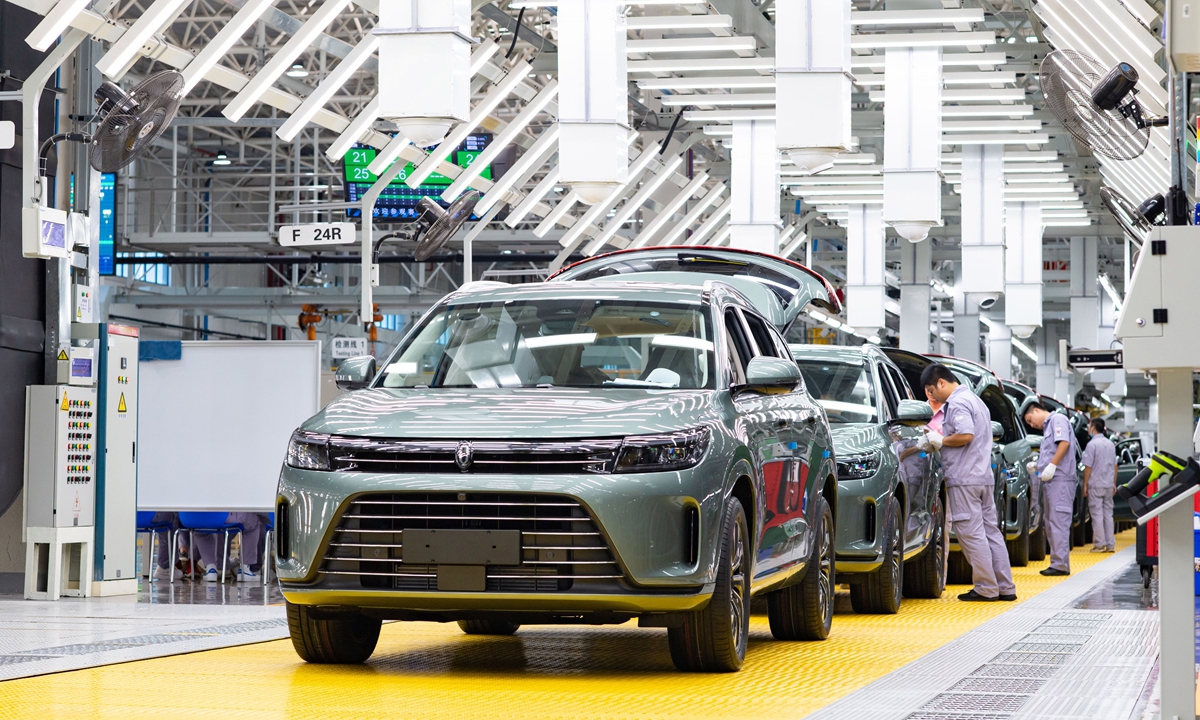
An NEV manufacturing line in Southwest China's Chongqing Municipality (Photo: VCG)
China's socialist market economy provides a systemic edge. With the strategic resolve to "carry through a blueprint to the end," China has coordinated the overall situation, closely integrating an effective market with a proactive government. It has advanced the implementation of a series of policies covering top-level planning, fiscal and tax subsidies, and infrastructure deployment, delivering tangible results and providing strong strategic support and institutional guarantees for a leap-forward development in the NEV sector.
Thanks to an unparalleled demand advantage. China has the world's largest vehicle ownership base and a massive market demand, with automobile sales staying above 20 million units for consecutive years. From major cities to counties and townships, from plains to mountainous areas, from entry-level models to mid- and high-end vehicles, the domestic market is large in scale, diverse in tiers, and rich in scenarios — this is a tremendous advantage for nurturing and strengthening the NEV industry.
Thanks to an irreplicable supply advantage. A fully integrated industrial system is a distinctive supply-side strength of China. After more than a decade of development, China's NEV industry has connected key segments including basic materials, core components, complete vehicles, manufacturing equipment, and charging/refueling infrastructure. The comprehensiveness, systemic nature, and completeness of its industrial chain are leading globally.
Thanks to the continuous advantage in talent supply. China ranks first in the world in total R&D personnel, and the engineer dividend continues to emerge. The achievements of China's NEV industry today are built on the sustained efforts of a large number of highly skilled workers with interdisciplinary expertise and the courage to tackle tough challenges, as well as entrepreneurs who have long devoted themselves to cultivating new tracks.
High-level scientific and technological self-reliance and self-strengthening are the key engine driving China's NEV industry from large to strong and toward the top of the global value chain. Statistics show that over the past 10 years, the annual average growth rate of published patents in China's NEV sector has reached 17.1 percent.
Relying on the industrial foundations and resource endowments of eastern, central, and western China, production bases for NEVs and key components are being laid out in an orderly manner. Gradually, five major NEV industry clusters are taking shape: the Yangtze River Delta, the Guangdong-Hong Kong-Macao Greater Bay Area, the Beijing-Tianjin-Hebei region, the Hubei-Henan-Hunan region, and Chengdu-Chongqing economic zone.
Becoming a pace-setter
On the new track of high-quality development, Chinese automakers are launching a new race to set the world's "new standards" for the global automotive industry.
China has introduced the world's strictest safety standard for power batteries, requiring that in the event of thermal runaway, there must be no fire or explosion for two hours. The newly released national standard for intelligent connected vehicles requires that the safety level of Level 3 and Level 4 autonomous driving must not be lower than that of a qualified and attentive human driver.
Changan Automobile has introduced a comprehensive "Pan-Safety" concept, redefining automotive safety by expanding its scope from body crash protection to health, psychology, and data privacy. As of early August this year, Huawei's Qiankun intelligent driving system had accumulated more than 13 billion kilometers of assisted mileage, making active safety and all-domain safety the defining features of China's approach.
Automotive mobility scenarios are constantly expanding, and the value of cars in everyday life is continually being extended. In Shenzhen, TianNian No. 1 flying car developed by FAW Hongqi completed final assembly and rolled off the line, making its maiden flight; in Guangzhou, XPeng AeroHT has successfully completed batch trial production and multi-aircraft test flights for its modular "Land Carrier" flying cars.
In 2019, Li Auto first brought onboard refrigerators, front-passenger entertainment screens, and ultra-comfortable seats into vehicles. BYD's Yangwang and the Maextro S800 luxury sedan developed by JAC and Huawei are redefining luxury and reshaping automotive aesthetics through technology and Chinese-style design.
NIO pioneered the world's first "chargeable, swappable, upgradable" charging and battery-swapping system, as well as a "battery-as-a-service" leasing model. Over eight years, it has built more than 4,000 battery-swapping stations, turning energy replenishment into a differentiated strength.
Driving industrial leap
As China advances into the 15th Five-Year Plan period, the NEV industry will embark on a new cycle of high-quality development.
By the end of 2025, two models from Changan and BAIC had received the first batch of domestic Level 3 conditional autonomous driving product access permits. China's autonomous driving industry is rapidly moving from "technology validation" to a new stage of "mass production and application." As one of the first automakers in China to obtain Level 3 conditional autonomous driving access, BAIC Group's Arcfox Alpha S (L3 version) has begun pilot road operation on designated roads in Beijing, including the Daxing Airport Expressway.
In June this year, the Ministry of Commerce and multiple other Chinese government departments jointly issued 17 specific measures across six key areas to cultivate and expand consumption in the automotive aftermarket, providing clear policy guidance and broad market space for automakers to deepen their presence in the service sector and develop new profit growth points.
The first Chery Life Gallery officially opened on June 21, 2026, at the Ruixun Bay Automobile Life Plaza in the Shantou Overseas Chinese Pilot Zone. This comprehensive automotive lifestyle space, integrating consumption, experience, and social interaction, has pioneered a new global model for auto exhibitions, sales, and services.
Accelerating expansion along the value chain. In Beijing's Yizhuang district, breakthroughs have been made in the construction of five major systems — "smart vehicles, intelligent roads, real-time cloud, reliable networks, and precise maps" — with efforts underway to support automotive industry development and smart city construction through iterative upgrades of autonomous driving technologies.
In Xiong'an New Area, North China's Hebei Province, China's first large-scale regional digital road network has been completed, spanning 153 kilometers, and intelligent connected buses have logged nearly 200,000 kilometers in safe test operations.
The rise of China's NEV industry is not merely a successful shift of track, it is also the concentrated realization of institutional advantages, market vitality, industrial resilience, and talent dividends on the timeline of building a strong nation. This path of industrial leap has been the right one, has been taken steadily, and will carry us even farther.
This was excerpted from an article originally published on the front page of the People's Daily on August 30, 2026. The article was written by the research team members Xu Lijing, Xie Rongbin, Du Haitao, Gui Junsong, Wang Zheng, Shen Qian, Ge Mengchao and Feng Yingjie.
(Source: Global Times)