


In China, agricultural produce brokers work between urban and rural areas, connecting farmers with buyers and playing a key role in the circulation of agricultural products. According to a five-year plan for accelerating agricultural and rural modernization, China aims to train 30,000 prominent agricultural produce brokers nationwide during the 2026-2030 period.
Ma Zhongmi, 47, is an agricultural produce broker in Fuyu, northeast China's Jilin Province. He has specialized in buying and selling potatoes for 10 years and has earned a strong reputation among his clients.
To help farmers find buyers, Ma has traveled to agricultural wholesale markets and procurement platforms in many places over the years, seeking business opportunities.
Ma has a stack of field notes containing information he has compiled on potato pests and diseases. After noticing that some growers mixed potatoes of different sizes and grades for sale, Ma introduced sorting and grading equipment to meet buyers' varying needs and ensure that better potatoes command better prices.
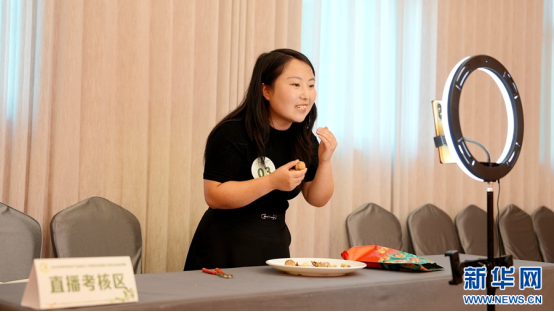
A trainee takes part in a simulated livestream marketing exercise during a training session for agricultural product brokers in southwest China's Guizhou Province. (Photo: Xinhuanet/Zhou Yuangang)
China has more than 1 million brokers who are regularly active in producing areas, buying and selling agricultural produce, according to estimates.
"Agricultural produce brokers are an important link between farmers and markets," said an official with the Ministry of Agriculture and Rural Affairs. "They play a vital role in matching supply with demand, upgrading agricultural industries and increasing farmers' incomes."
At daybreak, Qiu Xinhang's vegetable stall at the Jiangnan Fruit & Vegetable Wholesale Market in Guangzhou, south China's Guangdong Province, is already bustling. The market is one of China's largest fruit and vegetable distribution hubs.
Qiu is a broker serving the consumer market. He signs purchase contracts with farmers in producing areas such as Qujing, southwest China's Yunnan Province, securing stable supplies while passing the latest market information back to growers.
To keep produce fresh, his company has built 15 cold-storage facilities near partner farms for post-harvest pre-cooling, Qiu said. At the Jiangnan market, a 10,000-tonne cold-storage facility provides temporary storage for produce that cannot be sold the same day.
In July, the seventh National Agricultural Industry Vocational Skills Competition introduced an agricultural produce brokerage contest for the first time. Five contestants, including Li Qian from northwest China's Shaanxi Province, won first prize. More than 46 percent of the contestants held bachelor's degrees or higher.
For Li, 2022 was a turning point in his career. As supply and demand shifted, kiwifruit prices rose after the fruit hit the market, only to fall sharply after the Mid-Autumn Festival. Local growers turned to Li for help selling their produce. But local kiwifruit was relatively expensive, and its low firmness made it difficult to store, so several buyers he contacted refused to take it.
After consulting village officials, Li quickly sorted the kiwifruit into different grades. He contacted community group-buying platforms and nearby markets to sell the softened fruit at a loss of 6 yuan ($0.89) per kilogram, though this was only a small portion of the harvest.
He then tried various approaches, including shooting videos, livestreaming from the orchards and shipping freshly picked fruit directly to consumers. These efforts drew the first wave of traffic, generating more than 200 orders in an hour, with over half coming from northwest China's Xinjiang Uygur Autonomous Region.
To seize the opportunity, Li immediately contacted logistics companies to negotiate lower shipping costs and traveled overnight to Urumqi, the capital of Xinjiang, to arrange temperature-controlled storage. Once online sales stabilized, he also visited pastures around the Tianshan Mountains to promote the fruit. With the help of e-commerce platforms, he fulfilled 191,000 kiwifruit orders in just two months.
As new business models and formats emerge, more agricultural produce brokers are using targeted online marketing and other tools to improve transaction efficiency and better match supply with demand.
"The high-quality development of modern agriculture places greater demands on agricultural produce brokers' educational background and their ability to gather information and analyze markets," said Han Yijun, a professor at China Agricultural University.