


Rental economy opens up new possibilities for consumers
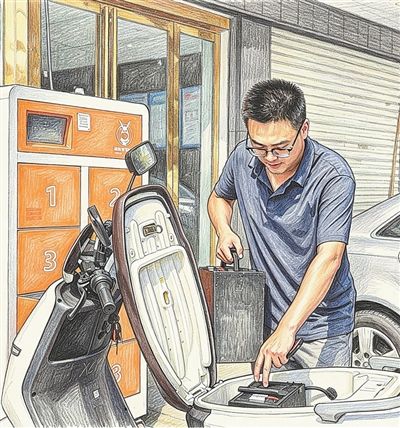
A staff member tests an electric rental vehicle at a rental shop in Pingqiao district, Xinyang, central China's Henan Province. (Photo by He Zeyao; AI-enhanced sketch rendering)
Before a trip to Shanghai Disneyland, Beijing-based office worker Lin Xiao, born after 1995, considered buying an Osmo Pocket 4 developed by Chinese commercial drone manufacturer DJI, but worried it would go unused because she does not travel often. On a friend's recommendation, she rented one through the rental platform rrzu.com with no deposit required. The device arrived the next day with all accessories included, and the two-day rental cost less than 100 yuan (about $14.88).
Lin's experience is a vivid example of how rental consumption is becoming part of everyday life.
In recent years, China's rental consumption sector has expanded rapidly. In January, nine government departments, including the Ministry of Commerce, jointly issued a guideline on promoting green consumption, calling for vigorous development of green rental services, innovation in green consumption models, and encouragement of shared mobility, shared spaces and shared goods.
According to a white paper released by the Development Research Center of the State Administration for Market Regulation regarding the healthy development of the consumer rental industry under the circular economy, China's rental economy exceeded 4.2 trillion yuan in transaction volume in 2024, an increase of 32 percent per year.
Since the start of the summer holiday, rental consumption has continued to heat up. In the travel sector, car rental provider CAR Inc. saw rental orders rise by more than 30 percent per year. Concert equipment and gaming gear saw the strongest growth, with orders rising 388.5 percent and 488.7 percent per year respectively.
Young consumers have become the main driving force, with those born after 1995 and in the 2000s accounting for more than 66.5 percent of orders in related categories.
In May 2025, a national standard on quality information for shared idle goods was officially enacted, filling a gap in quality information standards for the shared rental sector. Meanwhile, e-commerce platforms such as Dewu have launched rental services covering more than 100 categories, including digital products, clothing accessories and luxury handbags, making the industry ecosystem increasingly diverse.
According to industry estimates, large-scale circular rental services have enabled more than 30 million instances of equipment reuse, reducing electronic waste by about 80,000 tonnes. Individual consignment rental models can boost equipment utilization by more than tenfold and extend product lifespans by three to five years.
Zhu Di, a researcher at the Institute of Sociology of the Chinese Academy of Social Sciences, said that with improvements in standards and services, rental consumption is expected to evolve from a niche option into a mainstream choice, providing new momentum for expanding domestic demand and promoting green development.