


Artificial intelligence top draw at upcoming digital trade expo
Artificial intelligence is set to take center stage at the fifth Global Digital Trade Expo, as the event moves beyond showcasing digital technologies to promote trade, investment and international cooperation, officials said on Monday.
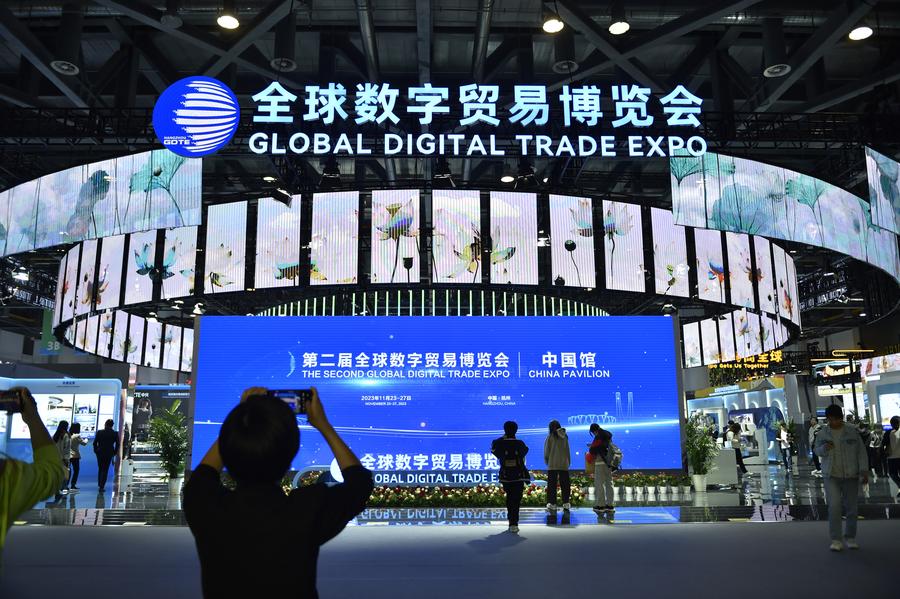
This photo taken on Nov. 23, 2023 shows the China Pavilion at the second Global Digital Trade Expo in Hangzhou, east China's Zhejiang Province. (File photo: Xinhua)
The expo, scheduled to take place in Hangzhou, Zhejiang province, from Sept 23 to 27, has attracted representatives from 121 countries and regions, and 29 international organizations to attend, with overseas exhibitors accounting for more than 20 percent of the total, said Yan Dong, vice-minister of commerce, at a news conference.
AI is expected to be one of the biggest highlights of the event. "More than one-third of exhibitors are AI companies, while the expo will feature a dedicated token-themed area and showcase the full industrial chain spanning computing infrastructure, foundation models and applications," Yan said.
The growing role of AI in trade is also reflected in the strong interest from buyers.
Zhejiang has received nearly 40,000 registrations from professional buyers, including more than 12,000 overseas buyers, while prearranged international purchase orders have reached $977 million and total domestic and overseas orders have reached 19.5 billion yuan ($2.9 billion), said Hu Wei, vice-governor of Zhejiang.
The expo will also seek to strengthen links between exhibitors and buyers by connecting with cross-border e-commerce platforms online and major professional markets offline, Hu said.
As the host city, Hangzhou is seeking to extend these trade links beyond the five-day event. More than 1,300 business-matching activities will be held during the expo, while an AI assistant will provide intelligent business-matching services, said Du Xuliang, mayor of Hangzhou.
The city will also upgrade its "digital trade online" platform after the event and establish online negotiation rooms to provide year-round business matching.
The focus on AI is not limited to commercial applications. Hangzhou plans to use the expo to promote international cooperation in AI, including joint research, product development and standards setting, Du said.
The city is also stepping up open-source cooperation, with Hangzhou's ModelScope community hosting more than 240,000 models and over 40,000 open-source datasets, while open-source Qwen models have recorded more than 1 billion downloads, he added.
The expo will further showcase AI applications in areas including healthcare and mobility, bringing technologies such as brain-computer interfaces, AI-assisted medical products and intelligent mobility devices closer to consumers.
"The AI featured at this year's expo is no longer a high-end technology or an abstract concept, but a new experience in life and a new driver for industry that can be seen, felt, used and purchased," Hu said.
The developments at the expo come as China's digital trade continues to expand. China's digitally deliverable services trade reached $432.31 billion in 2025, up 6.3 percent year-on-year, while cross-border data flows reached 142.3 exabytes, up 14.9 percent, Yan said.