


China Focus: China eyes strong cultural, tourism industries by 2030
BEIJING, Sept. 19 (Xinhua) -- China will strengthen its cultural industries and tourism over the next five years, aiming to steadily raise their share of GDP, according to the Ministry of Culture and Tourism.
The 15th Five-Year Plan (2026-2030) for cultural and tourism development, newly released by the ministry, calls for turning the sectors into pillars of economic development and businesses that improve people's livelihoods and sense of happiness.
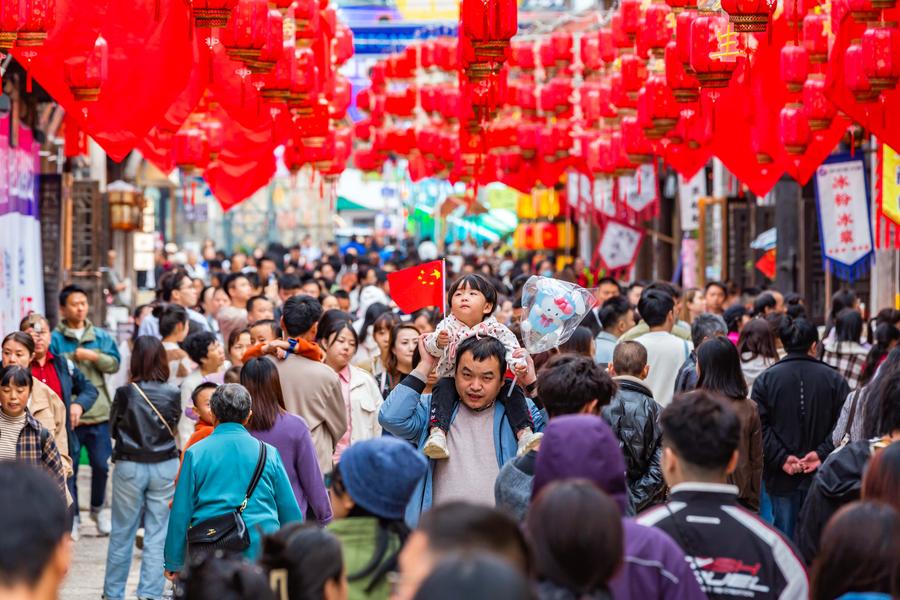
People visit a historical and cultural street in Xixiu District of Anshun City, southwest China's Guizhou Province, Oct. 2, 2024. (Photo by Chen Xi/Xinhua)
One key target is 8.3 billion domestic trips a year by 2030, nearly 2 billion more than in 2025.
Chinese tourists spent 6.3 trillion yuan (about 933 billion U.S. dollars) on domestic trips in 2025. The 2030 target is 7.7 trillion yuan.
Market analysis shows tourism spending is increasingly flowing into sectors that blend culture and new experiences into travel.
Traveling for concerts, sports events and commercial performances, or to explore places known for revolutionary history or modern industry, is a notable example.
"It all points to the same trend: tourists are no longer satisfied with a tour that is just about moving from one place to another, but a trip that can invoke cultural identity, or enable them to express their identity or experience something new," said a report by Meadin Research Institute, a market analytics firm.
Such an infusion represents a focus of efforts to boost cultural industry and tourism in the 15th Five-Year Plan (2026-2030) for cultural and tourism development.
The plan supports industrial tourism based on equipment manufacturing and consumer goods, travel packages featuring farming experiences, and comprehensive consumption scenarios.
Other efforts include further integrating sports events with cultural tourism, fostering high-quality ski destinations and promoting deeper links between cultural tourism and transportation.
For 2030, the plan pledges to create diverse, immersive and interactive consumption scenarios, while boosting spending on cruise and yacht tours and recreational vehicle camping.
To cultivate tour packages and business models that integrate culture and tourism, the plan says revolutionary culture and fine traditional Chinese culture can be used to build an emotional connection and improve the tourist experience.
It also encourages employers to ensure paid vacation and stagger holidays to boost tourism spending.
GROWING APPEAL FOR INTERNATIONAL TOURISTS
Improving tourist experience in China appeals to both domestic and international visitors, especially with continued support expected over the next five years.
The World Tourism Cities Federation (WTCF) listed Beijing, Shanghai, Hong Kong, Hangzhou and Chengdu among the world's top 20 tourist cities in its latest World Tourism Cities Development Report (2025-2026).
China has the most cities on the list, according to the report released at a sideline event during the 2026 China International Fair for Trade in Services, held in Beijing from Sept. 9 to 13.
Joseph Lema, an expert with the WTCF, said competition among tourism cities has moved beyond attractions and visitor numbers. What matters now, he said, is the ability to deliver quality experiences, effective governance and sustainable development.
On the way to building strong cultural and tourism industries, China is more confident in realizing its ambitious inbound tourism goal. In the 15th Five-Year Plan (2026-2030) for cultural and tourism development, the target is to attract 190 million inbound tourist visits a year by 2030.
To reach that goal, China will continue to make travel easier for international tourists in areas such as visa-free policy, payment, tax refund, accommodation and transportation.
Easier access and more options, from hairstyling and dental care to traditional Chinese medicine and custom tailoring, will bring longer stays by overseas visitors.
"This allows them to see a more authentic, diverse and vibrant side of China," said Hu Yang, senior vice president of Tujia. ■