


Economic Watch: China's five-year plan to elevate electronic information manufacturing sector
BEIJING, Sept. 20 (Xinhua) -- As artificial intelligence (AI) plays an increasingly significant role in reshaping the global industrial landscape, China has recently unveiled a plan to advance its electronic information manufacturing sector, a critical foundation for AI development, over the next five years.
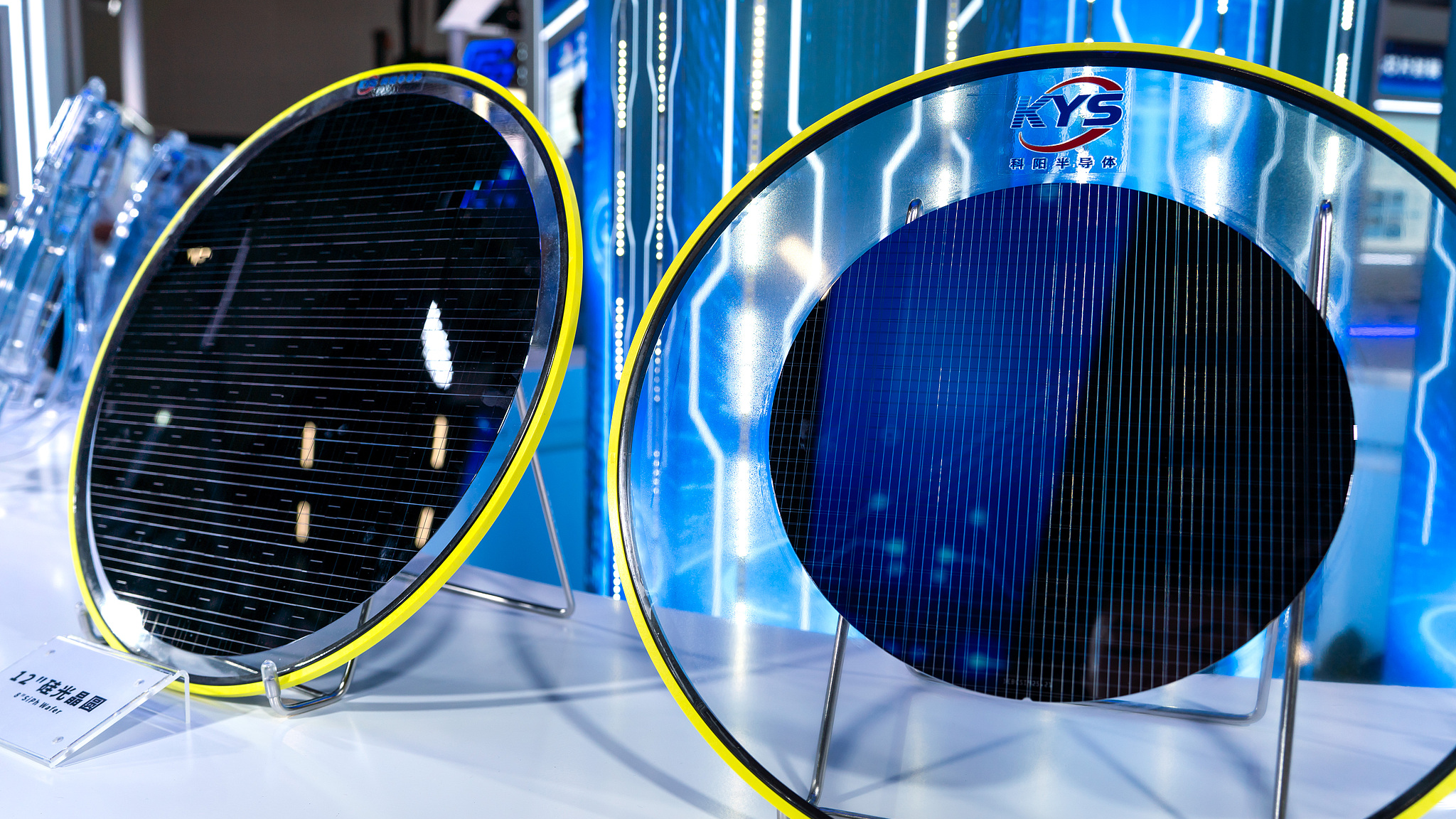
Keyang Semiconductor's silicon photonics wafers were exhibited at the China Integrated Circuit Specialization and Innovation Exhibition, Guangzhou, Guangdong Province, south China, September 4, 2026. (Photo: VCG)
The development plan for the electronic information manufacturing industry during the 15th Five-Year Plan period (2026-2030), jointly issued by the Ministry of Industry and Information Technology (MIIT) and the National Development and Reform Commission, aims to further consolidate the pillar role of the industry by 2030.
Industrial firms in the sector with an annual main business revenue of at least 20 million yuan (about 2.96 million U.S. dollars) are expected to see their combined revenue surpass 30 trillion yuan, and R&D investment intensity of the sector will rise to 3.5 percent, according to the plan.
TO ENHANCE INDUSTRIAL BASE
The electronic information manufacturing industry is a major force in the new industrialization drive. By the end of 2025, China's electronic information manufacturing industry had led the country's 41 major industrial sectors in terms of revenue for 13 consecutive years.
Building on that foundation, the plan presents a systemic framework to strengthen the industrial base, spanning integrated circuits, electronic components and materials, intelligent sensors, specialized electronic equipment and measuring instruments, and the photonics industry.
The framework aims to tackle bottlenecks in key areas and build an independent and controllable industrial base, said Liu Bin, an official with the MIIT.
Liu pointed to photonics as an example, noting that advancing breakthroughs in core technologies and establishing pilot testing platforms for key areas and shared needs will strengthen the sector from the ground up. These efforts, he said, will lay a solid foundation for development and accelerate both technological innovation and industrialization process.
As a representative sector of the electronic information manufacturing industry, China's integrated circuit industry is entering a new phase of rapid growth, driven by the explosive global demand for high-end computing and memory chips brought about by the AI revolution.
Customs data shows that in the first seven months, the country's integrated circuit exports reached 216 billion U.S. dollars, up 99.5 percent year on year, already surpassing the full-year total of 2025.
A semiconductor technology company in southwest China's Sichuan Province has already completed its first half-year production targets, and aims to double its output value from last year, according to its general manager.
TO STRENGTHEN COMPETITIVENESS
While strengthening the industrial base, the plan also sets out strategies to boost the competitiveness of whole devices and systems. This includes enhancing industrial chain resilience in key areas, developing a robust computing ecosystem, and promoting innovation in consumer electronics, among other initiatives.
Terminals form the basic foundation of industrial scale and serve as the gateway through which smart technologies reach hundreds of millions of users, said Liang Linjun, a researcher at China Academy of Information and Communications Technology (CAICT).
The plan outlines a dedicated push for innovation in key consumer electronics products, ranging from high-end mobile phones and personal computers to virtual reality devices. During the 14th Five-Year Plan period (2021-2025), China's output of core consumer electronics, including mobile phones and computers, maintained a top global ranking.
The accelerating evolution of a new generation of AI is bringing new demand, new product forms, and new ways of development to the electronic information manufacturing industry, while raising higher requirements for basic hardware supply and system coordination, said Liang.
Liang called for efforts to open up typical application scenarios, develop standards for agent collaboration, high-speed computing interconnect, and hardware-software compatibility, increase long-term capital supply that matches innovation cycles, and train more talent with expertise in both AI and electronics manufacturing.
The plan also addresses rising concerns over cutthroat competition in the industry. It calls for timely revisions to industry norms, coordinated planning and early-warning systems for capacity across subsectors, and a comprehensive effort to curb cutthroat competition.
As the "hardware foundation" of the digital world, the electronic information manufacturing industry is undergoing profound changes in its strategic position, competitive logic, and growth model, said Ao Li, vice president of the CAICT.
Turning scale into systemic strength, as well as moving from leading in volume to winning on quality, will be a major task for China's electronic information manufacturing industry during the 15th Five-Year Plan period, Ao said.
Industry insiders say government, industry, academia, research institutions, and users need to work together to translate the plan into results by strengthening the industrial foundation and making the supply chain more resilient.
Such a collective push is expected to put China's electronic information manufacturing sector on firmer footing, with a more complete chain and more active innovation, and to lay a solid base for the country's goals of building itself into a manufacturing powerhouse and a cyber powerhouse, they said. ■