


Real estate sector's entering into stock stage does not mean the industry is receding
On Friday, the Ministry of Housing and Urban-Rural Development said that China's real estate market has entered a new phase, centered on how to dissolve existing housing stock.
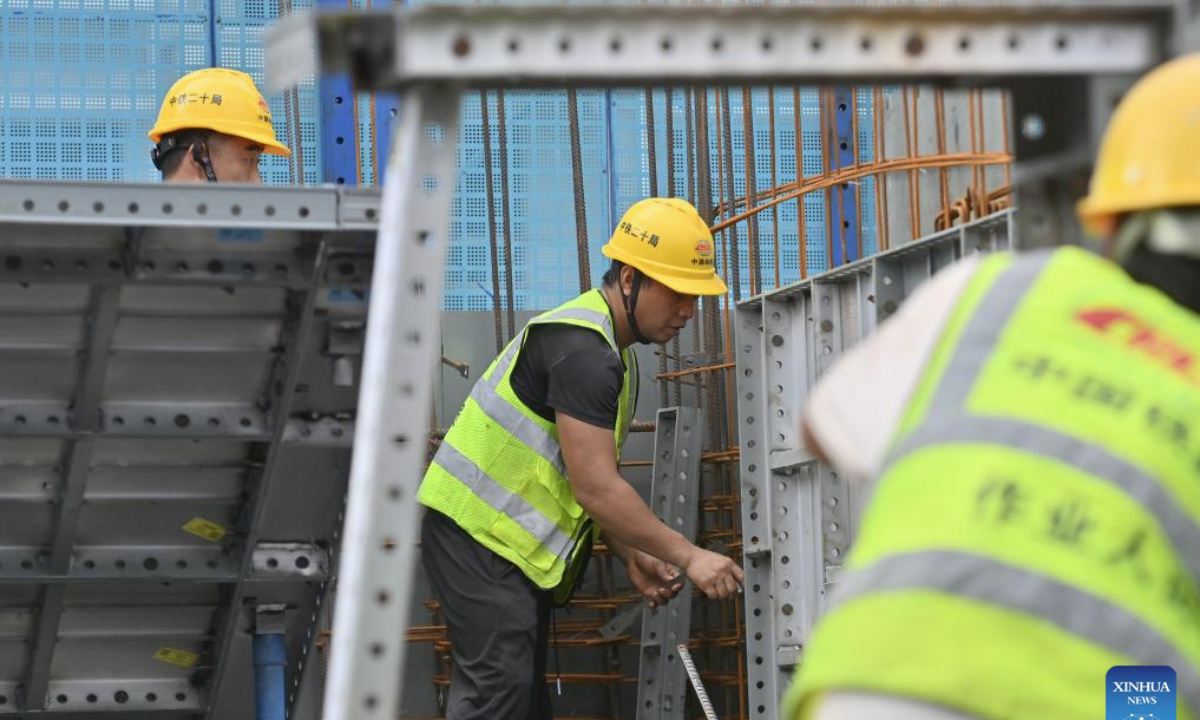
Workers work at a construction site of a urban village renovation project in Nanning City, south China's Guangxi Zhuang Autonomous Region, July 21, 2025. (File photo: Xinhua)
At present, the share of second-hand home transactions in total housing transactions rose from 27 percent in 2020 to 46 percent in 2025, and 52 percent in the first eight months of this year, surpassing new homes to become the main force in the housing transaction market. This is the most intuitive market evidence of the transformation of the stage of real estate development.
The shift did not happen suddenly, but is an inevitable result consistent with the laws of economic development.
On the supply side, China's per capita urban housing floor area has exceeded 40 square meters, and there are more than 1.1 homes per household. The problem of the people "having a place to live" has basically been solved.
On the demand side, China's urbanization rate is close to 67 percent. Urban development is shifting from large-scale incremental expansion to stock-based quality improvement and efficiency enhancement.
The improvement-oriented replacement demand of households, such as "selling the old home to buy the new one" and "swapping a small home for a larger one," has become the mainstream of transactions.
From "increment" to "stock," behind the stage transformation is a return to the purpose of development. For a long period, the investment attribute of real estate was continuously magnified. In the stock stage, the core contradiction of the industry has changed from insufficient total supply to insufficient structural supply.
Residents' demand has shifted from "whether there is housing" to "whether it is good," and increasingly prominent are refined requirements for housing quality, community environment, and property services. The value of real estate development must ultimately return to the fundamental livelihood attribute of "living."
For real estate to return to livelihood, the bottom line must first be secured. In the stock stage, policies should coordinate multiple goals, including preventing risks, promoting transformation, and benefiting people's livelihoods. For the industry, a new model of real estate development should be accelerated to form a more sustainable development model.
For economic development, real estate's contribution to the macroeconomy will shift from mainly incremental to stock improvement. Urban renewal, including the renovation and upgrading of urban villages, dilapidated housing, and old residential communities, will become an important force for stabilizing investment. For ordinary residents, it means a substantive improvement in living experience, and it means that every person striving in the city can have a secure place to live.
For real estate to return to becoming tethered to livelihood, the key is to improve quality.
In recent years, the Ministry of Housing and Urban-Rural Development has vigorously promoted the construction of "good houses," and new national standards for residential projects has put forward a number of requirements for improving housing quality. The new standards can not only guide the development of new housing, but will also provide a clear basis for the renovation and upgrading of existing housing.
For real estate to return to livelihood, it must ultimately land on tangible improvements in living experience.
In the first eight months of this year, the sales area of newly built commercial housing fell by 12.1 percent year on year, while the online signing area of second-hand housing transactions increased by 10.6 percent year on year.
This decline and increase do not mean that market demand is shrinking, but rather that the demand structure is "shifting gears" -- more and more people no longer fixate on housing prices, chasing rises and dumping falls, but instead, through rational replacement, switch the meaning of a house from an investment product to a more suitable living space.
Behind this is the choice of the people—people care more about whether a house can allow them to live more comfortably and securely.
When the value anchor of a house shifts from "whether it will rise" to "whether it is good," the real estate industry can truly resonate with the people's aspirations for a better life and embark on a more solid and longer-term path of development.
The author is dean of the Guanghua School of Management at Peking University and a Boya Distinguished Professor of Finance at Peking University.
(Source: Global Times)