


Solar overtakes coal as China's top power source by installed capacity
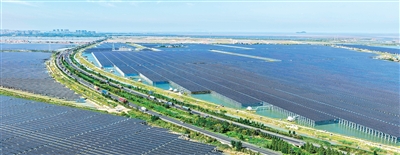
Photo shows a fishery and photovoltaic complementary project at the Qingkou salt field in Lianyungang, east China's Jiangsu Province. (Photo: Si Wei)
China's installed solar capacity overtook coal-fired capacity for the first time by the end of July, making solar the country's largest power source by installed capacity, according to data released Sept. 1 by the National Energy Administration (NEA).
By the end of July, China's installed solar capacity had reached 1.286 billion kilowatts, edging past coal's 1.285 billion, and PV accounted for 31.5 percent of the country's total installed generation capacity.
To put the figure into perspective, 1.286 billion kilowatts is roughly equal to the combined capacity of 57 Three Gorges Dams. China's solar capacity is also the world's largest, surpassing not only the U.S., India and Germany but the European Union's combined total.
The milestone capped roughly three years of rapid growth. By the end of June 2023, China's installed renewable energy capacity had surpassed that of coal-fired power for the first time, reaching 1.322 billion kilowatts, or 48.8 percent of the national total. By the first quarter of 2025, the combined installed capacity of wind and solar power had climbed to 1.482 billion kilowatts — 536 million from wind and 946 million from solar — surpassing coal-fired power capacity.
An NEA official attributed the shift to China's energy resource base: a pattern that had held since the birth of the electric power industry more than a century ago — coal as the largest power source — has now been broken for the first time.
The official called it another landmark in China's green and low-carbon energy transition. It follows an earlier historic first: in the first half of 2026, coal power's share of total electricity generation fell below 50 percent.
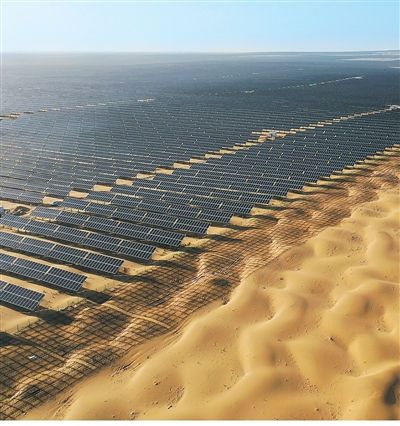
Photo shows a view of the Shuofang new energy base in the Kubuqi Desert, Hangjin banner in north China's Inner Mongolia Autonomous Region. (Photo: Xinhua/Li Zhipeng)
"From January to July this year, the country's PV generation reached 802.4 billion kilowatt-hours, up 15.5 percent year on year. Solar now accounts for 13 percent of total electricity consumption nationwide, meaning that for every 8 kilowatt-hours of electricity used in China, more than one comes from the sun.
"Installed capacity does not equal actual generation capability," said Liu Zhiqiang, deputy director of the planning and development department at the China Electricity Council. Solar power remains intermittent, dependent on daylight and weather, and its utilization hours still lag far behind those of coal.
Nevertheless, the rapid expansion of solar power reflects China's firm commitment to a greener, low-carbon transition.
"As the world's largest developing country, having installed solar power capacity surpass coal-fired power capacity shows China's determination and our results in tackling climate change and shifting toward cleaner energy," Liu said.
It also offers other developing countries "Chinese solutions" and "Chinese experience" they can learn from as they pursue their own energy transitions, Liu added.
Meanwhile, solar power also has an indispensable role to play. Solar output often peaks around midday, when demand is also high as air conditioners and factories run at full tilt. On July 10, when national electricity demand hit a record 1.518 billion kilowatts, solar supplied more than 35 percent of midday power, State Grid's data showed.
China now has the world's most comprehensive and competitive PV industrial chain, according to the NEA. Its module manufacturing spans a wide range of technological pathways — crystalline silicon cells lead the world in conversion efficiency, while research on next-generation technologies such as perovskite cells is progressing rapidly.
With Chinese solar modules accounting for about 80 percent of global output, the country is offering "Chinese wisdom" and "Chinese solutions" to support the green and low-carbon transformation efforts of nations worldwide.
During the 15th Five-Year Plan (2026-30) period, solar power generation will further explore diverse development models, including integrated PV-storage systems, PV-thermal hybrid plants, and solar-powered hydrogen production, said an official from the NEA.
These initiatives aim to shift solar power from a "weather-dependent" resource to one that is "dispatchable and predictable," ensuring that solar energy is "generated reliably, transmitted steadily, and utilized effectively," the official added.