


Why are US automakers exercising in China, the global 'super gym?'
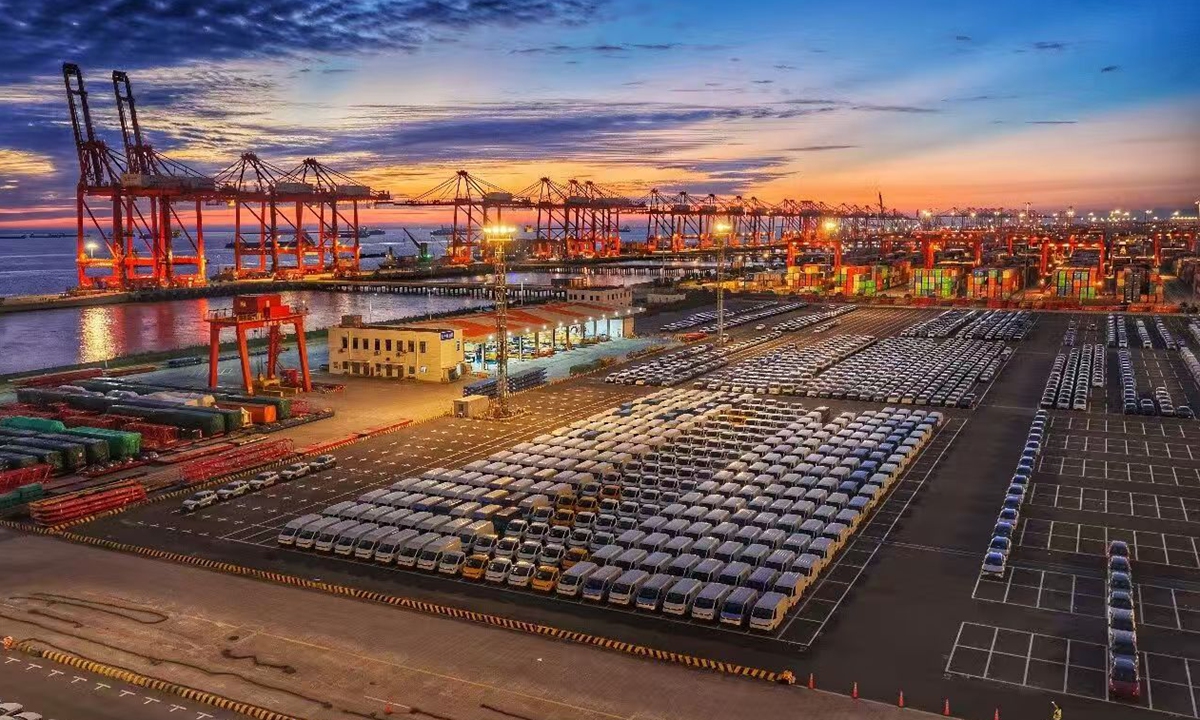
Rows of Ford's electric Transit City vans stand at a deep-water terminal on China's east coast in late September, waiting to climb aboard a giant roll-on/roll-off ship. (Photo: Courtesy of Ford China)
At a deep-water terminal on China's east coast in late September, rows of electric Transit City vans — fresh off Ford's China assembly line — stood in tight formation, waiting to climb aboard a giant roll-on/roll-off ship whose horns were sounding at the quay.
Soon, those electric cargo vans, built by Ford in partnership with Jiangling Motors for modern urban logistics, will embark on a voyage of more than 15,000 kilometers, heading for developed markets such as Europe. Later, the export market for the electric van will expand to 52 countries and regions across five continents.
Back in 1997, the first China-built Transit — a Ford design localized with Jiangling Motors — rolled off the line in Nanchang, East China's Jiangxi Province. Today, China-made electric vans from the same Transit family, which are also Ford's first battery-powered commercial vehicles to be exported from China to developed markets, are sailing toward Europe.
What began as local assembly three decades ago has evolved into a compelling story of deeper collaboration between the Chinese and US auto industries. The two sides are increasingly intertwined, working hand in hand and growing together — China is playing an irreplaceable, multidimensional role for American brands and suppliers seeking to expand globally.
Similarly, a growing roster of US carmakers, such as Tesla and General Motors (GM), has been pursuing deeper cooperation across the Chinese supply chain. These bilateral ties have strengthened even further with the sweeping wave of intelligent driving and new-energy vehicles (NEVs). In this context, the past years have witnessed a profound change in the country's role - from merely a sales market and a local factory floor to a global production base and a center of innovation that is setting the pace for the industry's transformation.
'China-based globalization'Chinese analysts believe that the imminent arrival of Ford's all-electric Transit City in Europe reflects a broader trend of China's elevating weight as a global hub for electric vehicle production - whether in balancing global supply chain cost, securing worldwide deliveries or defining the latest technologies.
Ford China, for its part, will begin exporting hybrid new-energy models built in its Chinese factory to North America next year, accelerating its strategy of "based in China, serving the world." Additionally, the American automaker is jointly developing a range-extended electric model - which the company says is the world's first of its kind - with a Chinese peer, and the model is slated for overseas export starting in 2027, the Global Times learned.
The deeper partnership plays to the strengths of both sides.
"It draws on Ford's established global sales network and brand, as well as the design, technology, manufacturing, quality and cost advantages of products developed in China, expanding complete-vehicle exports from China so that customers worldwide receive better products — and Ford gains a sharper competitive edge in local markets," the company told the Global Times.
Another veteran US automaker GM is also embracing a similar paradigm shift, which the company describes as moving from "global localization" to "China-based globalization."
The company told the Global Times that in the past, joint ventures (JVs) established by US and Chinese partners primarily served to bring global technology into China and adapt it to local demand. Now, the roles of these JVs are to fully leverage China's strengths in user insight, technological innovation, intelligent manufacturing and industrial-chain efficiency, pushing more products and technologies defined, developed and made in China into global markets.
In August, GM and Chinese automaker SAIC Motor signed an agreement to renew their JV, SAIC-GM, extending the term by 20 years to 2047 — on the basis of nearly 30 years of smooth cooperation.
In October, the JV's Buick Electra E7 model will formally begin overseas exports, becoming the first high-end new-energy model from SAIC-GM to go abroad, the Global Times learned. The renewed JV will also continue to expand in the Middle East, Africa, South America, Mexico and the Asia-Pacific in the future.
This push is part of a much larger trend. In 2025, China's auto exports rose by 21.1 percent to nearly 7.1 million units, ranking first in the world for a third consecutive year, data from the China Association of Automobile Manufacturers showed. Among these exports, JV companies performed impressively.
China has been the world's largest auto market for years. The country also has one of the world's largest consumer markets, along with efficient supply chains, a rapid pace of innovation and a large talent pool. "Each of these strengths makes American companies more competitive globally, helping them bring better products to market faster and at lower cost," Harley Seyedin, president of the American Chamber of Commerce South China, told the Global Times.
On the consumer side, the sheer scale of the market allows US firms to spread R&D and production costs across large volumes and test products with demanding, fast-changing buyers. In terms of the supply chain, China's density and efficiency shorten lead times, reduce costs and facilitate easier customization, Seyedin said.
He also stressed that China's rapid feedback loops push companies to iterate faster. Products and business models honed in China increasingly shape what is offered elsewhere. Meanwhile, the country's deep pool of engineers, designers and technicians supports innovation and local decision-making.
Deepening cooperationThe momentum of deepening cooperation among Chinese and US auto chain suppliers was vividly displayed at the 2026 Beijing International Automotive Exhibition, held in late April this year, which put intelligent driving in the spotlight.
The Global Times observed that a wave of China-made models running on US tech giant Qualcomm's latest standard platform made a concentrated debut at the expo. The US chipmaker teamed up with more than 60 partners from China's auto ecosystem to power smart cockpits, in-car systems and onboard AI models during the expo, integrating deeply into the supply chain and R&D system of China's homegrown NEVs.
Conversely, China's intelligent-driving supply chain is also supporting the smart-vehicle push of US automakers.
The Global Times learned from Ford that the company has been working with NavInfo, a Chinese digital-map and intelligent-driving company, on vehicle-road-cloud connectivity, and the two sides have launched a cooperative infrastructure pilot on selected roads in Xi'an, the capital of Northwest China's Shaanxi Province, delivering vehicle-to-everything services to Ford vehicles to smooth traffic flow. GM also announced earlier a $300 million investment in Chinese intelligent-driving firm Momenta to accelerate development of next-generation autonomous-driving technology for GM's future models in China.
"The booming intelligent-driving partnerships between Chinese and US firms have further upended the old model in which multinational carmakers simply localized overseas technology for the local market. Today, China has become a core R&D source and an ecosystem hub for the US auto industry, nowhere more clearly than in the push toward intelligent vehicles," Zhong Shi, a Chinese auto industry expert, told the Global Times.
Chinese industry observers stressed that the deep interweaving of the Chinese and US auto industries and their supply chains is the inevitable outcome of market forces, corporate judgment and the global division of labor. The "strong and practical need" to complement each other is not only a fact of the past; it still holds today.
"Historically, China's vast auto market delivered rich profits to US carmakers — and it remains a crucial market for them today despite intense competition. Meanwhile, Chinese companies hold a global lead in NEV technology, power batteries and energy storage, and US automakers could absorb those advances to strengthen themselves," He Weiwen, an executive council member of the China Society for World Trade Organization Studies, told the Global Times on Thursday.
Some industry insiders compared the Chinese market to a "super gym," where rivals are crowded, buyers change fast, and technologies are refreshed every minute. But this is precisely why US automakers stay, localize and sharpen their technologies through competition. What they learn under China's tense competition, they argued, is what they carry into every other market.
The success of Tesla's Shanghai Gigafactory is a clear example of how the "super gym" logic works, and how the Chinese and US auto industries could cooperate in the NEV era to jointly expand the market.
In a recent interview with China's state broadcaster, the China Central Television released this week, Tesla CEO Elon Musk credited the company's Chinese workforce for the success of its Shanghai Gigafactory while speaking highly of China's broader manufacturing strengths.
"The quality is excellent, and the efficiency is excellent," Musk said. "In terms of the Shanghai factory, it's a gem. It's beautiful."
By the end of July, Tesla's Shanghai Gigafactory had been in production for six years and had produced more than 4.5 million vehicles, accounting for nearly half of Tesla's global deliveries. The Shanghai Gigafactory has also become Tesla's largest vehicle export hub worldwide. Currently, more than a third of the plant's output is shipped abroad, heading to Europe, Southeast Asia, Australia and dozens of other markets, according to media reports.
Now, the China-US partnership built on electric cars could undergo another test as a launchpad for a new complex, high-end manufacturing race: humanoid robots. Tesla is reportedly auditing its suppliers in China to prepare for the production of Optimus humanoid robots, and the company's robotics team has launched a new round of supplier audits in Ningbo, East China's Zhejiang Province.
Analysts pointed out that the next test is the same as the last one: stay in the market, share technology, and grow the pie together. Through cross-shareholding, technology sharing and jointly expanding the market, both Chinese and US players can ultimately compete more effectively worldwide.