


Chinese brands score big at 20th Asian Games
The 20th Asian Games opened in Nagoya on the evening of Sept. 19, with the final torchbearer lighting a heart-shaped cauldron before a roaring stadium.
The cauldron was just the start: Chinese involvement began elsewhere. From athletes' uniforms to competition equipment, Chinese technology and craftsmanship ran through the Games, with brands supplying both the engineering and the design.
The opening ceremony's stage engineering, cauldron design, digital content and on-site execution were all handled by a team from Zhejiang Dafeng Industry Co., Ltd. (Dafeng) in east China's Zhejiang Province. Dafeng also worked on the closing ceremony, providing creative planning, performances and overall operations.
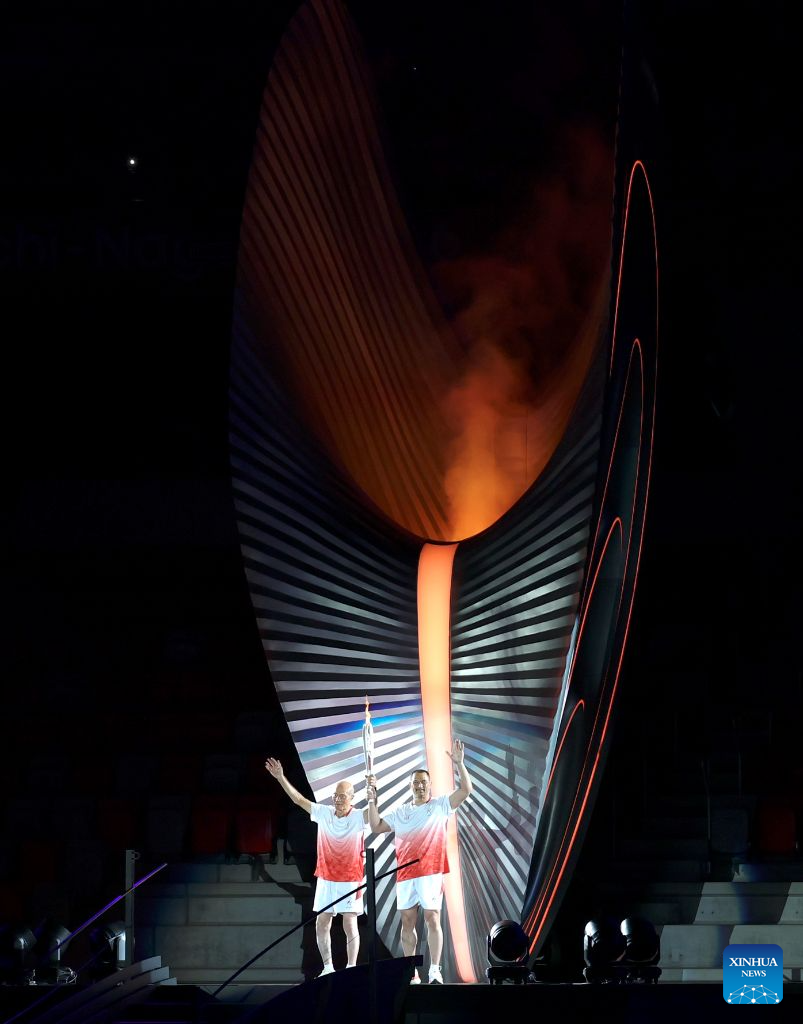
Torch bearers Murofushi Shigenobu (L) and Murofushi Koji wave after the cauldron is lit during the opening ceremony of the 20th Asian Games Aichi-Nagoya 2026 in Nagoya, Japan, Sept. 19, 2026. (Xinhua/Li Bo)
"The project took more than 500 days from contract signing to the opening ceremony," said Zhu Xian, executive producer and artistic director of the ceremonies at Dafeng's performance arts division. His team began work in April 2025, juggling design revisions and equipment development alongside cross-border approvals and Japanese regulatory requirements.
Nagoya's coastal setting brought its own demands. The outdoor cauldron and stage systems had to meet Japan's strict standards on several fronts at once — wind and water resistance for typhoon season, and earthquake resistance for a country where seismic risk is a constant.
"The hard part wasn't the performance of any single piece of equipment — it was coordinating dozens of subsystems. A millisecond of misalignment in lighting, staging, projection or sound could throw off the whole sequence," said Xu Huiwen.
The team split the work across two sites in China: engineers in Hangzhou refined the design and used digital twin technology to simulate wind and lighting conditions in Nagoya, while a smart manufacturing base in Yuyao, Zhejiang Province, produced the cauldron. After repeated stress tests, it was shipped overseas in August 2026.
The heart-shaped cauldron, designed to symbolize a heartbeat and friendship, used a lighting method Dafeng developed in-house: mist and light combined to mimic flame, without fuel burning continuously. Compared with a traditional open flame, that approach is estimated to have cut carbon emissions by 200 tonnes over the course of the Games.
Dafeng has previously worked on the Jakarta Asian Games, the Beijing Winter Olympics, the Hangzhou Asian Games and the G20 summit in Hangzhou. Its technology and services are now used in more than 100 countries and regions.
Beyond the competition venues, Chinese design appeared in another form: the official uniforms, supplied by sportswear brand 361°. As the Games' uniform partner, the company dressed volunteers in forest green, staff in indigo and technical officials in metallic gray and silver — colors chosen to mark each group's role. The fabric was lightweight and quick-drying, made for long hours on their feet in hot weather.
Zheng Yexin, general manager of the company's brand management center, said event uniforms serve a purpose beyond giving staff a professional appearance — they're "a language of action, a bridge between cultures, and a bond of communication."
The company also designed uniforms for six national and regional delegations, including Angkor Wat-inspired designs for Cambodia and grassland motifs for Mongolia. Nagoya marked its fifth consecutive Asian Games, bringing its total apparel supplied to more than 5.4 million pieces. It has expanded into Indonesia and opened a Nagoya store in April.
At the gymnastics venue, a team from Chinese equipment maker Taishan Sports inspected each piece one by one.
The team remained at the venue around the clock, ready to report any equipment issues to coaches through the organizing committee to help keep athletes safe. "Every detail has to follow standard procedure. On competition day, we run one more full inspection an hour before the event starts. That's a hard rule," said Wang Wei, the company's chief engineer.
Beyond gymnastics, Taishan supplied equipment and on-site support for 16 sports. The company has worked every Asian Games since Beijing 1990 and says it has never recorded an equipment failure or a complaint.
"We want to be more than just participants in these events. We want to help shape the brand and set the standards for sports equipment worldwide," Wang said.