


China rolls out measures to spur consumption through tech innovation
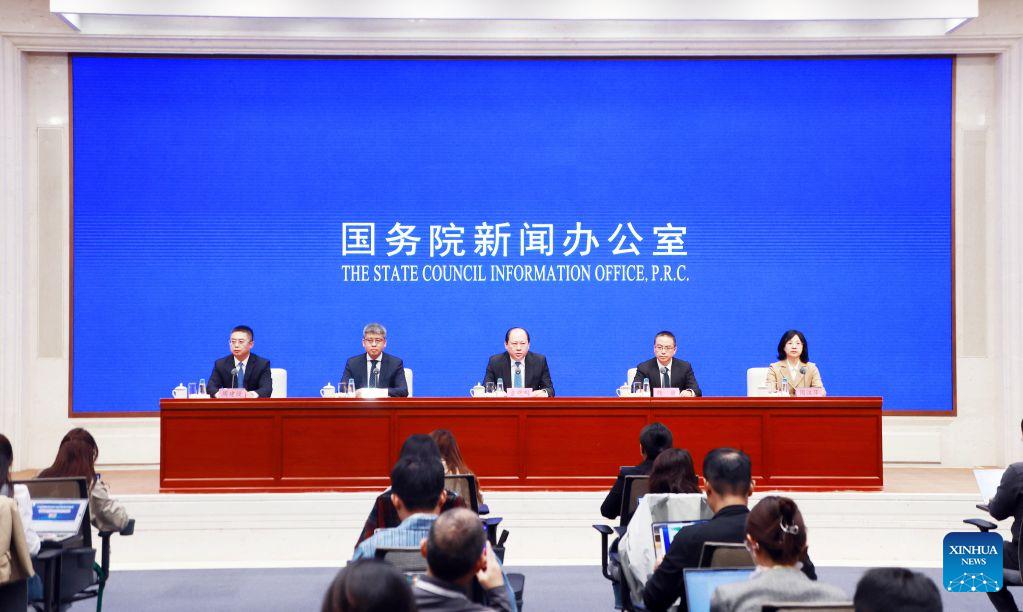
The State Council Information Office (SCIO) holds a press conference on accelerating technology-driven commerce, in Beijing, capital of China, Oct. 19, 2026. (Photo: Xinhua)
BEIJING, Oct. 19 (Xinhua) -- China has released new guidelines to promote the application of artificial intelligence (AI) and other advanced technologies in commerce, as part of efforts to expand consumer demand, upgrade traditional businesses and improve the efficiency of goods distribution.
These guidelines, jointly issued by nine government departments, including the Ministry of Commerce, outline 18 measures covering goods consumption, services consumption, commercial distribution, innovative business applications and policy support.
"The move aims to meet the immediate need to boost consumption and invigorate the consumer market, while using technology-driven innovation to upgrade traditional commerce and foster emerging business models," Yuan Xiaoming, assistant minister of commerce, told a press conference on Monday.
To upgrade consumer goods, the guidelines call for integrating AI into product development, design, manufacturing and marketing, expanding the supply of smart devices and robots, and encouraging flexible manufacturing and AI-powered customization.
New technologies, including AI, the Internet of Things and blockchain, can help drive consumption upgrades, Yuan said. Data from the ministry showed that sales of smart glasses on major platforms rose 110 percent year on year in January-September 2026.
The measures also encourage the use of AI in healthcare and smart elderly care services, as well as the digital transformation of catering businesses, to expand services consumption.
China's retail sales of consumer goods rose 1.1 percent year on year to 37 trillion yuan (about 5.5 trillion U.S. dollars) in the first three quarters of 2026, while retail sales of services increased 5 percent, outpacing the 1-percent growth in retail sales of goods, official data released on Monday showed.
To create more personalized consumer experiences, the guidelines support emerging intelligent services such as companion robots. They also promote the use of ultra-high-definition audiovisual technology and digital twins in shopping districts, tourism, education and training.
They also call for pilot applications of AI in culture and tourism, as immersive experiences and digital performances gain traction in China's cultural and tourism market.
Data from the National Bureau of Statistics showed that revenue from emerging cultural sectors grew 9.6 percent year on year in the first half of 2026, 5 percentage points faster than the overall cultural industry.
In commercial distribution, the measures promote smart warehouses, intelligent logistics equipment and unmanned delivery, alongside digital upgrades in wholesale and retail businesses.
The guidelines also call for developing commercial AI agents for shopping assistance, business operations and logistics, expanding applications of embodied intelligence, and creating virtual shopping experiences. They additionally outline support for technology standards, digital infrastructure and financing.
The new measures build on China's broader push to accelerate the commercial application of AI and other advanced technologies.
China's AI industry has expanded rapidly, with AI-powered smartphones, intelligent connected vehicles and humanoid robots among the products seeing broader application. The country's AI core industry was estimated to have exceeded 1.2 trillion yuan in 2025.
In late 2025, China launched a special initiative to integrate AI into manufacturing. AI adoption among large industrial firms has since exceeded 30 percent, said Wei Wei, an official from the Ministry of Industry and Information Technology.
China will further develop the AI industry and expand its application in manufacturing, focusing on key AI technologies and the development of intelligent devices such as brain-computer interfaces and embodied AI systems, Wei added. ■