


China-Europe freight train runs top 140,000 now, with total value of shipped goods exceeding $560 billion
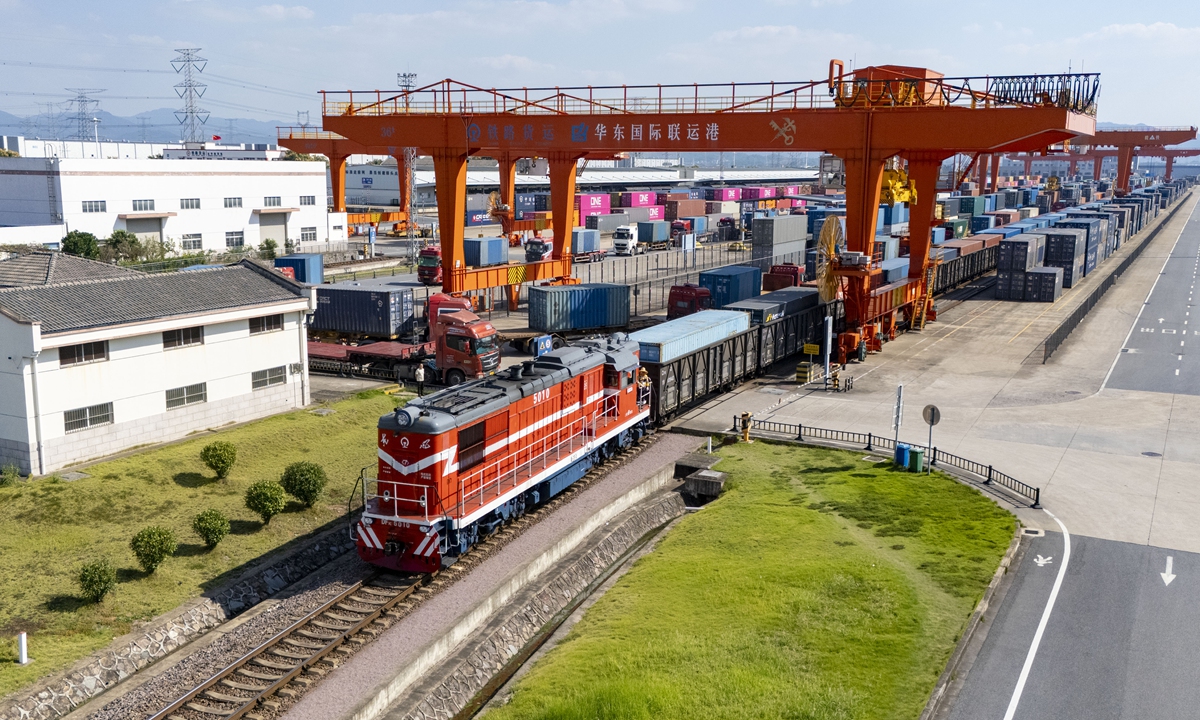
A China-Europe freight train on the Yiwu-Xinjiang-Europe route leaves the East China International Intermodal Port in Jinhua, East China's Zhejiang Province on October 8, 2026. Photo: VCG
As the X8059 China-Europe freight train bound for Moscow, Russia, departed from Shenyang, Northeast China's Liaoning Province, on Thursday, the cumulative number of China-Europe freight trains has surpassed 140,000 runs, with the total value of goods shipped exceeding $560 billion.
The 140,000th freight train, X8059, carried household appliances, auto parts, and other goods. After departing from Shenyang Puhe Station, it is expected to arrive in Moscow in nine days.
In recent years, the railway authorities did its best to expand the China-Europe freight train network to strengthen its radiating effect. Within China, they have fully utilized the western, central, and eastern corridors, with a total of 96 scheduled China-Europe freight train lines operating at 120 kilometer per hour within the country, connecting 132 Chinese cities.
Abroad, the railway authorities have developed diversified overseas routes, with the service now reaching 237 cities in 26 European countries, and more than 100 cities in 12 Asian countries, covering the majority of Eurasia.
According to data provided by China Railway Co, in May, the China-Europe freight trains topped 1,965 runs and transported 197,000 TEUs in that month, setting a new record high for monthly volume. Trains on the southern corridor have achieved regular operations, with 746 trains running from January to September, marking a year-on-year increase of 125 percent.
A total of 22 full-timetable China-Europe freight trains now operate stably each week between nine Chinese cities and six European cities, precisely matching the cross-border transport needs of high-end manufacturing.
As the service coverage and operational quality of the trains continue to improve, high-value-added goods such as automobiles and auto parts, machinery and equipment, and electronic and electrical products have become the main cargo sources for outbound trains. Meanwhile, European timber, pulp, specialty agricultural products, and daily consumer goods are rapidly entering the Chinese market via these trains, injecting new vitality into China-Europe trade.
Currently, the railway authorities are advancing preparatory work for cross-border standard-gauge second-line projects at the Alashankou-Dostyk Port between China and Kazakhstan and the Manzhouli-Zabaykalsk port between China and Russia to further ramp up port throughput capacity.