


China's economy accelerates in Q3, anchoring global stability
Official data released Monday showed China's gross domestic product (GDP) grew 4.5 percent year on year in the third quarter, keeping it among the fastest-growing major economies and reinforcing its role as an anchor of stability in an increasingly fragmented global landscape.

A robot demonstrates stair climbing skills at the 140th China Import and Export Fair, also known as the Canton Fair, in Guangzhou, South China's Guangdong Province, October 15, 2026. (Photo: Xinhua)
China's stronger-than-expected third-quarter economic performance has drawn widespread international media attention, with several major outlets highlighting improving growth momentum and robust exports.
Bloomberg reported that China's growth accelerated faster than anticipated in Q3, bringing the country closer to its annual target. Reuters noted that the stronger GDP figures have eased pressure for aggressive economic stimulus, while CNBC highlighted robust global demand for Chinese tech goods as a key growth driver.
While major economies grapple with mounting debt, sluggish growth and persistently high inflation, China's economy has performed resiliently. Over the past five years, China has grown at an average annual rate of 5.4 percent, contributing roughly 30 percent to global growth—surpassing the combined contribution of the G7 nations. IMF research shows that every percentage-point increase in China's growth lifts output in other economies by an average of 0.3 percentage points.
International observers have underscored China's role as the world's primary growth engine, citing its vital contribution to global stability and prosperity.
Speaking at a recent forum in Beijing, former New Zealand Prime Minister Jenny Shipley noted that nations everywhere are seeking anchors of stability and pathways to shared prosperity, adding that China has consistently delivered on both fronts, according to China Daily.
At the same forum, former Ethiopian President Mulatu Teshome also highlighted China's stabilizing economic influence, noting that its transition toward green technologies, advanced manufacturing and modern services creates fresh opportunities for international partners.
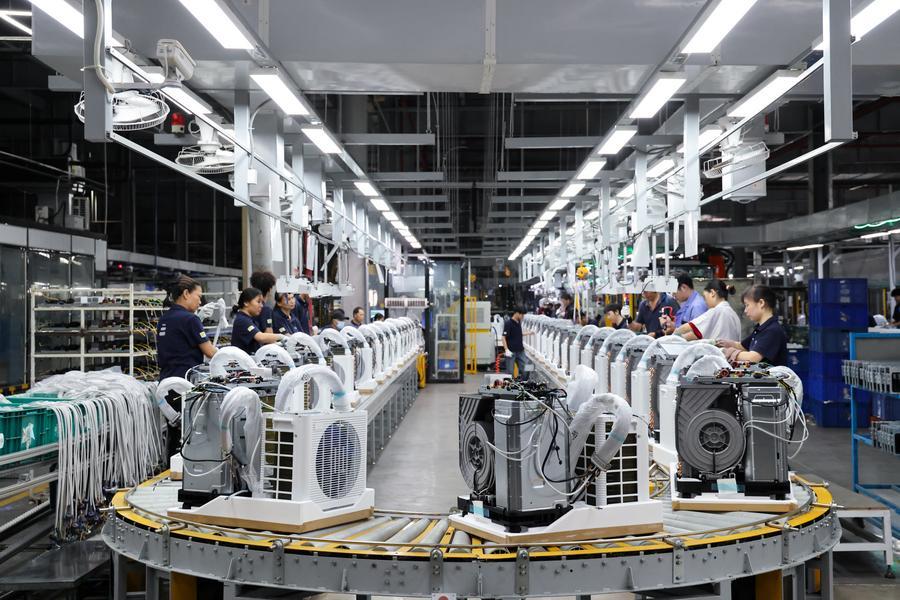
This photo taken on August. 7, 2026 shows a production line for PortaSplit portable split air conditioners inside Midea's household air conditioner factory in Guangzhou, South China's Guangdong Province. (Photo: Xinhua)
Amid mounting global uncertainty, China's comprehensive industrial ecosystem and resilient supply chains have become indispensable to the smooth functioning of world trade.
In Europe, Chinese-made air conditioners have become household staples during scorching summer heatwaves. In the Middle East, Chinese solar and photovoltaic products are playing a pivotal role in accelerating the regional energy transition.
Across the first three quarters, China's exports of mechanical and electrical products climbed 23.7 percent, accounting for 64.3 percent of total export volume. Intermediate goods made up more than half of all outbound shipments, underscoring the country's foundational role across global supply networks.
This stabilizing influence is further underpinned by Beijing's commitment to high-standard opening up and free trade.
Effective May 1, China became the first major economy to grant unilateral, comprehensive zero-tariff access to all African nations and least-developed countries with which it maintains diplomatic ties.
Meanwhile, trade with Belt and Road partner countries reached 20.37 trillion yuan, up 17.1 percent year on year. Chinese enterprises have set up more than 50,000 overseas entities, nearly 90 percent of which operate across the Global South.
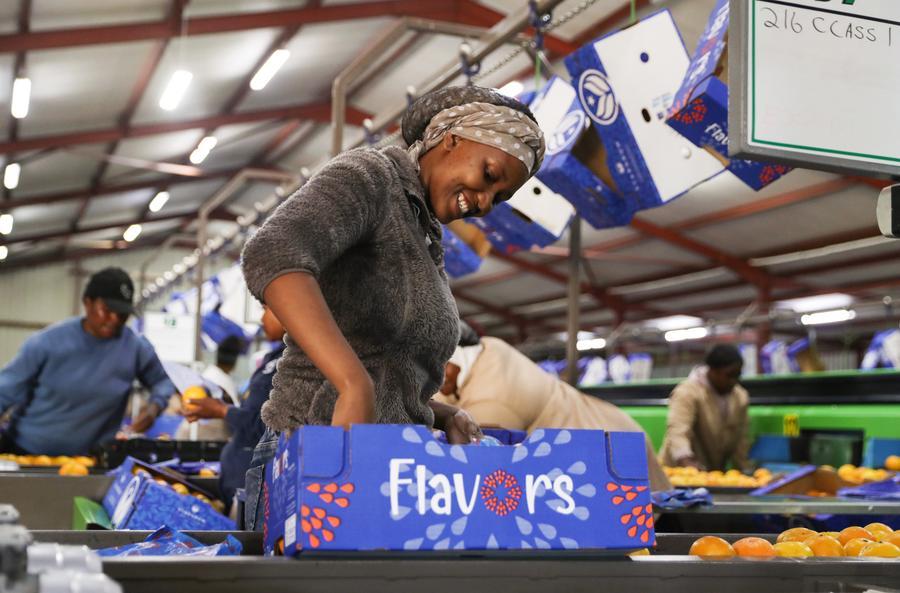
Workers pack citrus at a factory in Brits, North West Province, South Africa, April 28, 2026. (Photo: Xinhua)
China's "continued commitment to opening up, diversifying trade partnerships and facilitating market access contributes to international economic stability by supporting the movement of goods, sustaining production networks and creating opportunities for businesses across different regions," Jackson Kagobora, head of the Department of Economics at Kigali Independent University, told Xinhua in a recent interview.
(Compiled by Yang Yang)