


Japan nears 2% inflation target, but households struggle
Despite progress toward its long-sought inflation target, Japan continues to grapple with weak purchasing power, rising living costs and structural economic challenges.
On October 30, the Bank of Japan (BOJ) kept its policy interest rate unchanged at 1.25%, voting 8-1 to maintain its current stance. In its latest quarterly economic outlook, the Japanese central bank said underlying inflation had reached a level generally consistent with its 2% price stability target, marking a significant milestone in the country's decades-long battle against deflation. However, the achievement has done little to ease concerns over the cost of living and the broader health of the economy.
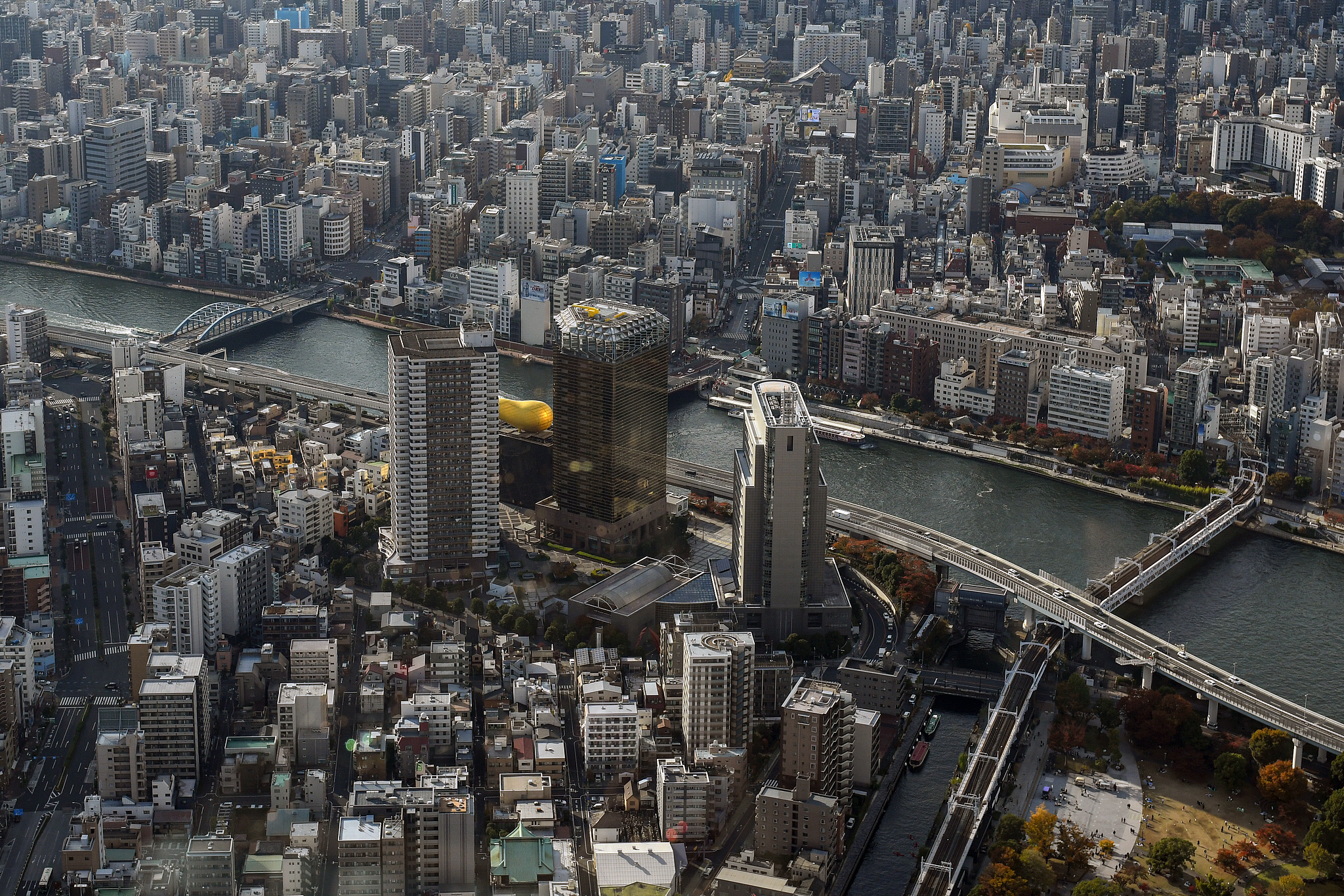
The Sumida River and surrounding commercial and residential buildings in Tokyo, Japan, November 16, 2025. (Photo: VCG)
Japan has struggled with deflation and economic stagnation since the collapse of its asset-price bubble in the early 1990s, a prolonged period often referred to as the "Lost Three Decades." In January 2013, the BOJ introduced a 2% inflation target and subsequently launched successive rounds of large-scale monetary easing to stimulate demand and revive price growth. Yet for years, inflation remained stubbornly below the target, while weak domestic consumption and sluggish wage growth continued to constrain the economy. The BOJ's latest assessment therefore represents an important turning point, although it does not mean that Japan has fully overcome its structural economic problems.
More importantly, the recent rise in prices has been driven partly by external cost pressures rather than a robust recovery in domestic demand. Since the escalation of conflict in the Middle East, disruptions to oil supplies through the Strait of Hormuz have pushed up energy and raw material costs, adding to inflationary pressure in Japan, which relies heavily on imported energy.
The depreciation of the yen has further increased the cost of imported goods. In July, the currency weakened beyond 163 yen against the US dollar, touching its lowest level in four decades. Although it has since recovered somewhat, the weak yen continues to weigh on import costs. Japan's consumer price index rose 2.1% year on year in September, while the index excluding fresh food and energy increased 2.4%, according to the Statistics Bureau of Japan.
The pressure is particularly evident in household budgets. According to Teikoku Databank, 3,153 food and beverage products saw price increases in October, bringing the number of products subject to price hikes in 2026 to 20,187. This marked the second consecutive year in which the annual total exceeded 20,000. Although wages have begun to recover, the improvement has not fully translated into stronger household spending. Japan's real wages rose 2.4% year on year in July, supported by higher nominal pay and relatively moderate inflation. However, real household consumption expenditure among households with two or more members fell 6.8% year on year in July, highlighting the continuing pressure on consumer demand. These figures suggest that stronger wage growth alone is not enough to restore household confidence when essential expenses remain elevated.

Japanese yen banknotes and stock market indicators. (Photo: VCG)
Japan's longer-term economic position is also facing mounting challenges. According to the International Monetary Fund's October 2026 World Economic Outlook, Japan's nominal GDP is projected to fall to sixth place globally in 2027, behind India and the United Kingdom. Its economy is forecast to reach approximately $4.47 trillion, compared with $4.52 trillion for India and $4.49 trillion for the UK. The yen's depreciation is an important factor behind this decline in dollar-denominated GDP, although Japan's relatively slow economic growth also reflects deeper structural constraints, including an aging population, a shrinking workforce and weak domestic demand.
Meanwhile, the government's expanding defense budget is adding pressure to public finances. Japan's Defense Ministry has requested a record 8.9 trillion yen for fiscal 2027, with the final figure potentially rising as the government revises its national security strategy. While national security remains a major policy priority, the growing allocation of public resources to defense also raises questions about how the government will balance military spending with social security, healthcare, elderly care and other essential public services amid mounting demographic pressures.
Ultimately, the real test for Japan is not simply whether inflation can reach the BOJ's 2% target, but whether the country can translate price growth into sustainable economic expansion and tangible improvements in household living standards. A durable recovery requires stronger domestic demand, more consistent real wage growth and greater confidence in future income. Without these foundations, achieving the inflation target risks becoming a statistical milestone rather than a meaningful improvement in people's everyday lives.
Editor's note: Xue Tianhang is an associate researcher at the Institute for National Strategy and Regional Development and China Academy of West Region Development, Zhejiang University. This article reflects the author's opinions and not necessarily the views of CGTN.