


Swap facility gives boost to A shares
China's financial regulators are stepping up efforts to bolster capital market liquidity and stability, with the central bank preparing a fresh round of funding support for institutional investors and the securities regulator moving to encourage more share buybacks and attract additional long-term capital.
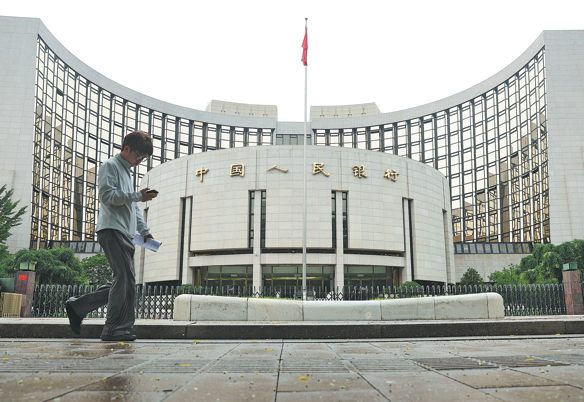
A pedestrian walks past the headquarters of the PBOC in Beijing. (Photo: China News Service)
The People's Bank of China announced on Monday that it would conduct a new round of operations under its securities, funds and insurance companies swap facility (SFISF) on Tuesday to support the sound and stable development of the capital market.
The move will have a one-year tenor, with possible extensions, the PBOC said in a statement. So far, 31 securities and fund management firms have applied for more than 100 billion yuan ($15 billion) under the operation.
Introduced in 2024, the facility allows eligible securities firms, fund managers and insurers to swap assets including bonds, stock exchange-traded funds and CSI 300 Index constituent shares for highly liquid assets such as government bonds and central bank bills.
The funds obtained should be used exclusively for capital market investments, including stock and stock ETF investments and market-making.
Lou Feipeng, a researcher at Postal Savings Bank of China, said the new SFISF operation will provide nonbanking financial institutions with liquidity support that can help break the vicious cycle of redemptions and forced sell-offs, facilitating countercyclical share purchases during market downturns without expanding the monetary base.
In the short term, the facility can channel fresh capital into the stock market and improve investor risk appetite, while over the medium term, it can reduce market vulnerabilities and mitigate forced selling, Lou said.
The move comes as the China Securities Regulatory Commission is also considering a package of measures to strengthen the market's resilience and bolster investor expectations, including making it easier for listed companies to conduct market-stabilizing buybacks, which are aimed at stabilizing their market values and protecting shareholder interests.
The proposed changes include adding shares trading below their initial public offer prices as a trigger for market-stabilizing buybacks, easing relevant trading restrictions and requiring newly listed companies to honor their market-stabilizing buyback commitments.
Before the revised rules take effect, the CSRC will encourage eligible companies — particularly major index constituents and leading tech firms — to actively conduct share buybacks, the commission said on Monday.
During the first 10 months of the year, 645 Shanghai and Shenzhen-listed firms announced 237.7 billion yuan in buyback plans, while 747 companies executed repurchases totaling 134.5 billion yuan, both setting record highs, official data showed.
The A-share market rebounded on Monday in anticipation of supportive measures, with media reports during the weekend speculating that two central State-owned enterprises — China Reform Holdings and China Chengtong Holdings — would obtain additional loans for shareholding increases and buybacks. On Monday, the CSI 300 Index closed up 0.79 percent at 4016.92 points while the tech-heavy STAR 50 Index jumped as much as 3.11 percent.
Yang Delong, chief economist at First Seafront Fund, said policymakers are making all-out efforts to support the capital market. A recent surge in ETF trading volume suggests that major institutional investors may have begun stepping up purchases to support a rebound in asset prices. Yang said the recent sell-off in artificial intelligence-related tech shares largely reflects a correction of previously overzealous transactions, with forced liquidations and panic selling exacerbating the declines. Many leading AI tech shares may now be undervalued, creating room for a valuation recovery that could become a key driver of a market rebound.