


China remains a source of opportunity for global companies
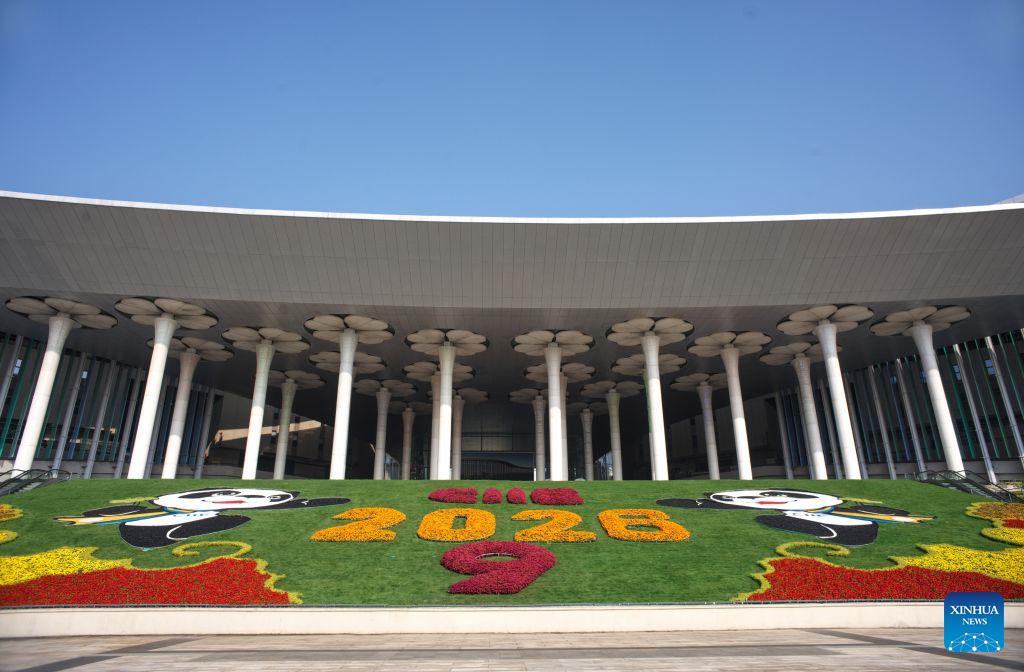
This photo taken on Oct. 26, 2026 shows the south square of the National Exhibition and Convention Center (Shanghai), the main venue for the ninth China International Import Expo (CIIE), in east China's Shanghai. Preparations are in full swing for the ninth CIIE, which is scheduled to take place from Nov. 5 to Nov. 10 in Shanghai. (Photo: Xinhua/Fang Zhe)
BEIJING, Nov. 5 (Xinhuanet) -- When the ninth China International Import Expo (CIIE) opens in Shanghai this week, it will bring together 4,142 overseas exhibitors from around the world. For the first time, more than 300 Fortune Global 500 companies and industry leaders will take part, while over 2,000 companies will make their debut at the expo.
These numbers point to more than the appeal of a single event. As protectionism rises and uncertainty clouds the global economy, one question stands out: Why do international businesses remain committed to the Chinese market?
The answer lies not in any single advantage, but in the combination of a resilient economy, an extensive industrial ecosystem and growing opportunities for innovation. Together, these strengths make China not only a vast market for global companies, but also a place where they can build partnerships, innovate and grow.
A VAST MARKET WITH MOMENTUM
For businesses planning years ahead, economic stability matters.
In the first three quarters of 2026, China's economy expanded 4.6 percent year on year, with GDP exceeding 107 trillion yuan, adding 5.7 trillion yuan in output, the largest increase for the same period in the past five years. And new growth drivers contributed more than 40 percent to economic growth during the period, according to preliminary estimates from the National Bureau of Statistics.
The figures reflect both China's economic resilience and the growing role of industrial upgrading and technological progress in driving growth.
For multinational companies, China remains a key destination that boasts a stable market and great growth potential.
According to the Ministry of Commerce, China's foreign direct investment (FDI) equity stock reached 26.8 trillion yuan (about 4 trillion U.S. dollars) in 2025, ranking second globally and marking six consecutive years of growth.
In the first nine months of this year, 47,800 new foreign-invested enterprises were set up, while foreign investment in high-tech industries surged 33.8 percent to 228.53 billion yuan.
German chemicals giant BASF's investment in southern China offers a case in point. In March, its integrated production base in Zhanjiang City, Guangdong Province, became fully operational. With an investment of about 8.7 billion euros (about 10 billion U.S. dollars), it is the largest single investment project wholly owned by a German company in China.
"This investment shows confidence in the world's largest chemical market in the long run," said BASF CEO Markus Kamieth.
AN INDUSTRIAL ECOSYSTEM THAT CREATES VALUE
While economic resilience and a stable market give companies confidence to invest, China's extensive industrial network gives them another reason to stay.
China is the only country in the world with all industrial categories listed in the United Nations' industrial classification system. Its broad manufacturing base brings together suppliers, manufacturers and technical specialists across a wide range of industries. For companies operating within this network, the advantage lies not simply in finding individual suppliers, but in connecting different parts of the production process.
Airbus, for example, works with about 200 Chinese suppliers to support its commercial aircraft production. According to the company, the annual value of its industrial cooperation with China exceeded 1.4 billion U.S. dollars in 2025.
At the 2026 China International Supply Chain Expo, Honeywell brought together nearly 100 Chinese partners to showcase products across sectors including semiconductors, energy storage, data centers and intelligent manufacturing.
The examples of Airbus and Honeywell show how these networks connect suppliers, technical expertise and production facilities, helping international companies coordinate operations across markets.
AN INNOVATION HUB FOR GLOBAL GROWTH
China's appeal to global companies extends beyond its manufacturing strength. The country is playing an increasingly important role in developing new products and bringing new technologies into use.
For multinational companies, innovation depends on more than research facilities. It requires an ecosystem linking skilled talent, research partners and market demand. With its strong industrial base, research resources and evolving consumer market, China provides fertile ground for turning ideas into marketable products.
In March, French pharmaceutical company Sanofi launched its first China Innovation and Operation Center in Chengdu, southwest China's Sichuan Province. The center covers research and development, clinical trials and supply chain services, and is connected with the company's operations hubs in other countries.
The decision to establish the center in Chengdu reflects the company's commitment to staying at the forefront of global innovation, said Madeleine Roach, executive vice president, head of business operations of Sanofi.
More tellingly, products developed in China can go on to serve markets around the world. Adient, a global automotive seating supplier, developed its ProForce massage system in China, launched it first in the Chinese market and subsequently rolled it out globally.
Innovation is also translating into practical applications on the factory floor. HP's AI innovation center in southwest China's Chongqing Municipality has launched an AI-powered acoustic inspection machine that can identify product defects. The device has already been deployed for quality inspection across multiple manufacturing sectors.
Foreign businesses are increasingly treating China not just as a sales market or manufacturing base, but as a source of innovation, said Pan Yuanyuan, a researcher at the Institute of World Economics and Politics of the Chinese Academy of Social Sciences.
The CIIE provides a platform to deepen these connections by bringing overseas companies together with Chinese businesses, buyers and potential partners. Its value extends beyond deals made during the expo to the partnerships that can follow.
In a challenging global environment, strong participation in the expo underscores China's continued appeal to global businesses. Its economic resilience, extensive industrial networks and dynamic innovation ecosystem offer global companies more than market access -- they open new avenues for partnership, innovation and shared growth.