


APEC Primer in Four Words | Together: Three priorities shaping APEC 2026
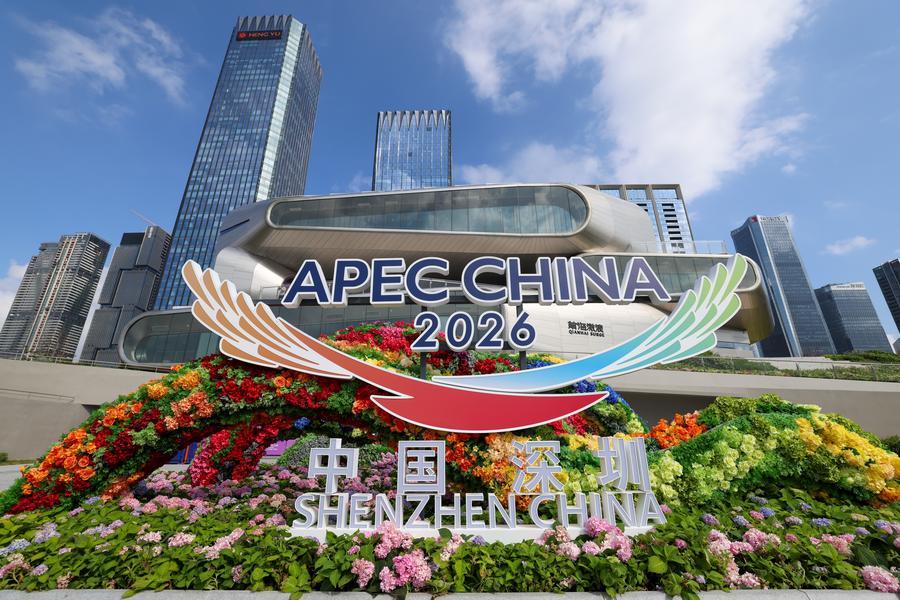
This photo taken on Nov. 3, 2026 shows an APEC-themed installation at a park in Shenzhen, south China's Guangdong Province. (Xinhua/Mao Siqian)
APEC Primer in Four Words: The 33rd Asia-Pacific Economic Cooperation (APEC) Economic Leaders' Meeting will be held in Shenzhen on Nov. 18 and 19 under the theme "Building an Asia-Pacific Community to Prosper Together." This four-part series unpacks four key words from that theme, one each day, to explain what APEC is and what the 2026 host year is about.
Trade, technology and economic resilience present different challenges for the Asia-Pacific. But they have something in common: progress often depends on economies working beyond their own borders.
"Together," the final word of the theme, is where the year's work comes into focus. Across China's host year, APEC's 21 economies have pursued three priorities: openness, innovation and cooperation. In practice, that has meant making cross-border trade easier, responding to the rise of artificial intelligence and building economic resilience.
Openness: trade and connectivity
On trade, policy dialogues this year have covered trade digitalization, competition policy, state-owned enterprises, and trade and labor, as part of discussions toward the Free Trade Area of the Asia-Pacific (FTAAP).
There has also been progress on paperless trade. APEC has established a Center of Excellence for Paperless Trade and is working to improve how electronic trade systems communicate across borders. APEC research suggests that digitalizing trade documents could cut trade transaction costs by 5.8 percent.
Connectivity is being revisited too. China has called for an upgrade to the APEC Connectivity Blueprint for 2015 to 2025, which was endorsed at the 2014 Beijing meeting, to make physical, institutional and people-to-people links more effective.
Innovation: digital, smart and green
Wang Yi, China's minister of foreign affairs, has called for digital, smart and green transformations driven by innovation, as well as people-centered artificial intelligence (AI) and "AI for good."
Throughout the year, APEC economies have examined how different approaches to AI governance can work together, including on data privacy, trust and technical standards. They have also looked at AI applications in energy, services and trade, alongside digital literacy and workforce development. AI is expected to feature prominently when leaders meet in Shenzhen.
Readiness is a recurring theme. Carlos Kuriyama, director of the APEC Policy Support Unit, said the benefits of AI are going mainly to economies that are ready to embrace it, which is why digital readiness and capacity building are part of the agenda.
Cooperation: shared goals
The third priority is about what economies can achieve together beyond trade and technology. Ministerial meetings this year have produced outcomes on digital infrastructure financing, financial inclusion, energy systems and food systems resilience.
These issues cross national and economic boundaries. Disruptions to energy supplies and food systems can affect economies across the region, while access to financing and infrastructure shapes their ability to respond. Cooperation offers opportunities to share experience, coordinate approaches and strengthen resilience.
APEC Secretariat Executive Director Eduardo Pedrosa has described the forum as a place where economies share experiences, compare policy approaches and identify where further progress can be made.
The regional economy provides a backdrop for those discussions. According to APEC's Policy Support Unit, the region is projected to grow 3.4 percent in 2026, up from 3.2 percent in 2025. Sustaining that growth while addressing shared vulnerabilities remains an important challenge.
Four words, one theme
APEC Economic Leaders' Week began Nov. 14 with meetings of senior officials and business representatives, ahead of the Economic Leaders' Meeting on Nov. 18 and 19.
Taken together, the four words in this series describe one idea. "Community" is the relationship among 21 economies, and "Prosper" is their shared ambition. "Building" is the sustained work needed to realize it, with Shenzhen's transformation as one example. "Together" is how they try to do it.
Building an Asia-Pacific community is not the work of a single meeting or host year. The measure of success will be what the region's economies can continue to achieve together.