


10,000 trains and counting: China's auto export rail service picks up speed
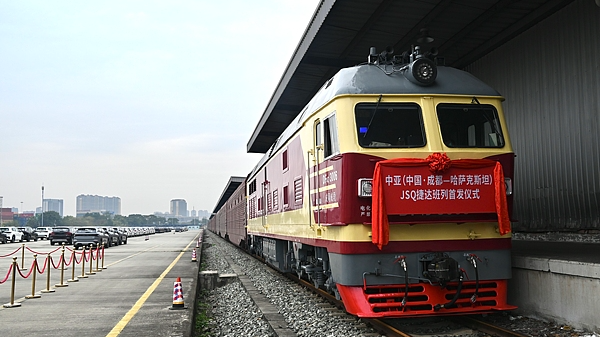
A JSQ Jetta train loaded with 290 finished Jetta vehicles departs for Almaty along the Asia-Europe Link Global Central Asia route (Chengdu–Kazakhstan), Chengdu, Sichuan Province, southwest China, November 19, 2026. (Photo: VCG)
A train carrying 203 domestically made new energy vehicles departed from Zhengzhou International Land Port on Thursday, marking the milestone of 10,000 special trains for exported finished vehicles transported by dedicated rail wagons.
The train will first travel by rail to Minhang Station in Shanghai, where the vehicles will be transferred onto ro-ro ships at Shanghai Port. It will arrive in Australia in roughly 14 days, covering a total distance of more than 10,000 kilometers.
Wang Xiaolu, project lead from the Marketing Department of China Railway Special Cargo Services Co., Ltd., said dedicated trains for Chinese-made vehicle exports entered regular service in 2021.
It took around four years to run the first 5,000 trains, while the jump to hit the 10,000-train mark took just over a year, showing a sharp acceleration in export volumes.
To meet surging overseas demand for finished vehicles, the dual-track international logistics network combining rail exports and rail-sea intermodal transport is expanding rapidly.
Regular outbound routes have been arranged via land ports including Khorgos, Manzhouli and Alashankou, with cross-border trains on the China-Laos Railway delivering vehicles steadily to Southeast Asia.
Rail operators and ports have also deepened cooperation to advance integrated construction of rail sidings, logistics bases and pre-storage yards, forming an export network with multiple ports and parallel routes.
Zhao Ruijie, deputy party secretary of Henan International Logistics Hub Construction and Operation Co., Ltd., explained that the model enables direct rail delivery to ports and immediate loading onto vessels.
Around three to four special vehicle trains run regularly from the hub each day, shipping 700 to 1,000 export vehicles daily.
Since the start of this year, more than 2.035 million finished vehicles have been exported via rail, a 79% year-on-year increase.
A growing number of special trains are carrying Chinese-made vehicles to global markets with faster delivery and better cost efficiency.