


Wenzhou's trade model: Connecting markets, capital and industry
An international trade agreement might be celebrated with a formal event, but the real challenges start once the delegates have gone home. That's when shipments face customs, suppliers look for financing, or factories think about investing abroad.
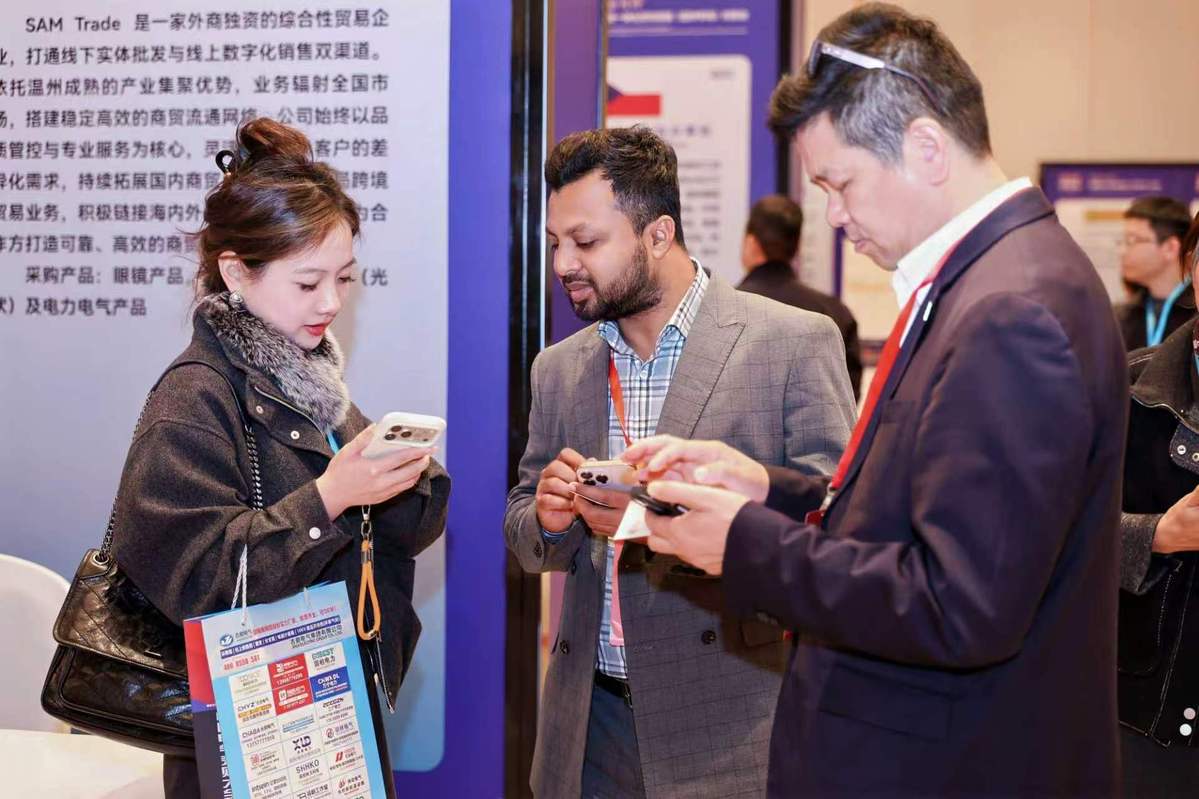
Mohammad Saiyedul Islam (middle) communicates with other participants during the trade matchmaking conference in Wenzhou, East China's Zhejiang province. (Photo: China Daily)
This was the main takeaway from the Trade and Investment Integration for Two-way Empowerment Matchmaking Conference in Wenzhou, East China's Zhejiang province, on Nov 20. As supply chains change, global business relies more on building strong partnerships than just signing agreements.
The Wenzhou gathering offered a practical illustration. Hosted by the Zhejiang Provincial Department of Commerce, organized by the Wenzhou Bureau of Commerce and implemented by Zhejiang Donnor International Exhibition, the conference brought governments, banks, enterprises, customs authorities, and business associations into one conversation. Its theme, "Integrated Trade and Investment for Win-Win Collaboration", recognized that promising business relationships often stall over interconnected practical problems.
The scale of Zhejiang's economy makes this approach particularly relevant. According to Hangzhou Customs, the province's imports and exports reached 4.57 trillion yuan ($680 billion) in the first three quarters of 2026, up 9.5 percent year-on-year. Its trade with ASEAN climbed 23.4 percent to 788.43 billion yuan, while private enterprises accounted for 82.7 percent of total foreign trade.
These figures reveal more than export strength. They show how a commercially dynamic region can continually diversify markets and connect entrepreneurial businesses with international demand.
Wenzhou has its own compelling story. Its gross domestic product surpassed one trillion yuan in 2025, and the city already had more than 30,000 registered import-export enterprises by March of that year.
Such an outward-looking business community creates both opportunity and complexity. A smaller manufacturer may have a competitive product and still lack reliable overseas partners, knowledge of foreign standards, or access to affordable trade finance. For these businesses, coordinated services can matter as much as a new customer.
That is why the presence of different institutions matters. Banks can address letters of credit, payments, and financing gaps. Customs authorities can clarify documentation, inspection, and clearance procedures. Government agencies can explain investment rules and connect firms with public services. Business associations can help verify counterparties and sustain contact after an event.
No single institution can eliminate every obstacle. Together, however, they can turn an initial introduction into a functioning supply chain.
The conference's international participation underscored the importance of relationships beyond any single market. Wenzhou Vice-Mayor Zhang Benfeng and Zhu Ying, chief economist of Zhejiang's Department of Commerce, were among the officials scheduled to speak, alongside Moldova's Ambassador to China Petru Frunze and India's Consul General in Shanghai Pratik Mathur.
The diplomatic delegation included representatives associated with countries in Africa, Europe, Latin America and South Asia. This diversity matters because the next generation of trade cooperation will not be confined to the largest economies.
The program moved deliberately from speeches toward practical matching. It included the release of a master list of procurement needs, presentations on Wenzhou's investment environment, the China-Belarus Great Stone Industrial Park, the Thailand Wenzhou Business Industrial Park, and the city's electrical industry cluster.
These were not unrelated subjects. They connected immediate demand for products with questions of where production, distribution, and future investment might take place. That is the bridge trade promotion should build: from finding a buyer today to developing productive capacity tomorrow.
Industrial visits provided another important dimension. Delegates' itinerary included Fox ESS, a developer of energy-storage technologies, and Weidouli Valve. Fox ESS opened a second manufacturing facility in Wenzhou in June, demonstrating the city's growing role in advanced energy products.
Factory-level engagement can help prospective partners assess technology, quality control, and production capabilities more effectively than brochures alone. It raises a more substantial question: can purchasing relationships evolve into technology partnerships, training, and local assembly?
For developing countries like my own, Bangladesh, this difference is very important. Getting access to affordable Chinese machinery, electrical equipment, and renewable energy technology can help lower production costs and boost industrial capacity.
But just importing equipment is not enough. The real opportunity is in building maintenance skills, developing talent, forming joint ventures, making components, and setting up strong after-sales support.
Bangladesh, in turn, offers manufacturing strengths and businesses seeking wider markets. Foreign partners should also have credible pathways to sell into China. Cooperation is truly two-way when each side creates value, not merely more shipments.
Yet international matchmaking should avoid an easy assumption: more meetings automatically mean more trade.
Commercial relationships confront real risks, including differing product standards, exchange-rate volatility, shipping costs, contract enforcement, and uneven access to finance. A sustainable partnership must address these constraints transparently.
Smaller enterprises in particular need understandable compliance guidance, dependable dispute-resolution arrangements and digital procedures that reduce administrative delays. Openness is meaningful only when businesses can actually use it.
Wenzhou has begun developing such coordination. In July, the city introduced a service mechanism involving 15 government agencies to support companies expanding abroad, covering issues from customs and taxation to intellectual property and legal affairs.
During the first half of 2026, more than 160 trade events involving over 2,000 companies generated reported intended orders worth $1.44 billion. The word "intended" deserves attention. Expressions of commercial interest are encouraging, but they are not the same as completed transactions or productive investments.
A serious assessment of this Wenzhou initiative should therefore follow what happens six or 12 months after the conference. How many introductions become fulfilled orders? How many businesses establish long-term distribution or investment partnerships? Do local workers gain skills? Are smaller firms able to participate? Do projects meet environmental and commercial standards? These are better measures of success than attendance numbers or the value of memorandums announced on stage.
With protectionism and uncertainty making global business harder, Wenzhou shows a positive way forward: practical cooperation based on entrepreneurship, teamwork between institutions, and shared opportunities.
The real success won't be how many business cards were handed out on Nov 20. It will be seen in better factories, new markets, skills being shared, and strong partnerships built after the event. Global trade will be stronger when both sides can grow together.