


Anhui city targets 10 billion yuan for fermented mandarin fish
By 2027, Huangshan city in east China's Anhui Province aims to raise the fermented mandarin fish industry's output value to 10 billion yuan (about $1.49 billion) and to grow the number of large processing enterprises to 22.
The dish, a signature of Anhui cuisine, is known as "chouguiyu" — literally "stinky mandarin fish." The smell is the point: fermented to a pungent strength, it is prized for a flavor that fans find irresistible. Its preparation technique was added to Anhui's provincial intangible cultural heritage list in 2022. Today, Huangshan has more than 100 processing companies turning out the fish, an industry worth 5.7 billion yuan (about $850 million) a year.
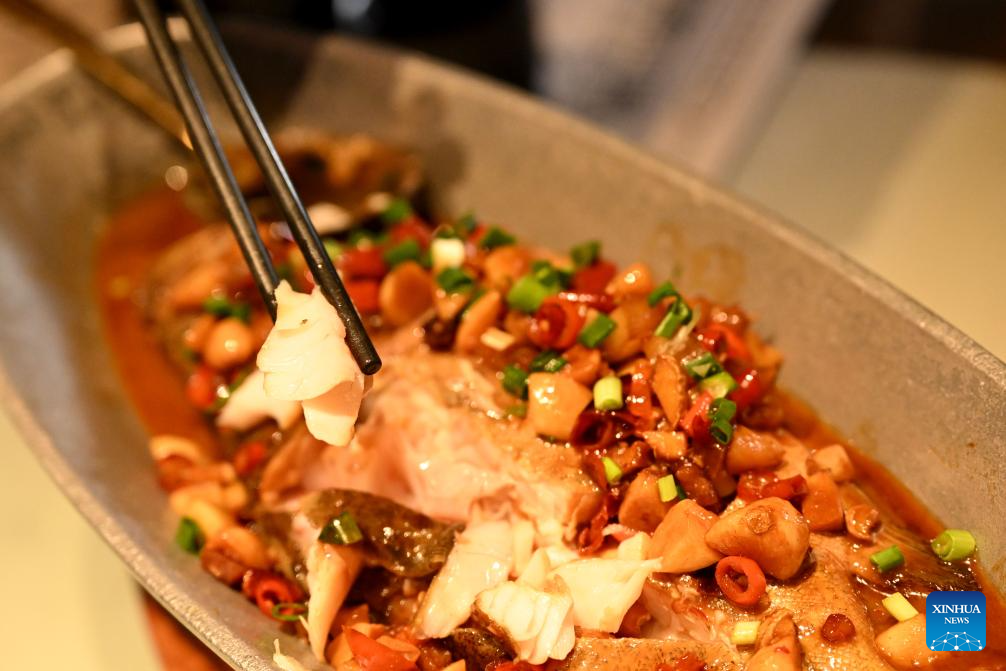
This photo shows a cooked fermented mandarin fish in Huangshan city, east China's Anhui Province. (Photo: Xinhua)
To grow the industry, Huangshan is working along the whole chain: farming the fish locally instead of importing them, standardizing production, and reaching more buyers in China and overseas.
The sector once relied heavily on fish farmed in other provinces, resulting in inconsistent quality, high transportation costs and price fluctuations, said Hu Haojie, head of a supply chain company.
To address this, Huangshan has expanded local fish farming. At a pilot base in Shexian county, technician Pan Hengfeng said his team and researchers at Huazhong Agricultural University developed a local strain that takes readily to artificial feed, a breakthrough that allowed them to scale up production in standardized ponds.
At a breeding farm in Hanshan village, Huizhou district, a recirculating system of 12 land-based tanks reuses more than 95 percent of its water. The farm expects to produce 100 tonnes of fish and 100,000 fry a year. In May 2026, it became the province's first standardized base certified to supply the export trade in fermented mandarin fish.
Exports were once considered nearly impossible: fermentation is hard to control, and keeping the fish cold across borders is harder. Wang Yang, who runs a company in Huizhou district, worked with Wu Yongxiang, a researcher at Huangshan University, to solve both. In August 2025, they filed for a PCT patent on their processing method — the first such filing in China for deep-processed fermented mandarin fish. The method, which uses a plant-based antibacterial solution and gentle heat, keeps the product fresh for nine months at room temperature, with no cold chain required.
Huangshan has led the drafting of eight industry and group standards for fermented mandarin fish. More than 90 percent of the city's related enterprises above designated size have adopted standardized production processes that reduce salt content as well as odor.
A collective trademark was registered in October 2025, with 13 companies authorized to use it in May.