


Manufacturers unveil low-cost small turbojet engine to support mass production of UAVs
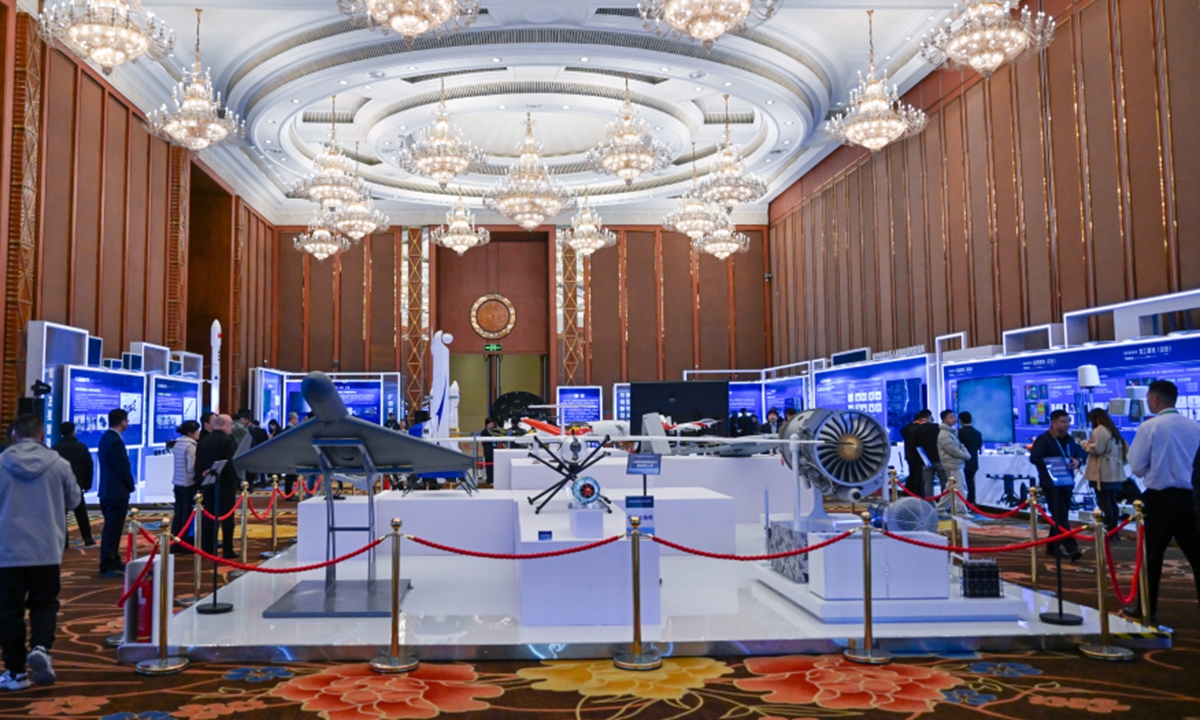
Photo: VCG
Chinese manufacturers have jointly unveiled a small turbojet engine designed to power lightweight unmanned aircraft, as they seek to reduce propulsion costs and build up a domestic supply chain capable of supporting large-scale production of such platforms.
The AEJ8, an 80-kilogram-thrust-class turbojet engine developed by Sichuan Tianfu Light Power Technology Co, a subsidiary of the Aero Engine Corporation of China (AECC), was jointly released with the Sichuan Chengfei Integration Technology Corp at the 2026 Aerospace Industry Ecosystem Conference in Chengdu, Southwest China's Sichuan Province, China Aviation News reported.
"The AEJ8 turbojet engine is a small turbojet engine with 80 kilograms of thrust that we have developed for lightweight unmanned aircraft. It can serve as the core power unit for mid-to-high-end model aircraft, and has the potential to become the preferred power source for ultra-low-cost unmanned aircraft, providing reliable and economical propulsion support for various lightweight flight platforms downstream," Wei Xin, director of the development planning department at Tianfu Light Power, was quoted as saying by Sichuan Television.
A turbojet is a type of jet engine that draws in air, compresses it, mixes it with fuel and burns the mixture to produce high-speed exhaust that generates thrust. Unlike piston engines, which drive a propeller, turbojets generate thrust directly through the exhaust and can support higher flight speeds.
The two types of propulsion offer different trade-offs, with piston-engine drones generally having lower costs but slower speeds, while jet-powered models can fly faster and potentially make interception more difficult, Chinese military commentator Song Zhongping told the Global Times.
However, small turbojet engines also face challenges in manufacturing costs and fuel efficiency. The development of the AEJ8 therefore highlights not only the availability of another propulsion option, but also efforts to make small jet engines more economical to manufacture and integrate into unmanned aircraft.
He noted that the lower cost of piston-powered drones makes them suitable for mass production, but argued that the speed advantage of jet-powered models has made the latter an increasingly important development direction for military drones.
Although jet-powered drones are more expensive than piston-engine models, their costs remain substantially lower than those of crewed combat aircraft and many types of cruise and ballistic missiles, Song said.
"This kind of drone can be used in attrition warfare," he said, adding that large numbers of relatively inexpensive drones could also be deployed in swarms or saturation attacks to challenge an opponent's defenses.
Against this backdrop, the development of the AEJ8 also highlights efforts to make small jet engines more economical to manufacture and integrate into unmanned aircraft.
Tianfu Light Power said it is pursuing a low-cost, high-reliability and rapid-response approach, while seeking to shorten production and delivery cycles through closer coordination with suppliers.
Rather than building production facilities for every component, the company is opening up supporting links such as raw-material supply, machining and component manufacturing to established industrial partners, while retaining core capabilities in final assembly and testing, Wei told local media Jinguan News.
Song said expanding the participation of private manufacturers would be an important part of China further developing its low-cost drone industry and strengthening the resilience of its industrial supply chains.
"Development in this area needs to proceed on two fronts. First, we should substantially reduce engine costs and encourage more private enterprises to participate in the defense industry, rather than relying solely on State-owned enterprises," he said.
He argued that bringing more private-sector manufacturing capacity into engine and drone production could help reduce costs and expand output, while competition among suppliers could encourage greater efficiency.
"Military-civilian integration and the coordinated participation of both sides are important. The lower-cost production capabilities of private enterprises can help support drone manufacturing and expand its scale," Song said.