


During the pre-dawn hours of August 27, a swivel railway bridge of Beijing-Xiongan intercity high-speed railway had its main structure rotated to the targeted position across the Tianjin-Baoding high-speed railway. Jingxiong Intercity Railway, one of the iconic projects of China’s intelligent high-speed railway epitomizes huge progress of China’s infrastructure.
China is home to the longest sea-crossing bridge, the longest road-rail bridge and eight highest bridges in the world. During the past 70 years since the founding of the People’s Republic of China, massive infrastructure projects have facilitated more rapid urbanization and economic growth as well as ensured the wellbeing of people. How did this happen in China?
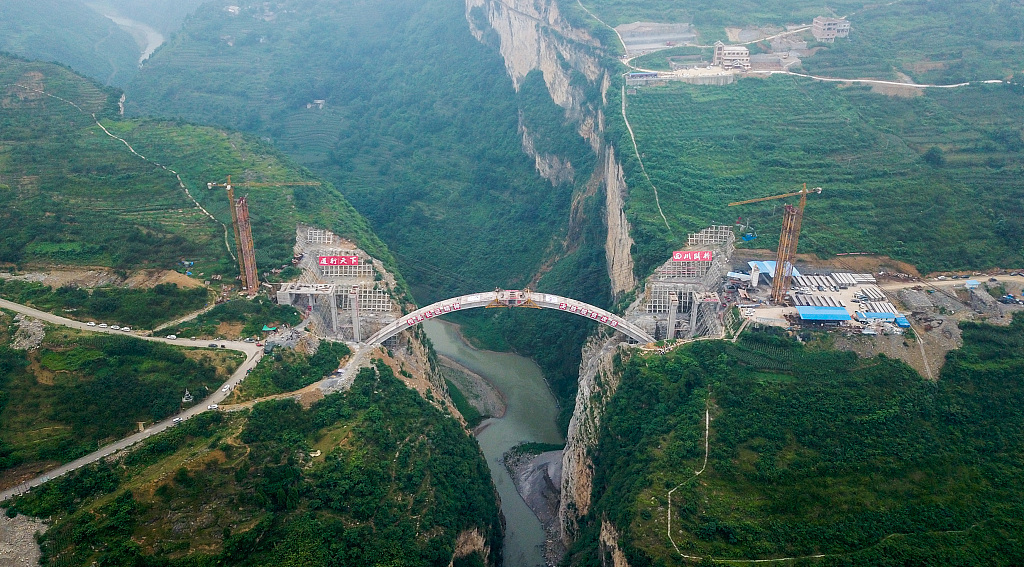
The main structure of Jimingsansheng Bridge, which links three provinces in southwest China, joins up in July, 2019. (File photo: VCG)
China’s mega projects lead the world
Beijing Daxing International Airport is expected to begin operations by the end of September and has started selling tickets. As the country’s landmark project, the new airport features the world’s biggest terminal. A mega bridge connecting three remote southwest China’s provinces named Jimingsansheng Bridge is scheduled to open to traffic by the end of the year, cutting a two-and a-half-hour drive to just one minute. When opened, it is expected to play an important role in alleviating poverty in the local area.
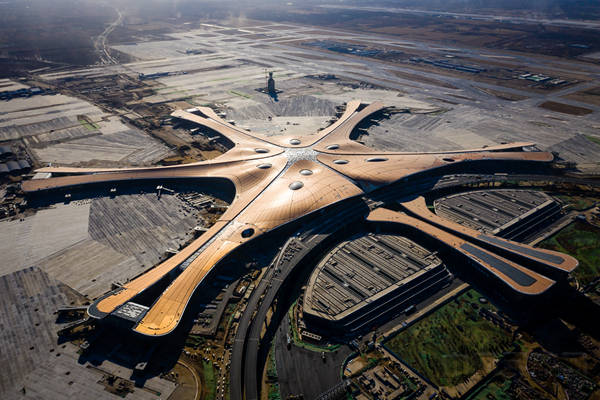
(Photo: People's Daily)
China’s mega projects lead the world today. Its infrastructure development has been undergoing catch-up growth and tremendous change.
Today, China has the world’s busiest railway network with more than 82,000 miles of track, five times that of 1949. The total high-speed track in China makes up over two thirds of the world’s total. China boasts over 88,800 miles of expressways. However, there were only 18,000 miles of roads during the early days of new China. Seven of the biggest and busiest shipping ports in the world are located in China with berth productivity of around 24,000. The development of civil aviation in China is even more astonishing. There were only seven domestic airlines across eight cities in the 1950s, while today 233 commercial airports are operating a proliferation of airlines by the end of 2018, according to data.
Chinese infrastructure development and growing investment
China has witnessed truly revolutionary advances in infrastructure development, from playing catch-up to leading the world. What is the basic background to the story?
President Xi Jinping once maintained that it is a major superiority of China’s socialist system to draw on resources to address major problems.
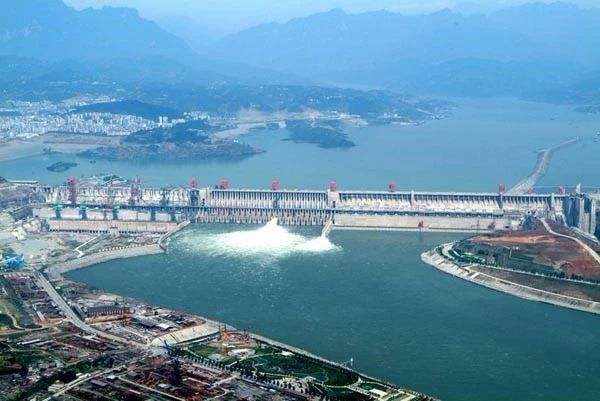
At the beginning of the founding of China, the Chinese government overcame considerable financial difficulty and implemented 156 major projects from the 1950s to the 1960s. Since the reform and opening-up, infrastructure spending was increased to safeguard development, among which government investment has been a major force.
(Photo: People's Daily)
The development of the Chinese high-speed railway network is a case in point. Bringing in advanced technology from abroad and drawing on various resources and talent, China has renewed its capacity for innovation and leads the pack in high-speed transportation. It took five years for China to achieve the high-speed technological development for which developed countries has undergone more than 30 years of exploration.
By the same token, it is also beyond imagination the fact that China ushered in the 3G era in 2009, built the largest 4G network in the world in 2014, and then planned a 5G launch in 2019.
Quality infrastructure hinges on national conditions and boosts development
High-quality infrastructure in China is determined by China's national conditions: high domestic demand and infrastructure-building capacity.
A large amount of infrastructure construction is the internal need of economic and social development because of a large population and incomplete urbanization in China.
In 2018, China's major coastal ports above the designated size handled 9.22 billion tons of cargo, 1,390.6 times than in 1949. The rise of big ports made China the world's largest manufacturing and trading power.
The throughput of air passengers per million in China's airports generates 1.81 billion yuan and more than 5,300 jobs. Airports, expressways and high-speed railways and other convenient transportation allow Chinese people to travel at any time. In 2018, the passenger turnover of China was 3,421.8 billion passenger kilometers, increasing 220.8 times since 1949, which fuels the service sector, including tourism, to keep the top engine of economic growth.
The impressive development of infrastructure construction has also driven the overall upgrade of Chinese manufacturing. Bai Chong’en, dean of the school of economics and management at Tsinghua University, said large-scale infrastructure construction has delivered three obvious benefits: absorbing huge numbers of migrant workers, supporting rapid economic growth and making markets more efficient and freer.
(Compiled by Zhang Tong and Du Aoran)