


On the menus of Chinese restaurants in the West, dish names mostly appear as a list of long descriptions of different ingredients and cooking methods. Their accompanying Chinese counterparts, brief yet inaccessible to most diners, are therefore neglected. It is, however, through some curiously unique dish names, that one could get closer to the variety and history of Chinese cuisine. Believe it or not, many Chinese people themselves might not know the stories behind these names. Read on and explore.
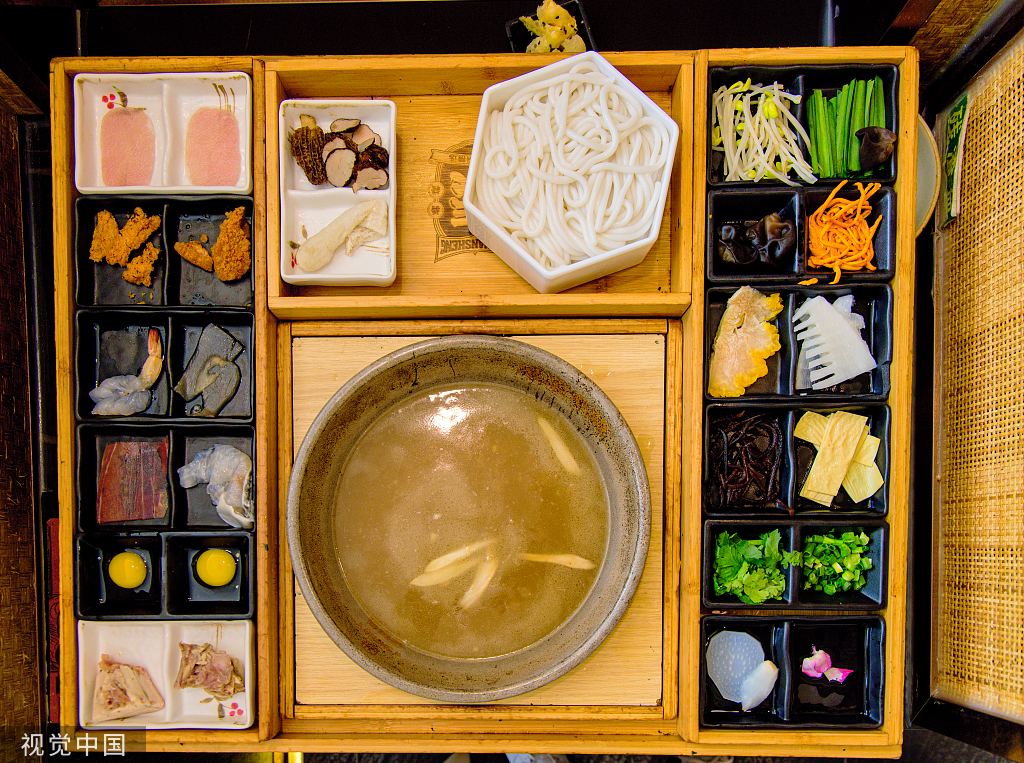
Photo: CFP
“Crossing-the-Bridge” Rice Noodles
One of the best-known dishes in China’s Yunnan Province, Guo-Qiao, or “Crossing-the Bridge” Rice Noodles, has centuries of history, and is now listed as part of China’s intangible cultural heritage. Despite its nationwide or even worldwide popularity, very few know in detail the roots of its unusual name—why does a bowl of noodles have to “cross the bridge”?
Local folklore tells that the origin of its name traces back to a bridge-crossing tale. In ancient southern Yunnan, it is said, a young scholar worked and studied on a lake island connected to his home village over a bridge, which his wife crossed every day to deliver his meals. The noodles, however, would get cold and soaked with soup on the way. The good and clever wife, by chance, discovered that a layer of oil on soup naturally retained the warmth. She was then inspired to box the soup and the noodles separately, and put the noodles into the hot soup just before eating. Thus, the smooth yet chewy texture of the noodles was masterfully preserved through this small touch—and people still do so when eating Yunnan Noodles centuries later today.
Gourmands and scholars, on the other hand, might offer a different interpretation. They believe Guo-Qiao is used as a cuisine metaphor, referring to the practice of putting the noodles and toppings into the hot soup. Similarly, we may find other Guo-Qiao dishes in Chinese cuisine, although less popularly known. For example, two thousand kilometers away from Yunnan in Jiangsu Province, there is a dish named “Jiang-Jun Guo-Qiao”, or literally “The General Crossing the Bridge”. Sliced fillets of black snakehead, the “general” in this case, are presented alongside a hot bowl of fish soup, into which they are dropped before being consumed.
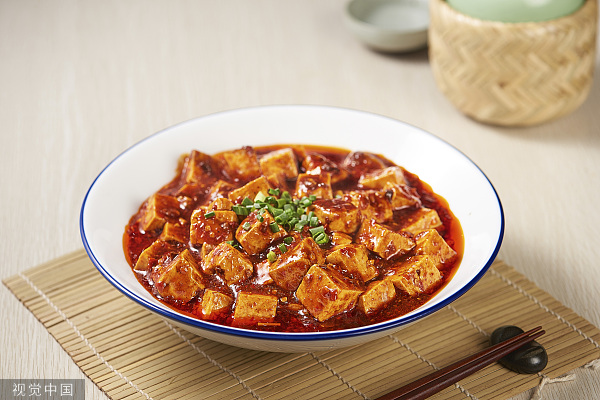
Photo: VCG
Ma-Po Tofu
The curious name of Ma-Po Tofu is not without perplexation. In Chinese, “Ma-Po” means a “pockmarked woman”—is it just another folkloric fancy, or was the dish’s creator really a Ma-Po?
Today, the restaurant chain “Chen Ma-Po” is still much renowned in Sichuan, and its house dish, as you may suppose, is still Ma-Po Tofu. The enterprise was first established by Mr. and Mrs. Chen, over 150 years ago in Chengdu, starting off as a small restaurant. The chef, Mrs. Chen, was nicknamed “Chen Ma-Po”, because of her pockmarked face. Her rich, tender, hot tofu, topped with fried beef mince, fresh garlic leaves, and a heavy layer of ground Sichuan peppercorn, has been a representative local dish since the late Qing Dynasty. Yet much about the life of the pockmarked chef was not recorded, nor was her full name.
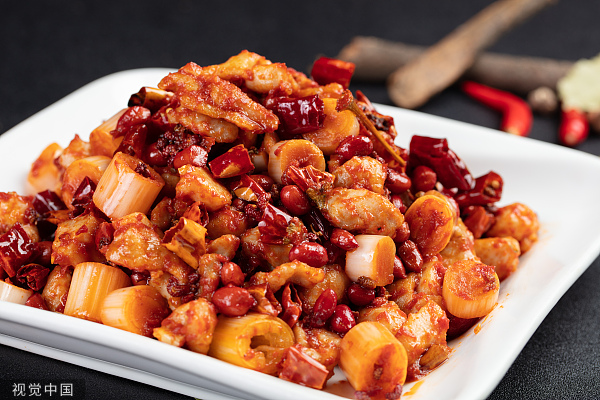
Photo: VCG
Kung-Pao Chicken
A favorite among even Western diners, Kung-Pao Chicken scarcely needs introduction. It is named after Ding Baozhen, who served as the governor of northern-east Shandong and southern-west Sichuan provinces during the Qing Dynasty; “Kung-Pao” was the honorary title bestowed on him posthumously, and Ding was subsequently addressed as “Ding Kung-Pao”.
During Ding’s tenure as the Sichuan governor, his private chef created a new dish, by adding a Sichuan twist of chilli and peppercorn to the traditional Shandong-styled chicken. The flavor of the new chicken dish is often referred to as “lychee”, or slightly sweet and sour, one of the twenty-four typical flavor types in Sichuan cuisine. Although the Sichuan Kung-Pao Chicken is more widely spread and known, there is also a Shandong version that joins the competition—whether the dish’s proper origin is in Sichuan or Shandong is still under debate.
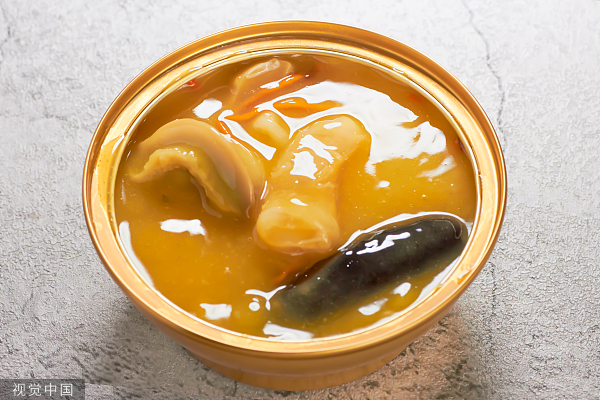
Photo: VCG
“Buddha Jumps Over the Wall”
Fo-Tiao-Qiang, or literally “Buddha Jumps Over the Wall”, is amongst the most esteemed state-banquet-level delicacies in China. Piling a wide range of luxurious ingredients, most commonly (and only to name a few) abalone, sea cucumber, fish maw, shark fin, scallop, Jinhua ham, pigeon egg, and rare mushrooms, Fo-Tiao-Qiang requires meticulous cooking for days with the finest stock and yellow wine. The result is, as you could imagine, an unimaginably rich and mellow dish, that once entertained President Ronald Reagan and Queen Elizabeth II.
The dish’s name seems to describe quite well its great sensual temptation, that even the strictly vegan monks cannot resist. Restaurant owners might tell you versions of folkloric stories in relation to a Buddhist succumbing to his stomach, or quote lines of classic poetry that praise Fo-Tiao-Qiang’s vegan-corrupting power, but I think historically the naming of the dish has nothing to do with these.
Fo-Tiao-Qiang originally was named in quite a literary manner: “Fu-Shou-Quan”, literally “All the Fortune and Longevity”, a metaphor for its exceptional luxury and nutrition. According to local records, Fu-Shou-Quan was first seen in the Ju-Chun-Yuan restaurant in Fujian around 1900, a dish that the governor of the province presented to his guests with pride. In the Fujian dialect (Hokkien), “Fu-Shou-Quan” sounds very similar to “Fo-Tiao-Qiang”, and the less cultivated diners may have misheard, and confused “All the Fortune and Longevity” with “Buddha Jumps Over the Wall”.