


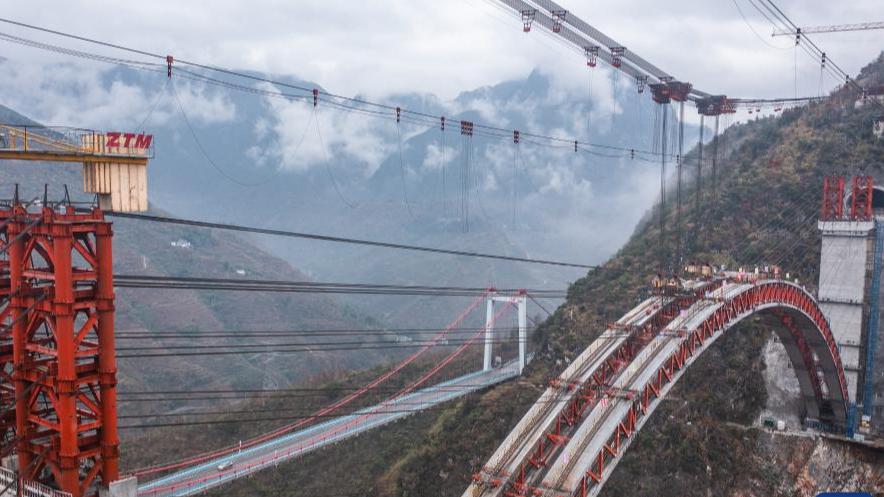
The construction site of Wumengshan grand bridge on Nayong-Qinglong Expressway in southwest China's Guizhou Province, January 11, 2024. (Photo: Xinhua)
Chinese engineers have developed innovative technologies to build bridges in astonishing mountainous area, setting fresh records in mega project construction.
Eighty-one individuals and 50 teams were bestowed the National Engineer Awards for their outstanding contributions to the field of engineering technology in Beijing on Friday.
One of the teams winning recognition is made up of engineers based in mountainous Guizhou Province in southwest China. The team has developed seven state-of-the-art technologies and built 12 world-leading bridges despite difficult geographic conditions, fragile ecological environment and other challenges.
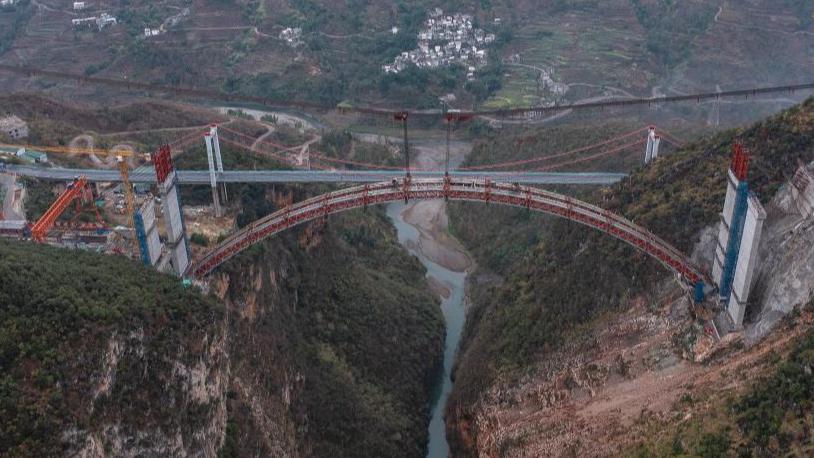
The construction site of Wumengshan grand bridge on Nayong-Qinglong Expressway in southwest China's Guizhou Province, January 11, 2024. /Xinhua
A world first
On January 11, the joining of the main arch of the Wumengshan grand bridge on the Nayong-Qinglong Expressway was completed. It is the first time a fully prefabricated hoisting technique has been used in a mountainous area anywhere in the world.
Zhang Shenglin, a member of the award-winning engineering team, told China Media Group (CMG) that in canyons within mountains, tunnels are built on both ends of the bridge.
"Traditionally, we have to use a large bridge erecting machine for construction. Instead, we adopted a hoisting system to install all of the components, which has improved efficiency," said Zhang, who is also the chief engineer of highway group affiliated to Guizhou Communications Construction Group.
Han Hongju, leader of the award-winning engineering team, told CMG that "when we built the Beipanjiang Bridge on the Guanxing Highway, there was no road (to the planned location)."
"All materials were transported by humans or horses. It is more than 10 kilometers from our base to the planned bridge. It took about four hours (for us to travel between them). We went out to the construction site early in the morning to do measure work for two or three hours, and returned right after that," added Han, who is also a chief engineer at Guizhou Communications Construction Group.
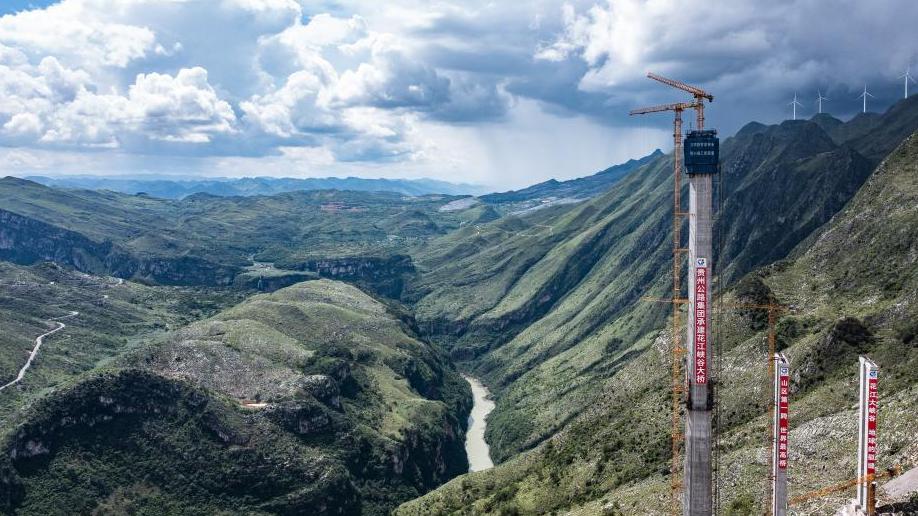
The construction site of the Huajiang grand canyon bridge in southwest China's Guizhou Province, August 2, 2023. (Photo: Xinhua)
Highest in the world
A suspension bridge across the grand canyon over the Huajiang River in southwest China's Guizhou Province is expected to become the highest in the world after it opens in 2025.
With a vertical height of 625 meters from the bridge deck down to the water's surface, the Huajiang grand canyon bridge has a total length of 2,980 meters.
The main span of the bridge is 1,420 meters, with a bridge floor that is 625 meters above the water surface. The main structure of the bridge was completed in 2024, and it's set to be put into use in early 2025.
Upon operation, the bridge will cut the travel time across the canyon from 70 minutes to just one minute. It is also expected to help promote tourism and rural revitalization in the region.
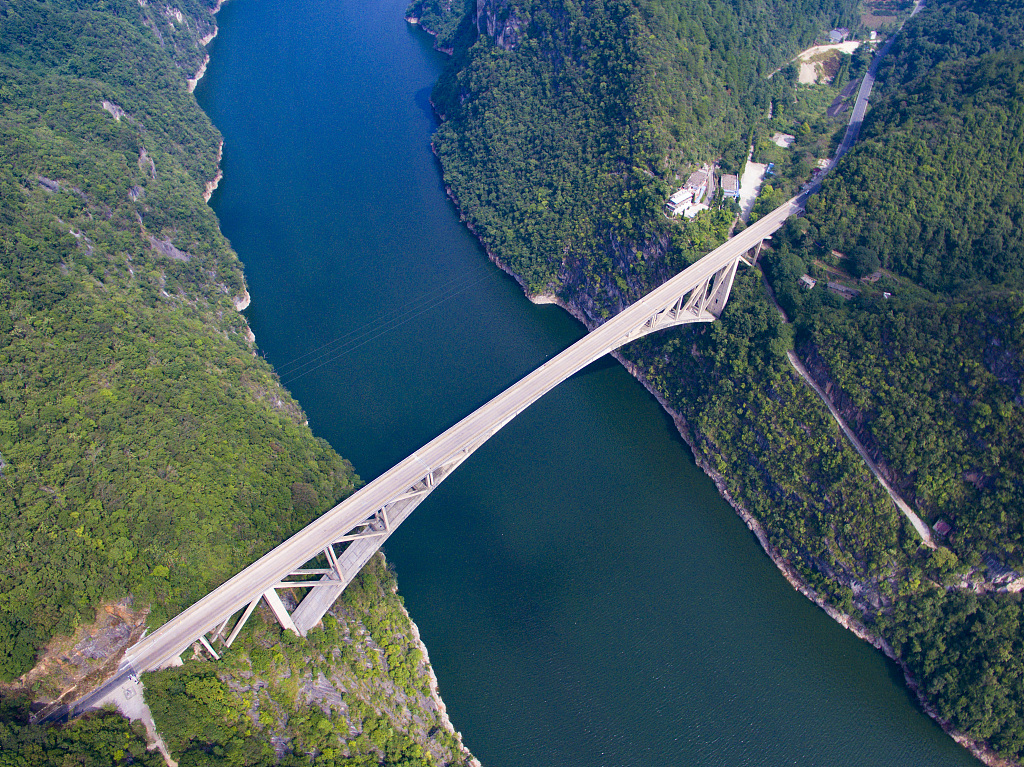
A view of the bridge across Jiangjie River in southwest China's Guizhou Province. (Photo: CFP)
Eco-friendly engineering
The bridge across Jiangjie River in Guizhou Province constructed by the award-winning team has not only facilitated local transportation but also brought about eco and economic benefits.
Mu Jinwei, a member of the engineering team, told CMG that "the materials we use for construction are all recycled earth and stone waste from roadbed construction. We have done detailed analysis and research, as well as a lot of experiments and engineering applications, to produce huge economic benefits."
"With breakthrough of machine-made sand concrete technology, the use of bridge construction alone has exceeded 100 million cubic meters, saving over 23 billion yuan (about $3.19 billion) in construction funds and offsetting carbon emissions by more than 3.3 million tonnes," added Mu, who is also deputy general manager and chief engineer at Guizhou Communications Construction Group.