


China's Spring Festival travel rush, the largest annual human migration worldwide, is a phenomenon that sees hundreds of millions of people return to their hometowns for family reunions during the country's most important festival.
Railway passenger trips in China hit record numbers on four consecutive days during this year's Spring Festival travel rush, with 14.25 million, 15.16 million, 15.29 million, and 16.07 million passengers between February 14 and 17.
As the busiest Spring Festival travel rush on record, these numbers highlight China Railway's robust transportation capacity and service standards, reflecting a dynamic and lively "flowing China."
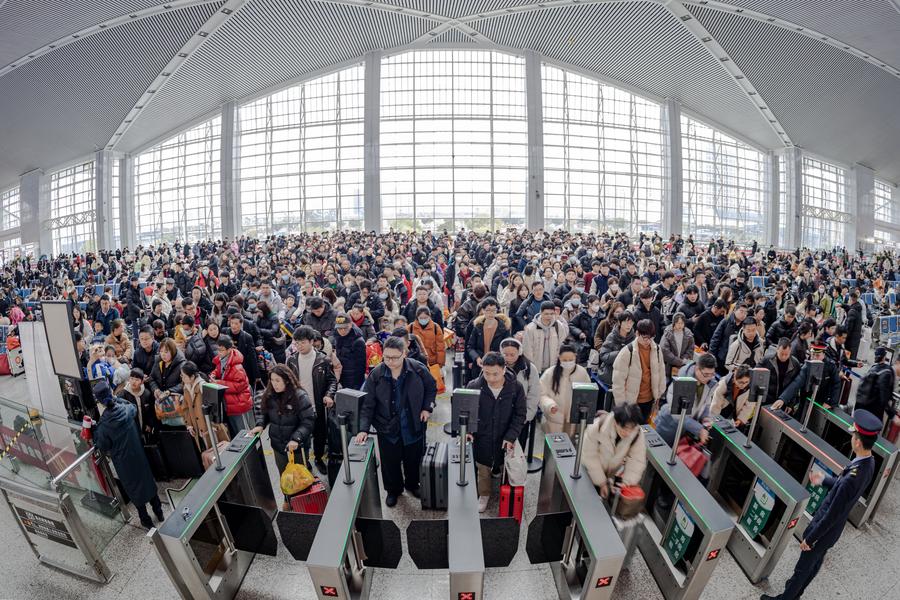
Passengers wait to board their trains at Wenzhou South Railway Station in Wenzhou, east China's Zhejiang Province, Feb. 17, 2024. (Photo: Xinhua)
The bustling passenger flow embodies confidence in China's railways, a testament to their rapid development.
Numerous high-speed railways have newly commenced operations. The Guiyang-Nanning high-speed railway allows travelers to enjoy Laoyou rice noodles in Nanning for breakfast and savor sour soup fish in Guiyang by noon. The Jinan-Zhengzhou high-speed railway connects Shandong and Henan provinces, offering service from provincial capitals Jinan to Zhengzhou in just 1.5 hours. The Fuzhou-Xiamen high-speed railway introduces Fujian Province's first 350-kilometer-per-hour railway service.
By the end of 2023, China's railway network spans 159,000 kilometers, including 45,000 kilometers of high-speed lines. The extensive transportation network connects cities and villages. With increased railway speeds, journeys during the Spring Festival travel have become quicker and more convenient.

An aerial drone photo taken on Jan. 26, 2024 shows bullet trains at a maintenance base in Nanjing, east China's Jiangsu Province. (Photo: Xinhua)
Amid the hustle and bustle and around-the-clock construction, China's railways showcase a remarkable scheduling capacity: China Railway's official online ticketing platform 12306 processes 1,000 tickets per second during peak hours; One thousand passengers enter Shanghai Hongqiao Station per minute during peak hours; High-speed trains depart from Zhengzhou East Station every 1.35 minutes; On the Beijing-Shanghai high-speed railway, trains run with a minimum interval of just three minutes.
Meeting the travel needs of tens of millions of daily passengers relies on intelligent dispatching systems and optimized schedules, emphasizing quality improvement and time efficiency. During this year's Spring Festival, China's railways operated about 12,800 passenger trains daily, with a 12.6 percent increase in passenger capacity compared to 2019.
During this year's Spring Festival travel rush, China's railways faced severe rain, snow, and icy conditions not seen since 2009. To combat this challenging weather, de-icing and snow melting equipment along the railways operated day and night, staff increased inspections and coordination efforts, and diesel-powered locomotives were kept on standby. By swiftly mitigating the impact of this adverse weather, China Railway demonstrated its strengthened emergency capacity, ensuring a smoother journey for those traveling home through the wind and snow.
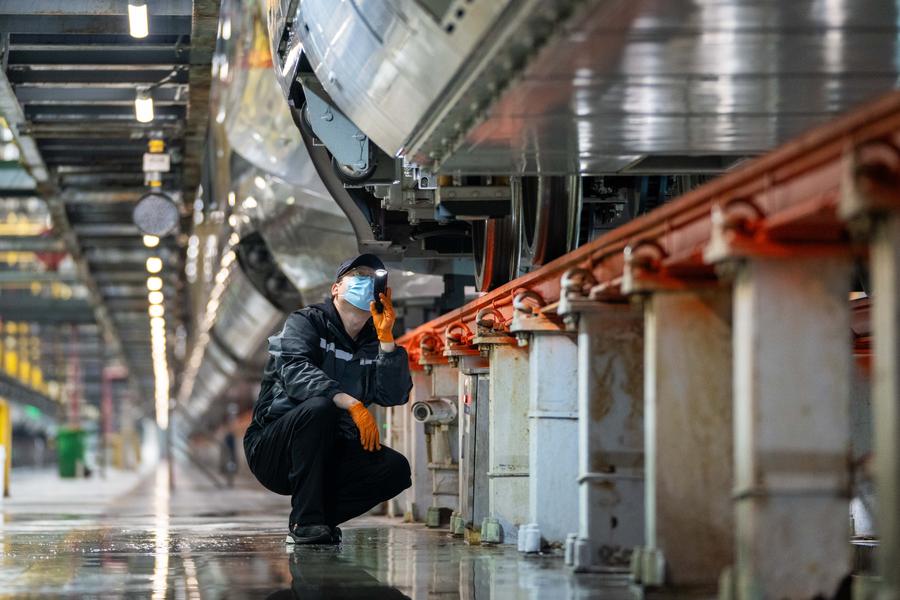
A mechanic checks a bullet train at a maintenance base in Changsha, central China's Hunan Province, Jan. 25, 2024. (Photo: Xinhua)
Alongside its growing hardware capabilities, China Railway's services are equally impressive.
In stations, baby care rooms have become a standard feature, complete with milk warmers, microwaves and diapers. Balloons, toys, books and games are provided on the train for children. Some high-speed trains departing from Xiamen, Fujian Province during this year's Spring Festival travel rush introduced a dedicated "children's carriage" to ease the concerns of families traveling with small children by providing their kids with more room and freedom to move. From baby changing rooms to barrier-free carriages, China Railway is increasingly addressing passenger needs, demonstrating a more meticulous and considerate approach.

Children have fun at Chongqing North Railway Station in Chongqing, southwest China, Jan. 26, 2024. (Photo: Xinhua)
The Spring Festival travel rush has changed immensely over the past 70 years.
In 1954, China's railway authorities established the Spring Festival Passenger Transport Office to address the Spring Festival travel rush phenomenon. Trips that took several days and nights by green trains decades earlier are now completed within a few hours by high-speed rail. In the past, people had to rush between railway stations and ticket agencies to secure tickets, but now they can simply purchase tickets with a swipe on their phone screens. Previously, stations were crowded with people sitting on the floor and stepping on one another's feet, but now they are lined with storefronts offering time-honored brands, trendy brands and high-quality goods from the Silk Road. In the old days, passengers had to bring instant noodles, steamed buns with pickled vegetables and hot water for their trips, but now people can enjoy a variety of delicious food onboard. These comparisons of Spring Festival travel then and now best illustrate the transformations of China's railways.
The Spring Festival travel rush serves as an important vantage point to witness China's economic and social evolution. Whether on the roads or on the tracks, everyone can feel the changes happening in step with the high-quality development of the new era, the acceleration of the Chinese path to modernization, and the enhancement of people's happiness and quality of life.
The accomplishments of China's railways increasingly shine as the Spring Festival travel rush continues to grow.
(Compiled by Zhu Yingqi, Lyu Mufei and Liu Lifeng)