


China's real economy's comprehensive financing cost has continuously decreased and the net interest margin (NIM) of banks has reached the lowest level in 20 years, according to recent data from Li Yunze, head of the National Financial Regulatory Administration.
In the context of the decline in deposit interest rates, the main driving force behind the decrease in net interest margin comes from the continuous decline in loan interest rates, becoming a concrete manifestation of banks surrendering profits for the real economy.
A bank's net interest margin is the ratio of net interest income to gross interest-earning assets. As commercial institutions, banks need to pay interest on deposits and gain interest from loans. The difference between the two is the banks' profit. The dropping NIM indicates a thinner interest difference between deposit and loan, meaning a declining profit.
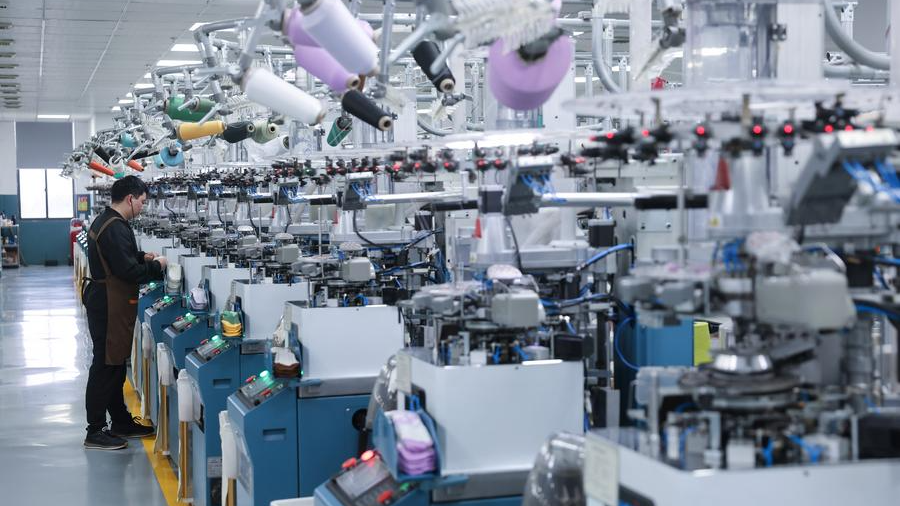
Intelligent machines produce socks in a workshop of a sock company in Zhuji City, East China's Zhejiang Province, March 24, 2024. (Photo: Xinhua)
Relevant data has fully proven this too. Regulatory indicators released by the National Financial Regulatory Administration show that the NIM of Chinese banking industries in the fourth quarter of 2023 dipped 4 base points to 1.69 percent from the previous quarter, and a 22-base-point drop year on year. Influenced by multiple factors, such as NIM and intermediate business revenue, commercial banks' net profit rose 3.2 percent year on year, with a growth rate 2.2 percent lower than that in 2022. In contrast to this, the weighted average interest rate on new corporate loans in December stood at 3.75 percent, 0.22 percent lower year on year, breaking record-lows and lowering companies' financing costs.
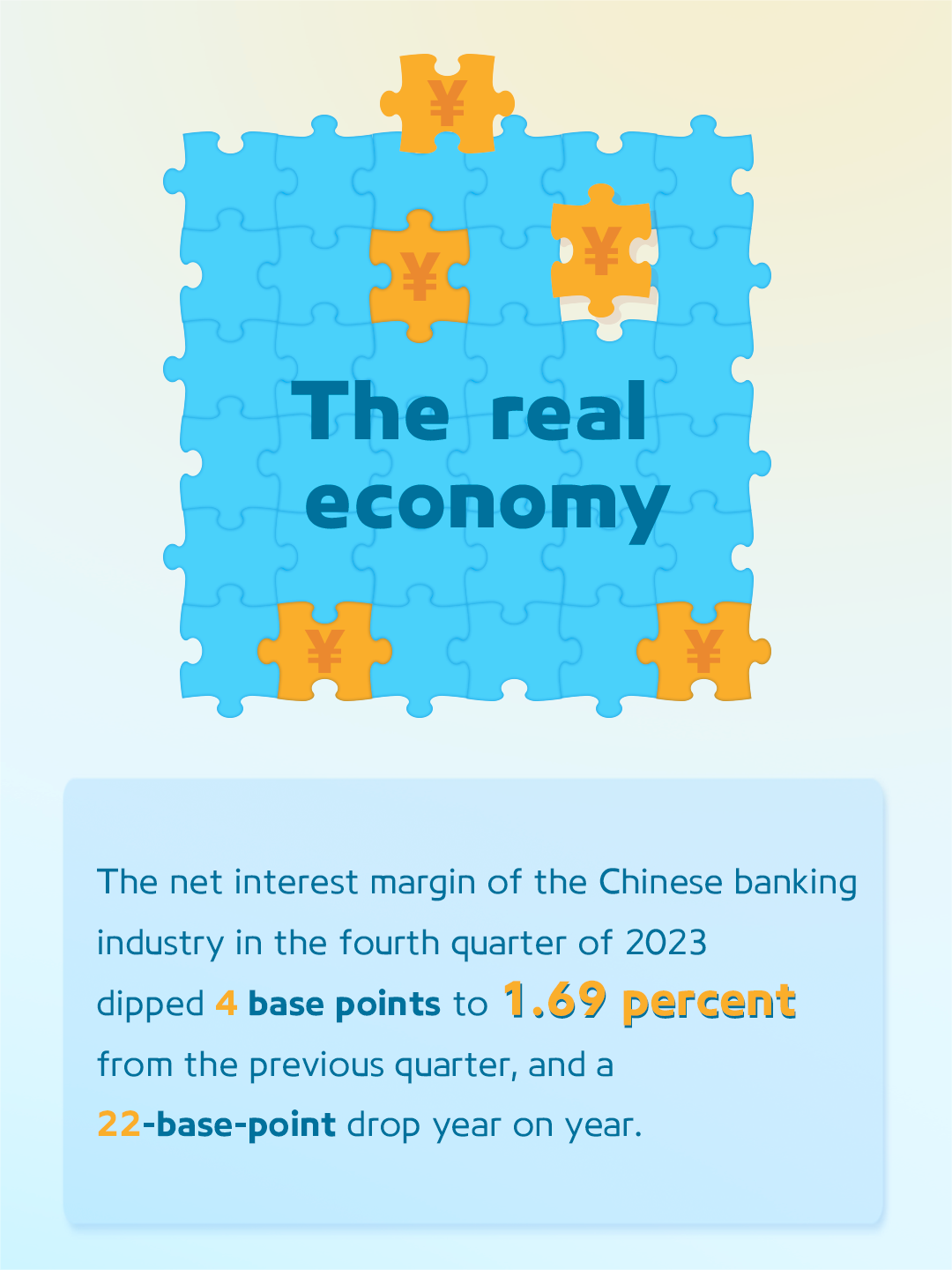
(Graphic: Lou Qingqing/People's Daily)
The economy is the flesh, while finance is the blood. The two must coexist and prosper together. On the one hand, economic development cannot live without the nourishment of financial vitality. On the other hand, economic stability and prosperity are the foundation of finance. Bank profits are built on the basis of enterprise development. Without sufficient profit margins or profitability in the real economy, banks cannot obtain sustainable development and profit space.
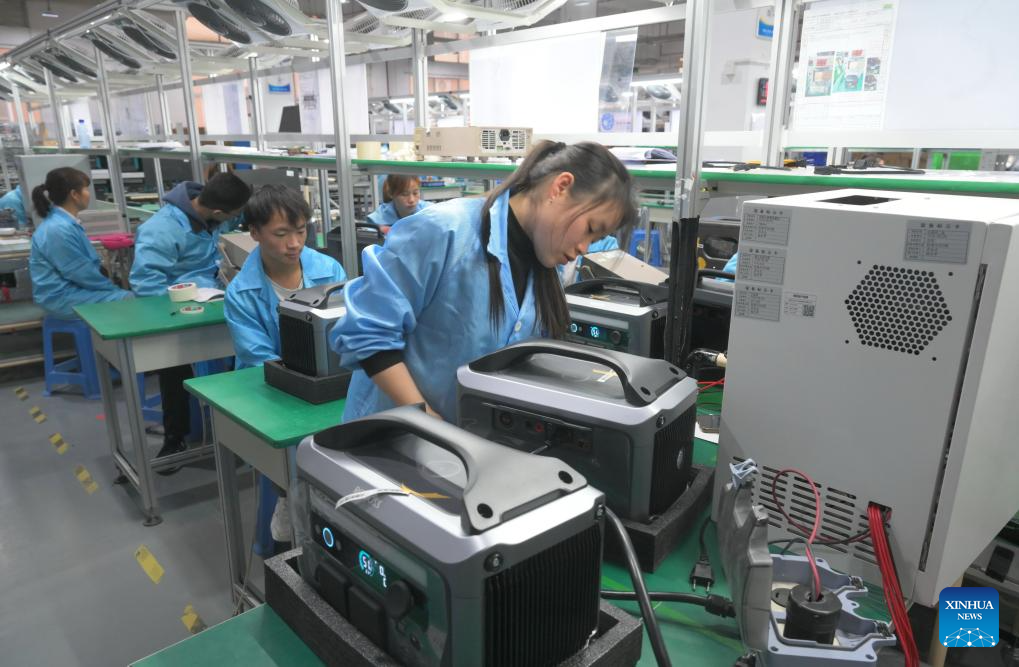
Workers work at Skytimes Green Energy Co., Ltd. in Fuzhou, Southeast China's Fujian Province, March 20, 2024. (Photo: Xinhua)
The reduction in net interest margin allows enterprises to obtain low-cost loans from banks, which can greatly reduce the burden of business development and allows enterprises to invest more funds in scientific research and innovation, transformation and upgrading, equipment updates and other fields, thus achieving high-quality development. Only by expanding the scale of the real economy, improving efficiency and enhancing quality, can banks obtain a solid foundation for high-quality development.
Only by pouring in fresh water while raising fish can fish thrive and the water be beautiful. In the short term, a decrease in the net interest margin of banks will put some pressure on their own operations and result in losses of some immediate benefits. In the long run, it will help the real economy achieve high-quality development, force the banking industry to improve its internal skills, promote a virtuous cycle of economy and finance, and make the banking industry stable and sustainable.
Reducing the reserve requirement ratio, guiding the downward trend of loan prime rate, introducing a deferred payment policy for principal and interest, and promoting financial institutions to reduce fees which benefits enterprises and the people. In recent years, China's financial system has adhered to the fundamental purpose of serving the real economy through financial services, continuously deepened supply side structural reform of finance, supported enterprises to overcome difficulties, transform and upgrade with solid financial support, and significantly improved the ability and efficiency of high-quality development of financial services.
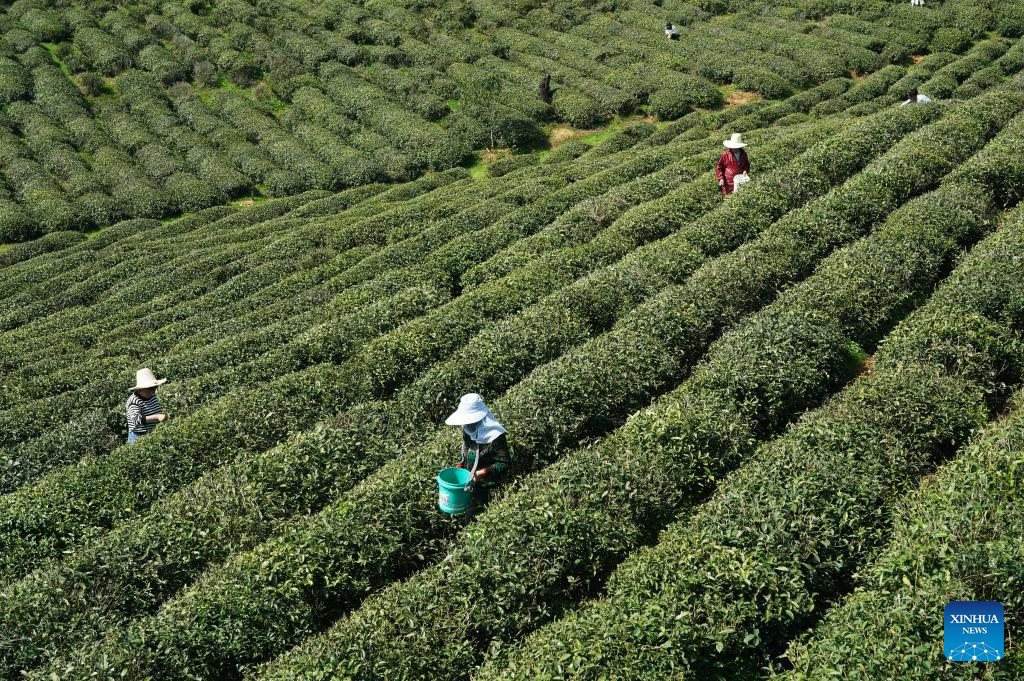
Farmers pick tea leaves at tea gardens in Ninghong Village in Xiushui County, East China's Jiangxi Province, March 28, 2024. (Photo: Xinhua)
By the end of 2023, the balance of green loan in yuan and foreign currencies increased by 36.5 percent year on year, nourishing lucid waters and lush mountains with financial vitality. The agriculture-related loan balance in yuan and foreign currencies increased by 14.9 percent year on year, moistening the fertile land of agriculture, rural areas and farmers with financial vitality. The balance of loans for technology-based small and medium-sized enterprises in yuan and foreign currencies increased by 21.9 percent year on year, nurturing the flower of innovation with financial vitality.
In 2023, China's GDP exceeded 126 trillion yuan ($17.51 trillion), a year-on-year increase of 5.2 percent. The increment of social financing increased by 3.41 trillion yuan compared to the previous year and Renminbi loans issued to the real economy increased by 1.18 trillion yuan year on year. This confirms the importance of finance in promoting economic and social development.
Finance is the lifeblood of the national economy. We should adhere to the concept of economic and financial integration, and coordinate the high-quality development of the economy and finance so that the source of financial vitality will better empower the high-quality development of China's economy.
(Edited by Zhu Yingqi, Li Bowen and Yang Yang)