


Chang'e-6 mission, which collected first samples from the moon's far side, may unravel mysteries of solar system.
On July 20, 1969, US astronaut Neil Armstrong became the first person to step onto the Moon's surface as part of the Apollo 11 mission. To celebrate this historical event, July 20 was designated as International Moon Day.
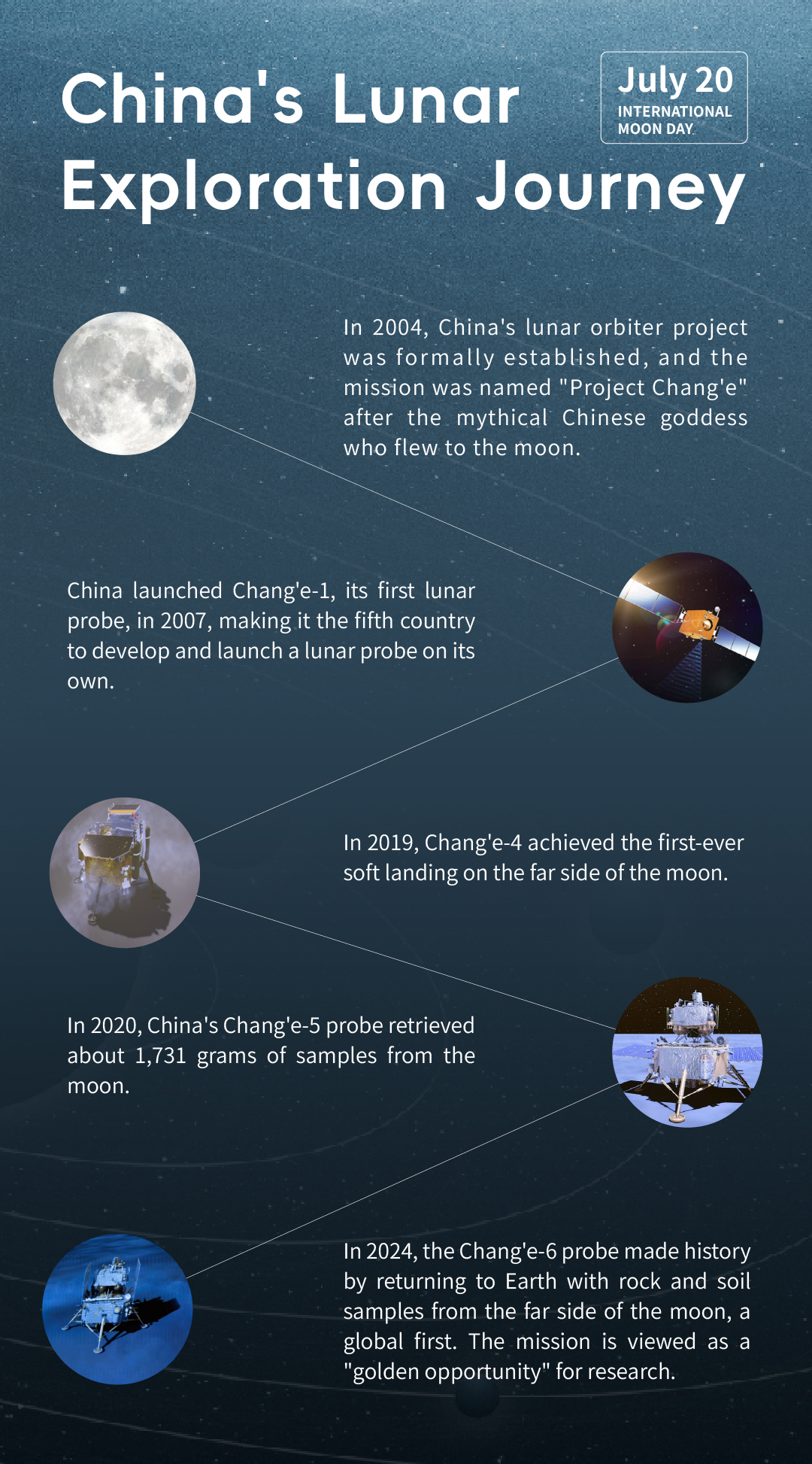
Since ancient times, the moon has been the subject of countless legends. From the launch of Chang'e-1 to the return of Chang'e-6 with lunar soil from the far side of the moon, China has transformed myth into reality.
2024 marks the 20th anniversary of China's lunar exploration program. Let's take a look at the remarkable moments of China's lunar exploration journey.
Chang'e-6 samples are anticipated to unravel mysteries of Moon.
Unlike past US and Soviet missions, which collected samples from the moon's near side, China's Chang'e-6 probe was the first to retrieve samples from the far side.
The far side of the moon has many secrets. Chinese scientists anticipate that the returned samples will answer questions about the geographic differences between the moon's two sides.
Although the samples weigh only 1,935.30 grams, their value is greater than gold. They may hold clues to the moon's past and even the secrets of the solar system.
Samples especially from the moon's South Pole-Aitken Basin, an impact crater created more than four billion years ago, may differ significantly from the samples from the moon's near side. These samples can promote the study of early impact history, early impacts on Earth and shed light on the solar system's formation and early evolution.
The Chang'e-6 samples may contain the following components: rock fragments from the lunar surface, mineral grains, glass materials formed by impacts, and trace elements such as copper, gold and Helium-3.
(Produced by Tang Yixin, Yang Mengxiao and He Jiahao)