


Thirty-six forestry officials and experts from Ethiopia, Nepal, Nigeria, Tanzania, Thailand, Turkey and Zimbabwe visited Jilin Province in Northeast China on September 16 for a five-day field trip focused on wildlife conservation.
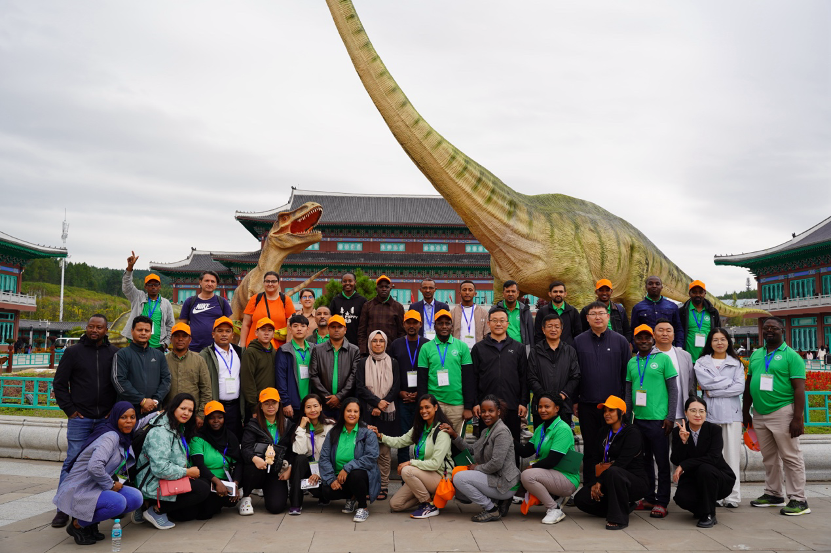
Participants gather for a group photo in front of the Yanji Dinosaur Museum in Yanji, Northeast China's Jilin Province. (Photo: Li Yuanxin/People's Daily)
The visit, sponsored by the Ministry of Commerce of the People's Republic of China (MOFCOM) and organized by the National Academy of Forestry and Grassland Administration (NAFGA), is part of the Seminar on Wildlife Conservation and the Convention on International Trade in Endangered Species of Wild Fauna and Flora (CITES) Implementation for Developing Countries, which aimed to highlight China's conservation practices and CITES compliance. Participants engaged in lectures, discussions and field tours to deepen international cooperation in wildlife conservation.
A key stop on the tour was a newly-built natural science museum dedicated to the Northeast China Tiger and Leopard National Park, which spans parts of Jilin and Heilongjiang provinces. Established in 2017, the park is dedicated to protecting endangered species like the Siberian tiger and Amur leopard. At the museum, the participants were briefed on China's efforts to resolve human-tiger conflicts, monitor wildlife and develop educational platforms.

Participants listen to the introduction of conservation efforts for the Siberian tiger and Amur leopard. (Photo: Li Yuanxin/People's Daily)
According to the Northeast China Tiger and Leopard National Park Administration, Hunchun city, the core area of the park, has a forest coverage rate of 86 percent and is home to over 1,270 species of wild flora and fauna. China's conservation work, including rigorous protection measures and the restoration of a complete food chain, has increased the populations of both species, with the number of Siberian tigers rising from 16 in 1999 to about 70 and Amur leopards growing from 12 to around 80.

Participants learn about tiger and leopard conservation through interactive displays. (Photo: Li Yuanxin/People's Daily)
Participants also explored wetland environments and sites like Xiawazi and Huilongfeng villages, where they learned about efforts to protect migratory fish.
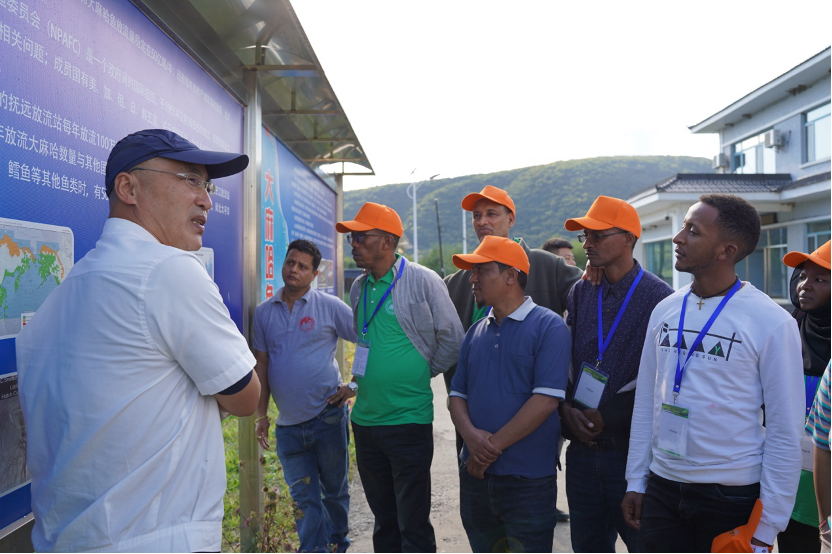
Participants listen to a staff member explain fish conservation efforts. (Photo: Li Yuanxin/People's Daily)
The visiting experts praised China's use of technology and scientific measures in its conservation work: Fahadi Shaban Jumanne, an official of the Ministry of Natural Resources and Tourism of Tanzania, commended China's "scientific and effective" conservation approach while Zimbabwean ecologist Thembelani Mbanga expressed interest in adopting similar technology in his home country.

A participant asks questions during the lecture. (Photo: Li Yuanxin/People's Daily)
Ethiopian researcher Taye Lemma Geleta said the trip offered valuable insights for improving local wildlife conservation efforts.