


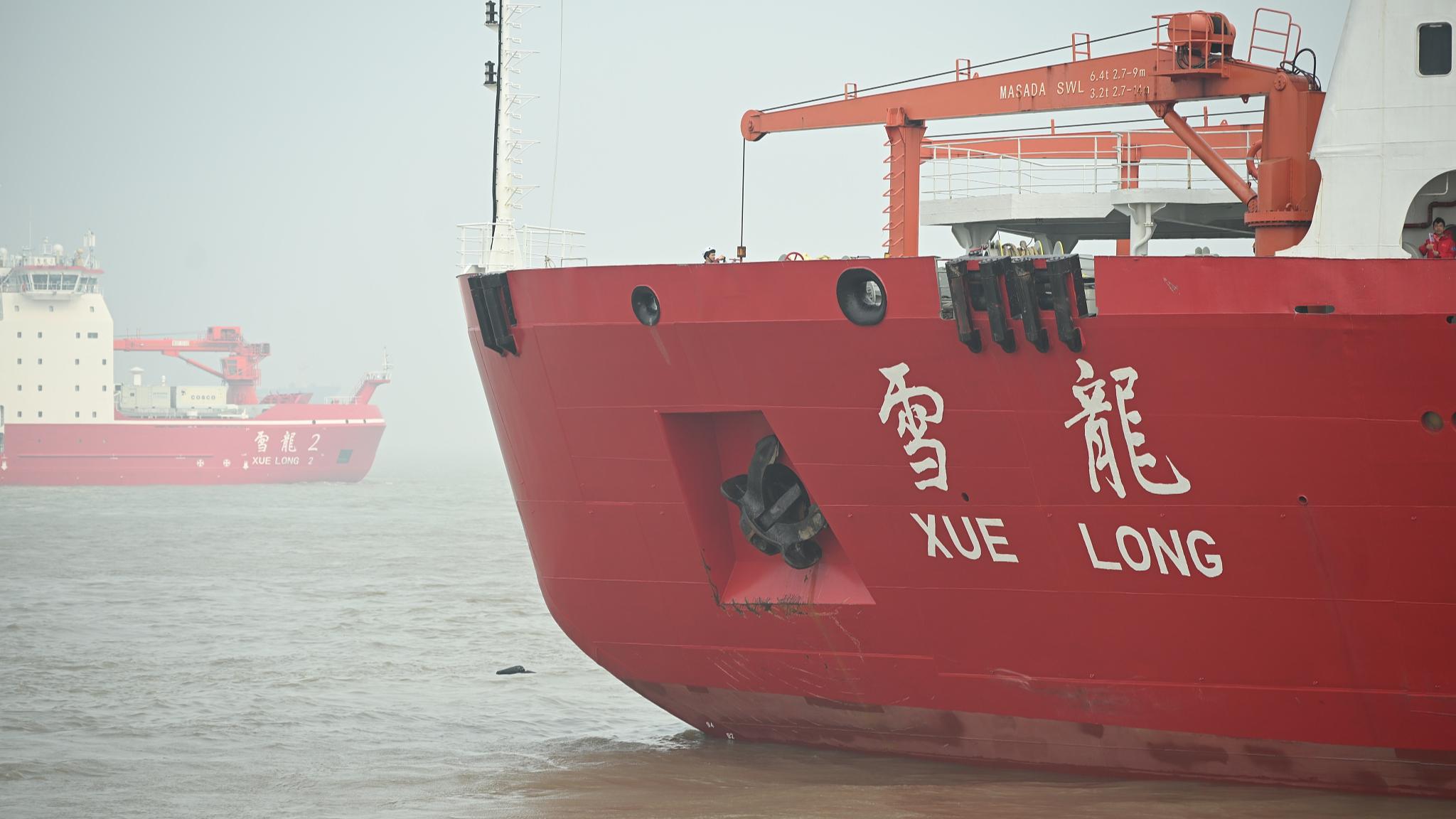
China's polar research icebreaker Xuelong has commenced its 42nd Antarctic expedition. (Photo: VCG)
China's polar research icebreaker Xuelong, "Snow Dragon" in English, has begun its 42nd Antarctic expedition while sailing toward the Amundsen Sea.
On January 16, members of the Antarctic expedition team deployed the first expendable temperature-depth profiler (XBT) of this voyage amid four-meter swells and strong westerly winds, signaling the formal start of marine survey operations.
According to Xinhua, a team of 31 scientists from 12 Chinese research institutions and universities will conduct fieldwork from mid-January to mid-February. The mission focuses on the Amundsen Sea and parts of the Ross Sea, aiming to study marine ecosystems and their responses to environmental change.
Researchers will collect physical and biological data from the mid- and upper-ocean layers, analyze nutrient structures, and monitor the distribution of key species. The survey will also include seabed topography studies to improve understanding of underwater landforms in the region.
The Amundsen Sea is among Antarctica's most climate-sensitive areas, making it a critical focus for international polar and climate research.
China has conducted multidisciplinary surveys in the Amundsen Sea for eight consecutive years since 2018. Wei Fuhai, chief scientist and head of China's 42nd Antarctic expedition, told Xinhua that such long-term, continuous observations are critical for capturing complex and rapid oceanic changes and will provide valuable data for assessing the impacts of global climate change on marine ecosystems.
He added that the current expedition will also deploy new eco-mooring arrays, apply advanced krill trawling systems, and test domestically-developed unmanned observation equipment, leveraging these technologies to enhance China's Antarctic marine research