


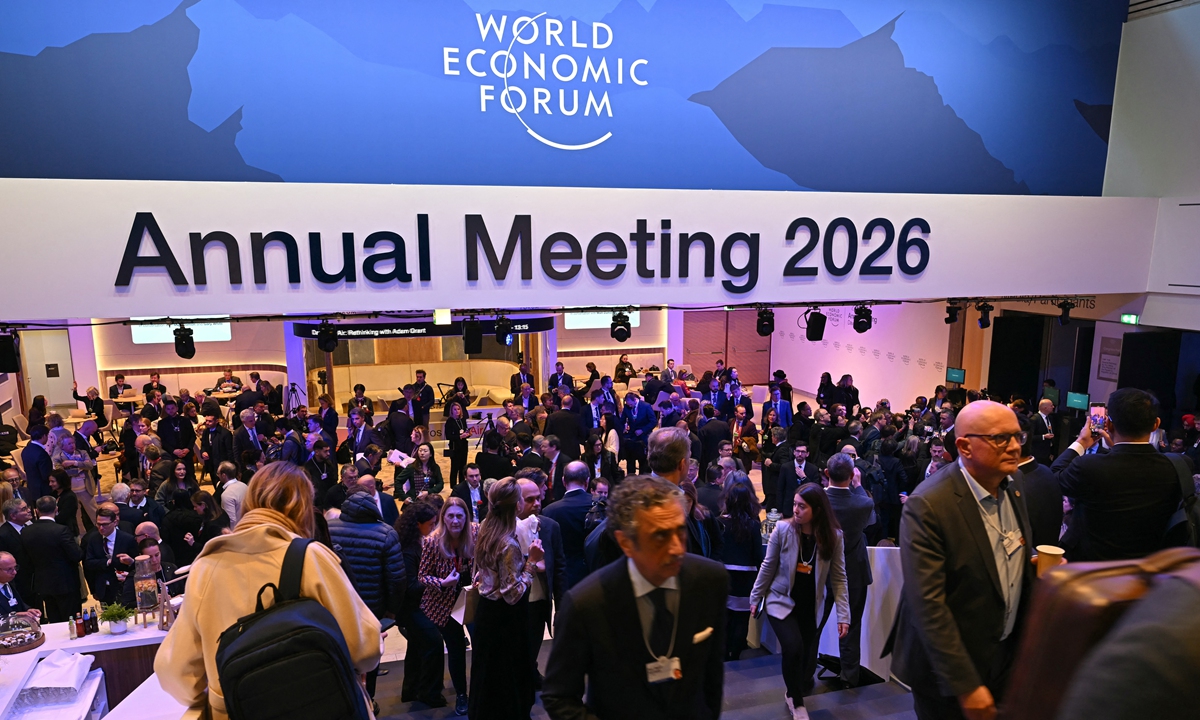
Visitors attend the World Economic Forum annual meeting in Davos on January 20, 2026. The World Economic Forum takes place in Davos from January 19 to 23. (Photo: AFP)
China calls for the firm support of free trade, vowing to steadfastly uphold multilateralism and work to build a more just and equitable international economic and trade order, Chinese Vice Premier He Lifeng said on Tuesday in his address at the World Economic Forum in Davos, Switzerland, Xinhua News Agency reported.
In his address at the forum, He put forward four key points: First, we must firmly support free trade and jointly promote an inclusive and universally beneficial economic globalization. Second, we must steadfastly uphold multilateralism and work to build a more just and equitable international economic and trade order. Third, we must adhere to win-win cooperation, strive to enlarge the pie of cooperation together, and collaborate to address development challenges. Fourth, we must uphold mutual respect and equal consultation, make effective use of dialogue to properly manage differences and resolve issues. He also stressed that China's development will bring significant opportunities to the world.
The Vice Premier's remarks came amid the World Economic Forum (WEF) Annual Meeting 2026 kicked off on local time Monday in Davos, at a time when the world is facing sluggish economic growth as well as rising unilateralism.
Chinese experts said that with the theme of "A Spirit of Dialogue," this year's WEF will offer a platform for attendees to resolve differences through negotiation, noting that China's presence sends a strong message in defense of multilateralism and the country brings stability to the world through tangible actions.
Multilateralism in focus
"In the context where unilateralism is disrupting the global economic and trade order, the current forum takes 'A Spirit of Dialogue' as its theme, stressing the need to address differences through dialogue and consultation in order to safeguard and enhance the multilateral framework," said Li Yong, an executive council member of the China Society for WTO Studies.
According to the WEF, it has brought together nearly 3,000 leaders from various sectors across more than 130 countries. The program will be structured around five key global challenges including "How can we cooperate in a more contested world?" and "How can we unlock new sources of growth?"
During his attendance at the World Economic Forum Annual Meeting, He Lifeng jointly met with President of the Swiss Confederation Guy Parmelin and Vice President Ignazio Cassis, saying that China is willing to strengthen high-level exchanges with Switzerland and deepen bilateral and multilateral cooperation. The Swiss side expressed its expectation to accelerate negotiations on upgrading the China-Switzerland Free Trade Agreement with China, and to jointly support multilateralism and free trade. He Lifeng also held separate meetings upon request with US Treasury Secretary Scott Bessent and British Chancellor of the Exchequer Rachel Reeves, as the respective co-chairs of the China-US economic and trade consultation mechanism and the China-UK economic and financial dialogue mechanism, exchanging views on relevant issues in the China-US and China-UK economic and trade fields, Xinhua reported.
"The WEF is a platform for open dialogue and exchange, and China's participation aligns with the very spirit of the forum. China has consistently delivered a stable and predictable message at Davos. In today's world of constant flux and uncertainty, where global concern about future development is widespread, China's remarkable degree of certainty and predictability provides an important anchor of stability for the world," Zhou Mi, a senior researcher at the Chinese Academy of International Trade and Economic Cooperation, told the Global Times on Tuesday.
Li noted that as a staunch supporter and defender of multilateralism, China has, through its calls for multilateralism and further opening-up, not only demonstrated its unwavering commitment to a free and open trading system, but also injected confidence into like-minded countries and regions to promote free trade.
"While fully complying with multilateral trade and economic rules, China continues to explore new frontiers of openness by expanding market access, reducing investment barriers, and creating favorable conditions for the emergence and growth of various emerging technologies and industries. As a result, the country's opening-up has become an important global benchmark and reference," Zhou said.
The annual Central Economic Work Conference, which was held in December, underscored the need to steadily advance institutional opening up, expand self-initiated opening up in the service sector in an orderly manner, and make solid progress in developing the Hainan Free Trade Port. The Recommendations of the Central Committee of the Communist Party of China for Formulating the 15th Five-Year Plan said that China "must continue to expand opening up at the institutional level, safeguard the multilateral trading system, and promote broader international economic flows."
"From policies to concrete moves, China has never been merely rhetorical in its commitment to upholding free trade and promoting opening-up to the outside world; it has always been a resolute implementer," Li noted.
China's call for multilateralism and free trade has caught the attention of some foreign media outlets. In a Reuters report, it mentioned Vice Premier's remarks on that China is willing to leverage the advantage from its "mega-sized market" and "more vigorously" expand imports. Bloomberg reported that "Speaking in Davos, He presented China as an advocate of cooperation, free trade and multilateralism."
Bringing opportunities
China's GDP grew at 5 percent year-on-year to 140.19 trillion yuan ($20.13 trillion) in 2025, data from the National Bureau of Statistics (NBS) showed on Monday, meeting the annual growth target of around 5 percent and surpassing the 140-trillion-yuan threshold for the first time.
"The robust figures have not only laid a crucial foundation for a strong start to the 15th Five-Year Plan (2026-30), but also provided a crucial safeguard for the sustainable development of the world economy," Tian Yun, a Beijing-based economist, told the Global Times.
LONGi, a Chinese solar tech giant said in an article shared with the Global Times on Tuesday that during this year's WEF, the company will participate in multiple dialogues to share its ideas and achievements in energy equity, system transformation and sustainable development, while working with others to explore how technological innovation and global cooperation can help advance the goal of affordable clean energy for all.
On Tuesday, China's National Development and Reform Commission (NDRC) said that it will this year start to study and formulate an action plan to expand domestic demand during the period of 2026-2030, to create "new demand through new supply by providing strong innovative measures and other supports." Meanwhile, China's Ministry of Finance announced on Tuesday that it will continue to pursue a more proactive fiscal policy in 2026.
"No matter how the external environment changes, China will follow its own path through pragmatic actions, providing the world with development opportunities through the stability of its own development," Zhou noted.