


BEIJING, Jan. 25 (Xinhua) -- China has successfully conducted its first metal 3D printing experiment in space, a significant leap forward for its in-orbit manufacturing capabilities.
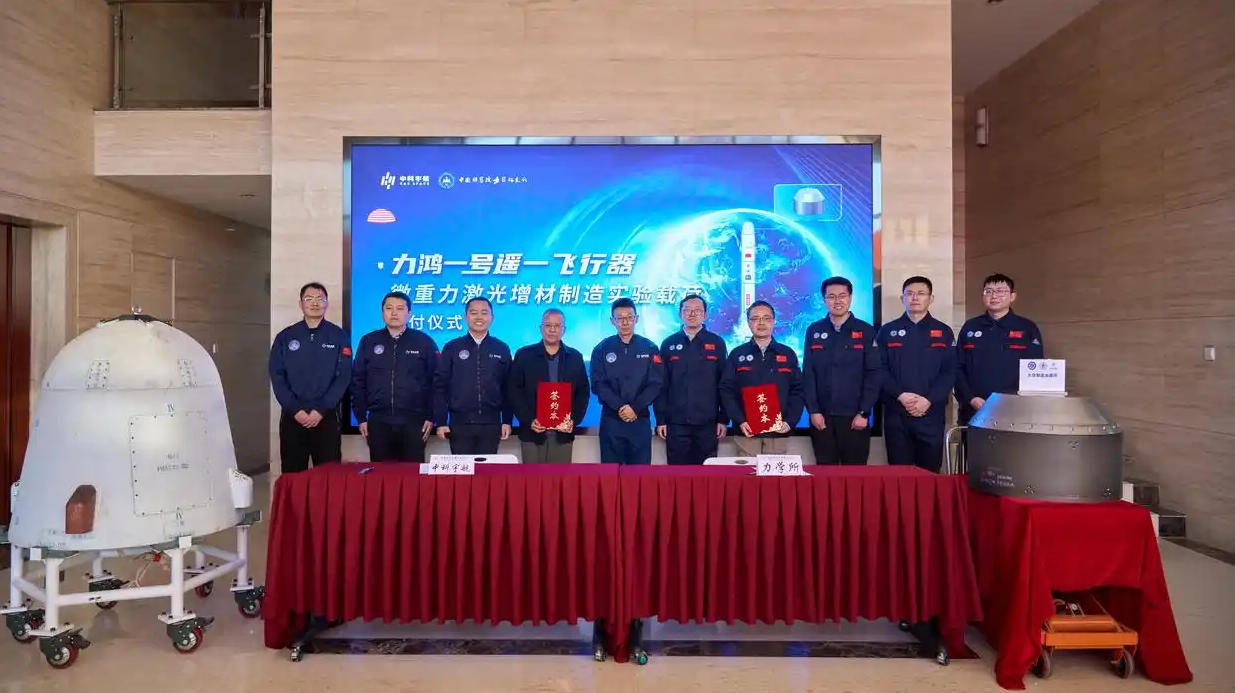
Photo: CAS Space
The breakthrough experiment was performed by a retrievable scientific payload developed by the Institute of Mechanics under the Chinese Academy of Sciences (CAS), the CAS announced on Saturday.
The pioneering payload hitched a ride to space aboard the Lihong-1 Y1 suborbital vehicle, a commercial recoverable spacecraft developed by the Chinese aerospace enterprise CAS Space for space tourism.
This vehicle successfully completed its inaugural test flight from the Jiuquan Satellite Launch Center in northwest China on Jan. 12.
According to the CAS, after the Lihong-1 Y1 crossed the Karman line, boundary separating Earth's atmosphere and outer space, and reached at an altitude of approximately 120 kilometers, the experiment autonomously fabricated metal components in the microgravity environment.
This successful mission marks a transition of China's space-based metal additive manufacturing technology from "ground-based research" to a new phase of "in-space engineering verification," elevating its overall technological capability to the world's forefront, the CAS said.
This breakthrough will strongly propel the development of China's space manufacturing technology and serve as a key enabler for future space infrastructure development, it noted.
Conducting metal additive manufacturing in the unique space environment is far more complex than on Earth.
The research team has overcome a series of core challenges, including stable material transport and forming under microgravity, full-process closed-loop control, and high-reliability coordination between the payload and the launch vehicle, according to the CAS.
Following the experiment, the payload capsule made a safe parachute-assisted landing and was promptly recovered. Scientists have now obtained invaluable first-hand data, including the dynamic characteristics of the melt pool, material transport, solidification behavior, and the geometric precision and mechanical properties of space-printed parts.
The Lihong-1 Y1, noted for its low launch cost and high flexibility, is proving to be a reliable testbed.
In addition to the metal 3D printing facilities, the onboard payload also included a batch of precious rose seeds for an agricultural research project.
The spacecraft will be developed for multiple reuse purposes. Its deputy chief designer, Wang Yingcheng, said that extensive tests are now underway to add crew-life-support and high-reliability escape technologies, which will boost low-cost suborbital scientific experiment capabilities and commercial space tourism possibilities.