


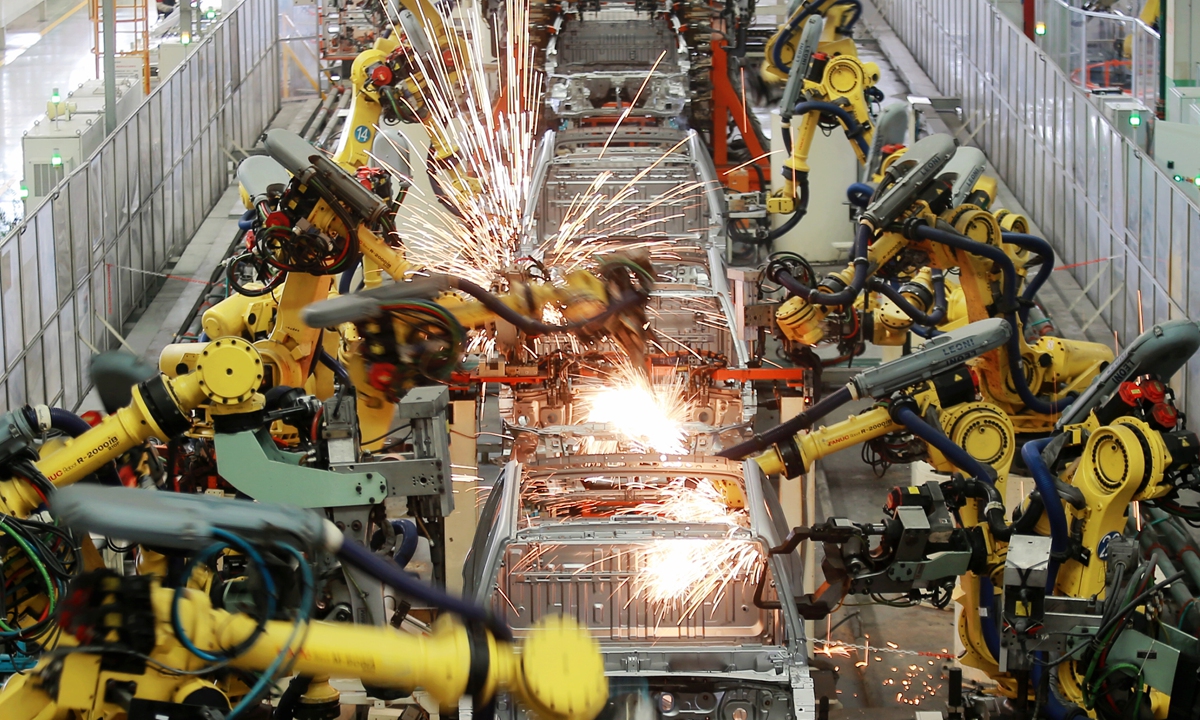
Industrial robots carry out welding operations in an intelligent workshop of an automobile manufacturer located in Jiangdu Hi-tech Industrial Development Zone, Yangzhou, East China’s Jiangsu Province, on October 18, 2024. China's GDP grew 4.8 percent year on year in the first nine months of 2024, data from the National Bureau of Statistics (NBS) showed on the day. (Photo: VCG)
A good number of provincial level governments in China have recently released their economic growth targets for 2026, with a strong focus on expanding research and development and increasing investment on innovation to drive growth.
South China’s Guangdong Province has set its 2026 GDP growth target at 4.5-5.0 percent, with local budget revenue projected to rise by about 3 percent and average household income to grow in lockstep with its GDP growth, CCTV News reported on Monday.
According to its provincial government work report, Guangdong pledged to accelerate the integration of technological innovation, targeting total R&D spending of 535 billion yuan ($76.9 billion) and an R&D intensity of 3.6 percent. Such efforts have made the Shenzhen-Hong Kong-Guangzhou innovation cluster in the Guangdong-Hong Kong-Macao Greater Bay Area the world's top innovation cluster, according to the work report.
The report outlines a number of plans, including 11 Guangdong companies being named among the world's top 100 listed humanoid robot firms, and an anticipated low-altitude flight scale of 20.6 million flights. Key sectors for expansion include new energy, new materials, intelligent connected vehicles, intelligent robots, pharmaceuticals and medical devices, aerospace, integrated circuits, the low-altitude economy, and bio-manufacturing.
Meanwhile, the province will also cultivate future industries such as 6G, embodied intelligence, gene therapy, brain science and brain-computer interfaces, hydrogen and advanced nuclear energy, deep-sea exploration and quantum technologies, CCTV News reported.
And, Central China’s Henan Province unveiled an average GDP growth of about 5 percent during the 15th Five-Year period (2025-30). The province plans to press ahead with strengthening agriculture, manufacturing, science and education, digital intelligence, transport, and cultural tourism, according to the website of Henan provincial government on Monday.
The work report calls for innovation-driven development tailored to local conditions, deeper integration of education, science and talent, and closer alignment of technological and industrial innovation. Targets include annual R&D expenditure growth of more than 10 percent and raising the share of strategic emerging industries to 30 percent of output among major industrial enterprises, while keeping the manufacturing size stable and growing at reasonable pace.
Meanwhile, in Beijing’s government work report delivered on Sunday, Mayor Yin Yong forecast 2026 GDP growth at about 5 percent. Beijing’s strategy stresses developing new quality productive forces, upgrading traditional industries, laying out future industries and consolidating the real economy, the Beijing Youth Daily reported.
Han Wei, deputy director of the Beijing municipal commission of development and reform, said investment must play a key supporting role: Beijing’s investment scale is expected to top 1 trillion yuan in 2026, with total planned investment exceeding 1.4 trillion yuan across science and technology, infrastructure and livelihood projects. The city will also introduce at least 200 billion yuan worth of major projects to attract private capital.
And, North China's Tianjin has set its main expected targets for 2026 economic and social development, according to Tianjin Fabu, the city's official WeChat on Monday. The targets include regional GDP growth of 4.5 percent; a 2 percent increase in local budget revenue; improved quality and efficiency of fixed asset investment; consumer prices rising by about 2 percent; household income growingy in step with economic growth; and meeting the national targets for energy saving, pollution control and carbon reduction, according to Tianjin Fabu.
The economic growth targets and action plans outlined at their annual legislative sessions revealed a strategy emphasizing faster R&D growth, the development of new quality productive forces and sizeable investment to support innovation-led economic growth, Wang Peng, an associate research fellow at the Beijing Academy of Social Sciences, told the Global Times on Monday.
The provincial authorities’ plans underscore the dual focus on both the quantity and quality of growth. The goal is to shift China’s regional economy toward higher value-added, innovation-driven sectors, Wang said, adding that they signaled continued public support for cutting-edge technology — from artificial intelligence and robotics to biotech, quantum and advanced energy — and a heavy emphasis on mobilizing investment to accelerate industrial upgrading.