


China is planning to launch a new solar exploration satellite, Xihe-2, between 2028 and 2029 to the fifth Lagrange (L5) point of the solar–terrestrial system for solar probing and space weather monitoring, according to China Media Group on Saturday.
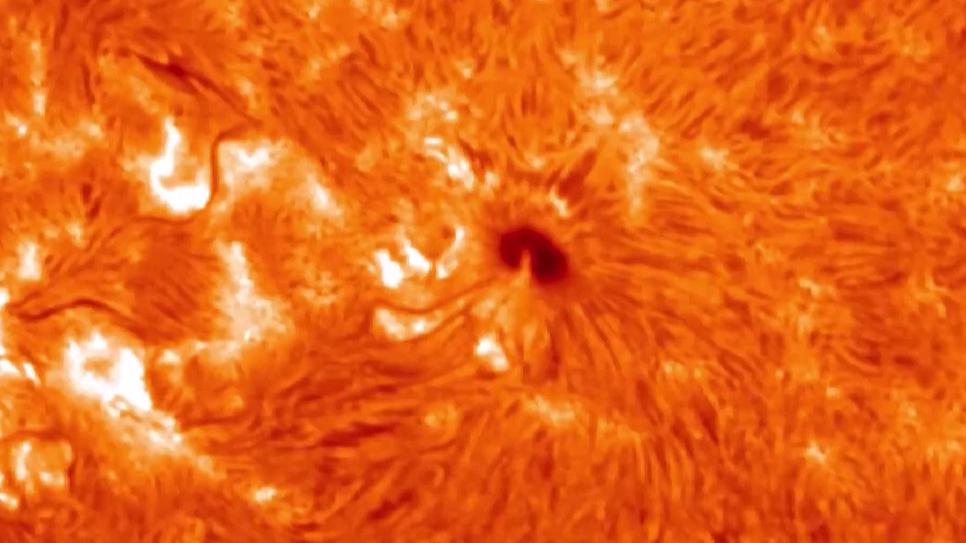
Image of solar activity taken by Xihe satellite. (Photo: VCG)
Xihe-2, also known as the space mission of the Lagrange-V Solar Observatory, was proposed by Nanjing University, the China Meteorological Administration, and the Shanghai Academy of Spaceflight Technology.
The solar probe will be deployed to carry out high-precision detection of magnetic fields, reveal three-dimensional solar eruptions and forecast space activities, according to Professor Fang Cheng of Nanjing University, one of the satellite's designers.
The fifth Lagrange point, located approximately 150 million kilometers from Earth, is a gravitational equilibrium position that offers unique advantages for space weather research and monitoring. From this vantage point, Xihe-2 will be able to forecast solar activity four to five days earlier – particularly hazardous space weather events such as solar flares – providing more preparation time for emergency response on Earth, said Wang Jingxiu, a solar physicist at the National Astronomical Observatories of the Chinese Academy of Sciences.
Xihe-2 will be the world's first artificial probe sent to the fifth Lagrange point. To date, more than 70 solar probes have been launched globally, yet none has been stationed at this location, according to Li Chuan, chief designer of the science and application system of Xihe and a professor at Nanjing University. He noted that Xihe-2 will therefore offer a new perspective for solar research.
Once at the gravitational equilibrium point, Xihe-2 will require relatively little energy to maintain orbital stability and is designed for a service life of up to seven years, Li added.
China launched its first solar exploration satellite, Xihe, on October 14, 2021, from the Taiyuan Satellite Launch Centre in north China's Shanxi Province. Its mission was to conduct solar H-alpha spectral imaging in a 571-kilometer-altitude orbit.
In ancient Chinese mythology, Xihe is the name of the sun goddess.