


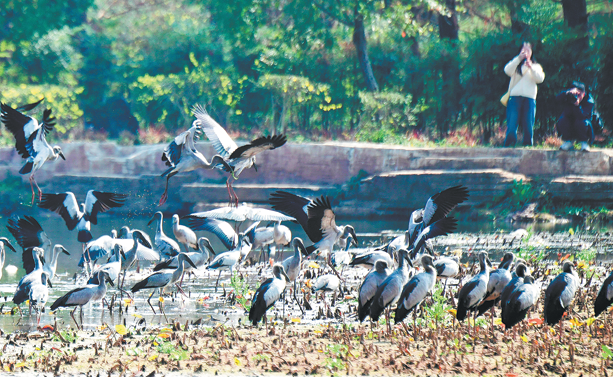
A group of Asian openbill storks forage and play along the riverside at Dianxi River Wetland Park in Mile, Yunnan province, on Sunday. (Photo: Pu Jiayong/For China Daily)
With sustained conservation and restoration efforts, China has added or rejuvenated more than 1 million hectares of wetlands since 2012, solidifying its position as the country with the largest expanse of wetlands in Asia and the fourth largest in the world.
This was announced by the National Forestry and Grassland Administration on Monday, the 30th World Wetlands Day. The administration added that the achievement was realized through more than 3,800 projects.
The theme for this year's World Wetlands Day was "Wetlands and Traditional Knowledge: Celebrating Cultural Heritage".
"China has achieved historic progress in wetland conservation, establishing a new framework that combines prioritized restoration with categorized protection," the administration said in a statement.
Highlighting wetlands as one of the Earth's three major ecosystems with irreplaceable ecological, social, economic and cultural values, the administration said that China has continuously strengthened legal safeguards for wetland conservation.
While a dedicated national law for wetland conservation took effect in 2022, 21 provincial-level regions have since formulated or revised their relevant regulations, it noted.
China has also established and refined a tiered wetland management system.
The administration said the country has designated 82 wetlands of international importance, 80 of national importance, and 1,208 at the provincial level.
In the meantime, 903 national wetland parks have been established, with approximately 90 percent offering free admission to the public, the administration said. These parks witness around 320 million tourist visits annually.
The administration also highlighted its efforts to enhance mangrove forest conservation at home and abroad.
Since 2012, 9,200 hectares of mangrove forests have been planted in the country. China has also stepped up efforts to develop the International Mangrove Center. Launched in late 2024, the center has expanded its consortium of interested member nations to 20.
At a news conference on Monday, Foreign Ministry spokesman Lin Jian highlighted the International Mangrove Center's global outreach.
The center, he said, has fostered international cooperation on mangrove conservation and knowledge-sharing with partners in regions including Southeast Asia and Africa.
It also runs specialized workshops that offer policy, technical and management training for participants from Global South countries, he added.
Meanwhile, the National Forestry and Grassland Administration outlined key priorities for wetlands conservation during the 15th Five-Year Plan (2026-30) period.
According to the administration, the country will advance work on refining the legal framework for wetland conservation and establishing a total wetland area control system.
Other focal points are enhancing baseline surveys, dynamic monitoring and early warning systems for wetland ecosystems.
In the Zhalong National Nature Reserve in Northeast China's Heilongjiang province, these national efforts are vividly illustrated on a daily basis.
At this globally significant freshwater reed marsh, a comprehensive monitoring network is in place, integrating remote sensing from space, video surveillance from towers, drones in the air and on-site patrols.
"With this integrated monitoring network for biodiversity conservation, we are enhancing the efficiency and effectiveness of wetland conservation," said Zhang Jianfei, director of the reserve's protection center.
On the front line, rangers patrol the 210,000-hectare expanse with handheld BeiDou navigation devices. When a path ends, drones become the eyes in the sky, feeding high-definition images back to enrich the reserve's species recognition database.
"Supported by these technological means, the reserve administration has managed to rescue more rare birds than ever before," said Xu Jiong, an employee at the reserve, adding that 28 birds from 15 rare species were rescued in 2025 alone.
These efforts are yielding remarkable results. The population of wild red-crowned crane, a species under first-class State protection in China, in the reserve has remained stable at around 300, making the area the world's largest breeding ground for the species, according to the reserve.