


This year's World Wetlands Day, observed Feb. 2, carried the theme "Wetlands and traditional knowledge: Celebrating cultural heritage." China has strengthened efforts to protect wetlands and their ecosystems, achieving notable progress in conservation. These efforts have enhanced the role of wetlands, contributing to global conservation.
The Tianfuyuan Wetland in Dujiangyan is a protected area that supplies drinking water to Chengdu, southwest China's Sichuan Province. Ren Changyun, Party chief of the Baisha community in Longchi town, Dujiangyan, has dedicated himself to safeguarding the wetland for the past 12 years.
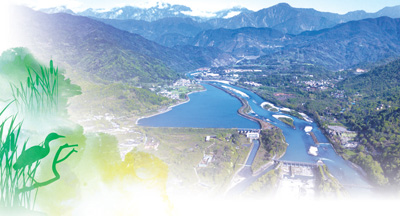
Photo shows the Tianfuyuan Wetland in Dujiangyan, Chengdu, southwest China's Sichuan Province. (People's Daily/Song Haoxin)
In 2018, Chengdu launched a plan to advance wetland conservation and restoration. Since then, workers have cleared river channels, removed invasive plant species and reintroduced native aquatic vegetation better suited to the local environment. Ren began visiting daily, learning to protect the water, cultivate wetland plants and boost the ecosystem's vitality.
He now uses a mobile app to support daily patrols and monitoring. More than 20 sensors send real-time water quality data directly to his phone. In the past, Ren said, he relied largely on personal experience, which was labor-intensive and often inefficient. With the help of technology, wetland protection has become far more targeted and efficient, he said.
The Yellow Sea Wetland in Yancheng, east China's Jiangsu Province, is among the largest coastal wetlands along the country's eastern seaboard.
The wetland is located along the East Asian-Australasian Flyway. Every spring and autumn, millions of migratory birds stop here to rest, molt and regain strength.

Migratory birds rest and fly at the Yellow Sea Wetland in Yancheng, east China's Jiangsu Province. (Photo/Li Siyuan)
"Monitoring data shows a steady increase in both the population and diversity of migratory birds," said Chen Juan, a senior engineer at the Yancheng Wetland and World Natural Heritage Site Conservation and Management Center. Chen, who has spent years working in wetland restoration and conservation, noted that protecting wetlands is a long-term effort that must respect natural processes rather than rely too heavily on human intervention.
More than 700 vertebrate species have been documented at the wetland, including more than 440 bird species. Many are rare and endangered, such as the spoon-billed sandpiper, red-crowned crane, oriental stork and black-faced spoonbill. In 2019, China's Migratory Bird Sanctuaries along the Coast of the Yellow Sea-Bohai Gulf (Phase I) were inscribed on the World Heritage List.
Over more than two decades, Xixi National Wetland Park in Hangzhou, east China's Zhejiang Province, has transformed from a low-lying marsh on the city's outskirts into what is now known as "the kidney of Hangzhou."

Photo shows a boat at Xixi National Wetland Park in Hangzhou, east China's Zhejiang Province. (Photo/Xiao Yisan)
As China's first national wetland park, it has prioritized restoring its native ecosystem, protecting vegetation and restricting development, setting a benchmark for wetland conservation in a densely populated area.
The wetland has also preserved traditional eco-agricultural systems of historical and cultural significance, including mulberry- and persimmon-dike fishponds. Today, more than 2,700 fishponds integrated with mulberry, persimmon and bamboo remain.
By the end of 2024, the number of bird species recorded at the wetland had risen to 224, up from 69 in 2005.
The wetland now attracts about 5 million tourist visits annually and generates approximately 200 million yuan (about $29 million) in tourism revenue.