


TIANJIN, Feb. 6 (Xinhua) -- At the dispatch and command center of Tianjin Rail Transit Group, Chinese instructor Cui He is training a group of light rail dispatchers from Kazakhstan on operating procedures of the light rail transit (LRT) system in their capital, Astana.
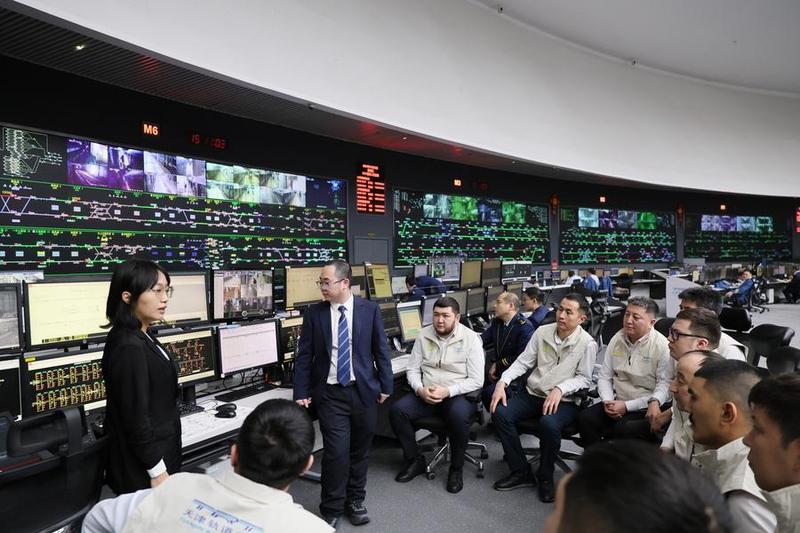
Trainees from Kazakhstan attend a lecture at a dispatching center of Tianjin Rail Transit in north China's Tianjin Municipality, Jan. 23, 2026. (Photo: Xinhua)
Twenty trainees are taking part in a three-month program in north China's Tianjin Municipality to learn Chinese rail transit dispatching technology and operating rules through classroom instruction, hands-on and simulated training, and on-the-job shadowing.
"I am deeply impressed by the efficient collaboration between the Chinese and Kazakh sides," said Assyl Nurmaganbetov, one of the trainees.
The Astana LRT project, a landmark Belt and Road project between China and Kazakhstan, is the first urban rail transit line in Kazakhstan's capital and the first rail transit project in Central Asia built entirely with Chinese technologies and equipment.
The 21.39-kilometer line will have 18 stations and operate at Grade of Automation 4 (GoA4), the highest automation level available. Once in service, it is expected to cut cross-city travel time by half and help ease chronic traffic congestion.
Chinese companies are overseeing the entire project from design and construction to operation and training.
Tianjin Rail Transit Group, which signed a consulting services contract in 2024, has dispatched technical teams to support system installation and ensure adaptation to harsh weather conditions.
The current training is also part of the cooperation. Trainees are studying driving regulations, dispatching system operations, and train traffic management, while also taking part in emergency response drills simulating scenarios such as signal faults and temporary passenger evacuation.
"I previously worked in signaling and had limited experience in dispatching. This training has given me a complete understanding of the dispatching system," said Ussen Nurke, a trainee who formerly worked as a signal technician for Kazakhstan's railway company.
The program has been tailored to Astana's extreme winter conditions and the challenges of operating a driverless line, according to Cui.
In a highly realistic simulation environment, trainees repeatedly practice responses to eight localized situations, including train traffic organization in snowy weather and power outages.
In June 2025, a first group of 29 train drivers from Astana began a three-month hands-on training program in Tianjin. A second round of dispatcher training was launched in November, with trainees arriving in Tianjin in December for a three-month hands-on session.
Nurmaganbetov said the training had enhanced his dispatching skills, including emergency decision-making, coordination across multiple processes, and information handling.
Subsequent training will further strengthen emergency response in complex scenarios, on-site reconnaissance, and multi-dimensional assessments, said Guo Hong, deputy general manager of the Tianjin Rail Transit Group's consulting arm.
After the training ends in late February, the company will also dispatch professionals to Kazakhstan to support joint commissioning and testing, Guo added.