


The fifth volume of "Xi Jinping: The Governance of China" is out. This is undoubtedly exciting news. From a Chinese perspective, here are the speeches of the Chinese president and the head of the Communist Party of China concerning the development of their country. The contents of these speeches focus on China's policies, economy, society and many other aspects that will not only directly influence China as a whole but also every individual Chinese citizen. For foreign readers, the fifth volume is a guide to understanding China.
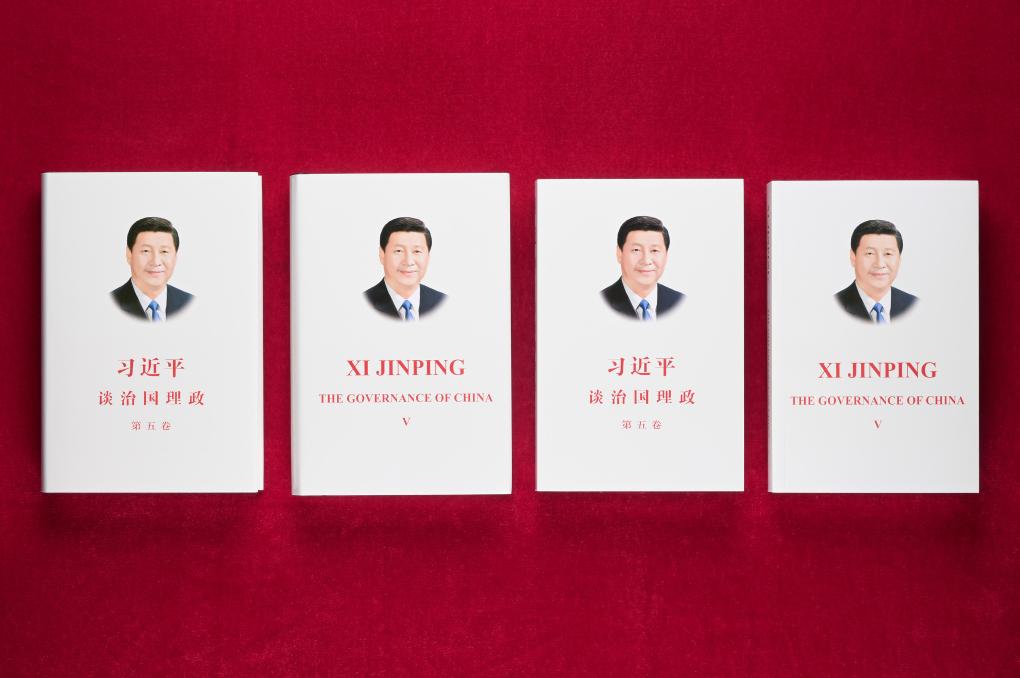
This photo shows the fifth volume of "Xi Jinping: The Governance of China" in both Chinese and English. (Photo: Xinhua)
China is now a world power and one of the most important players in international politics. And that means it is of the utmost importance to learn as much as possible about China, its political leadership and its intentions.
But to understand this, you need expertise on China. And most China experts agree that Germany has far too little of this. I sometimes get the impression that our politicians understand too little about China to really grasp how important it would be to have more expertise on China. Instead, they rely on China experts from the echo chamber: MERICS, the leading German China think tank, which is not only partly funded by the German government, but also offers no independent expertise, only highly predictable recommendations that follow the generally desired political line and relatively thin analyses whose results are just as unsurprising.
There is actually enough material available, because Xi Jinping's published speeches alone, summarized in the series "The Governance of China," offer a wealth of insights into the goals China is pursuing.
China's policies and the goals of its government are by no means as mysterious as they are sometimes portrayed. The fact that China has ambitious goals for research and technology development and has consistently pursued this path, accompanied by a corresponding expansion of the education sector, should come as no surprise to anyone. These topics are also covered comprehensively in Volume V. The section on New Quality Productive Forces and the following section on education, particularly in the field of science and technology, are among the most extensive chapters in the volume.
One theme that runs throughout the volume is China's modernization. Although this modernization has already come a long way, it is far from complete. This buzzword refers not only to technological development, but also to Chinese society, Chinese culture and, last but not least, the environment. While China's modernization was sometimes reckless with nature and the environment in its early stages, much has changed since then. China is a leader in the development and installation of solar energy. And in Volume V, four speeches are devoted to these aspects under the section "The Beautiful China Initiative," which deals with the creation of harmony between humans and nature.
It is important to bear in mind how complex it is to implement comprehensive measures, changes and reforms in a country the size of China. It takes the cooperation of many minds and hands to implement large projects.
This cooperation works remarkably well. Let's take the example of the Chinese railway. When I first came to China in 1992, the rail network was old-fashioned and cumbersome. The journey from one large city to the next took a day, and on some routes, even longer. I once traveled from Chengdu to Kunming, taking over 36 hours and sitting on wooden benches in the summer heat.
Today, all this seems like a distant memory. Now one can travel at high speeds to reach half of China in a matter of hours, in modern, comfortable, clean carriages.
Quite apart from how easy it has become to buy tickets, in the 1990s, you either had to fight your way through a crowd of people to the ticket office and, as a foreigner, consider yourself lucky if you ended up at the right counter.
Today, I have the 12306 app on my smartphone and can easily buy or cancel tickets, even for my whole family. And it's very spontaneous. During a visit to Zhengzhou, my hosts took me to the wrong station, but I didn't notice until the ticket inspection. No problem, within a few minutes I had canceled the old tickets and bought new ones, and less than half an hour later I was on the train to Beijing.
These developments did not happen overnight, but are the result of careful planning and persistent pursuit of set goals. But that's not all. China's successful growth over the last 40 years requires another ingredient: flexibility. China's path is a continuous learning process in which development must be constantly modified and adapted to reality. Anyone who studies the five volumes of "The Governance of China" will notice that the focus shifts, new topics emerge and others recede into the background.
Volume V thus offers readers a wealth of insights that cannot be covered in a single article. However, it is worth noting that the series has been published since 2014, more than a decade. The volumes are carefully edited and professionally translated, and that allows us to follow Chinese politics closely. German experts and politicians would do well to take note of this. We need more of everything: more emphasis on China studies in school and university curricula, more knowledge about China in government departments and, last but not least, more expertise on China in politics.
The author is a German sinologist and historian.