


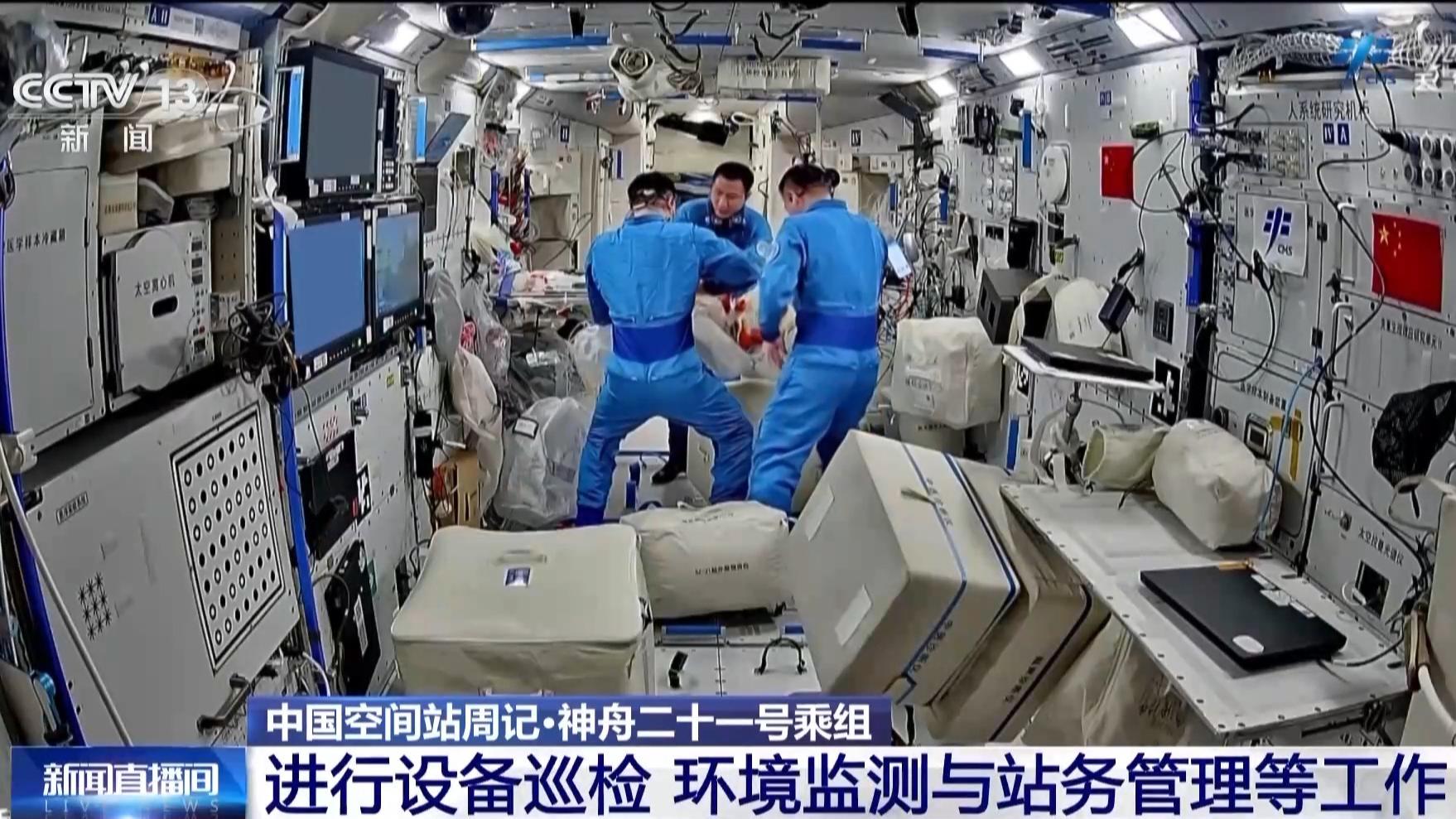
The Shenzhou-21 crew inside the China Space Station. (Photo: CMG)
China's Shenzhou-21 crew, which consists of mission commander Zhang Lu and astronauts Wu Fei and Zhang Hongzhang, has now spent more than three months on its space mission, with a wide range of tasks steadily progressing aboard China's space station. Over the past week, the crew continued scientific experiments, platform operations, equipment maintenance, and health management in an orderly manner.
In the field of space medicine, astronauts collected and processed blood samples for studies on bone-metabolism interactions and spaceflight-integrated omics. The returned samples will support research into how long-duration missions affect astronauts' skeletal, neural, and cerebrovascular systems, as well as the mechanisms behind physiological adaptation.
Using laptop computers, the crew also conducted experiments examining how microgravity influences asymmetry between upper and lower visual fields and the related cognitive and neural mechanisms.
Experiments in microgravity physical sciences continued as planned. The astronauts completed tasks including sample cleanup in containerless experiment chambers, electrode maintenance on axial mechanisms, cleaning observation window lenses, and the disassembly, reassembly, and sample replacement of fluid dynamics experiment modules.
For onboard environmental monitoring and equipment upkeep, the crew used instruments such as dew point meters to monitor the station's thermal environment and conducted air cleanliness tests. They also carried out inspections of on-orbit maintenance operation cabinets, replaced gloves in the scientific glovebox, organized supplies, and performed routine cabin cleaning and maintenance.
In terms of health management, the astronauts used specially designed adhesive devices to provide force stimulation to lower-limb flexor muscles during exercise in microgravity, ensuring effective workouts. They also completed a series of medical examinations, including intraocular pressure and fundus checks, comprehensive visual function assessments, and transorbital B-ultrasound measurements.