


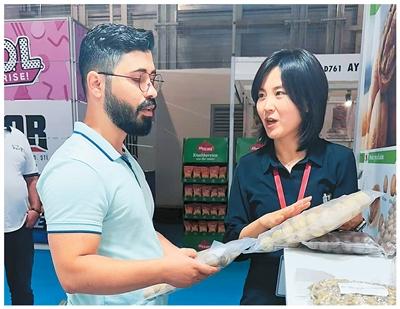
Zhang Jueya (right), a cross-border e-commerce operations manager, introduces products to an overseas client. (Photo courtesy of interviewee)
"Cross-border e-commerce operations manager" is a new profession riding the wave of "buy global, sell global." The role involves far more than simple online customer service: these professionals need the skills of data-savvy analysts and on-site operators linking factories and ports.
The occupation was publicly recognized by China's Ministry of Human Resources and Social Security on May 8, 2025, and officially included in the seventh batch of new professions released on July 22.
Around 4 p.m., Zhang Jueya, a cross-border e-commerce operations manager, walked into a factory workshop, phone in hand. She had chosen this timing deliberately — early afternoon in Russia and Central Asia, when customers were still at work. She filmed as she walked, her camera sweeping past neatly stacked bags of raw walnuts, then focusing on the sorting and roasting lines, before settling on the storage area filled with finished, labeled products.
Zhang serves as a consultant for Gansu Qianli Silk Road International Trade Co., Ltd. in Longnan city, northwest China's Gansu Province, managing the company's cross-border e-commerce operations.
Handling international buyer inquiries about products, prices, delivery times and transaction details has deepened Zhang's understanding of product selection.
"For companies transitioning from traditional domestic business to cross-border e-commerce, many customer requirements are entirely new," she said.
European Union organic certification and FDA approval in the U.S. — credentials often overlooked in domestic e-commerce — have become essential requirements in international markets. Her team has consciously prioritized these certifications when screening partner factories, highlighting them as core selling points in product descriptions. As a result, the company offers an increasingly diverse range of high-quality specialty agricultural products on its online store.
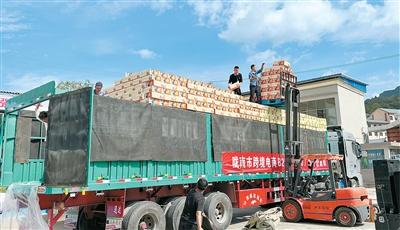
Agricultural products are loaded onto a truck for shipment to an overseas warehouse. (Photo courtesy of the interviewee)
After establishing partnerships, clients often present new demands. To maintain customer relationships and expand product categories, the team connected with suppliers in south China's Guangxi Zhuang Autonomous Region and east China's Shandong Province.
"Cross-border e-commerce works on the principle of 'find what customers want.' We're no longer just walnut sellers but trusted 'connectors to China's supply chain,'" Zhang explained.
Before major clients begin intensive inquiry sessions, Zhang concentrates on data processing and analysis.
"In e-commerce operations, you have to listen to what the data tells you. Look at data first, then identify problems," she said. Based on data analysis, the team makes targeted marketing adjustments: refining product titles, replacing main images with more appealing ones, or intensively promoting promising product links.
In Zhang's view, operators must not only be familiar with e-commerce platforms but also understand customs documentation, effectively linking digital systems and physical regulatory procedures.
Zhang shuttles daily between two fronts: data and cargo ships. In the morning, she might be an analyst studying traffic trends. In the afternoon, she becomes a supervisor monitoring production schedules. Late at night, she turns into a customer service representative, verifying bill of lading information with overseas clients. This is the daily reality of cross-border e-commerce operations managers — monitoring backend data to identify market demand while ensuring each shipment clears customs smoothly.
Zhang has discovered that cultural differences permeate every aspect of business. East Asian consumers prefer individually packaged snack foods, valuing convenience and experience, while in Russia and Central Asia, walnuts are important daily ingredients, with substantial household consumption and food-processing demand making bulk wholesale trade more active. Understanding these nuances means going beyond market research reports to grasp local dietary culture, family structures and even holiday traditions.
According to the White Paper on Talent Cultivation for Cross-Border E-Commerce in China, the country's talent gap in the sector reached 4 million people in 2025, and the shortage may continue to deepen.
Beyond her role as a cross-border e-commerce operations manager, Zhang also teaches at the College of E-Commerce of Longnan Normal University. She brings real-world logistics challenges, customs cases, and cultural differences into the classroom, giving students early exposure to the realities of global trade. In her view, future cross-border e-commerce professionals cannot simply understand platform operations. They must be versatile experts integrating internet thinking, supply chain management, international business rules, and policies and regulations in destination countries.
In recent years, Longnan city's cross-border e-commerce industry has developed rapidly. Its agricultural product cross-border e-commerce transactions reached 137 million yuan ($19.7 million) in 2024, while the number of registered cross-border e-commerce enterprises grew over 100 percent year on year in 2025.