


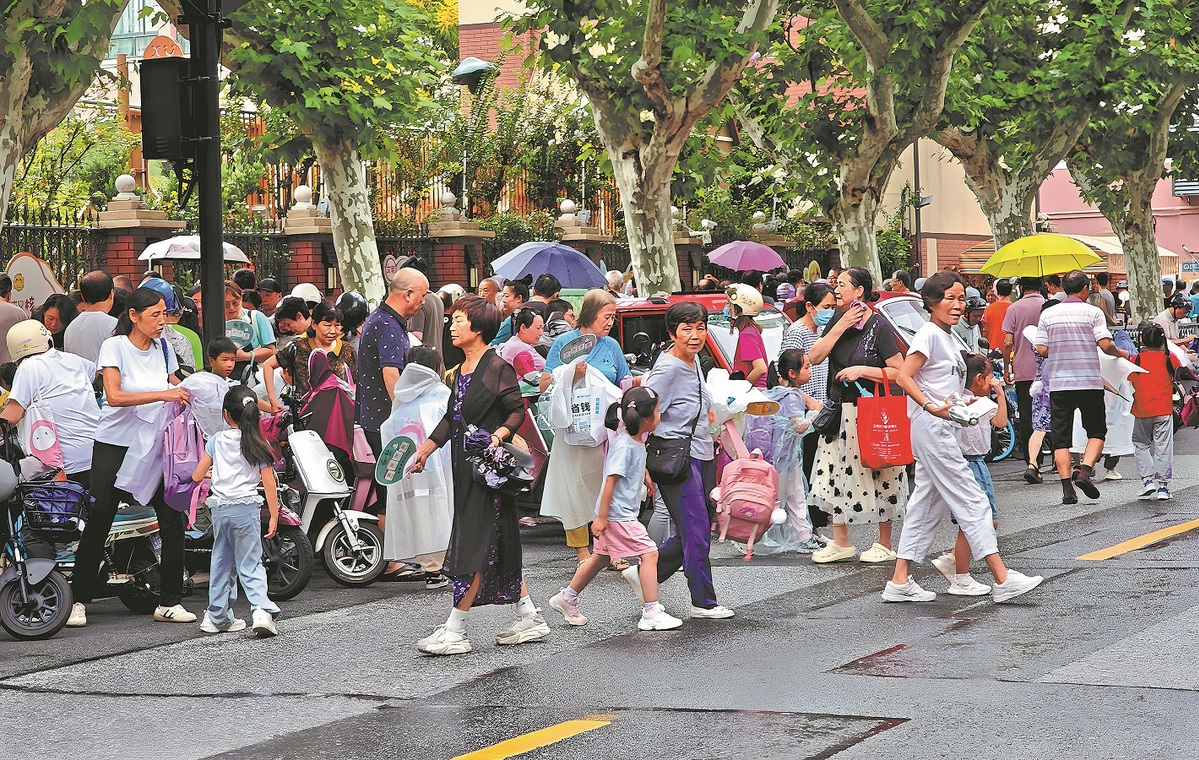
Grandparents wait outside a primary school in Shanghai to pick up their grandchildren in September. The scene highlights the active role of elders in childcare within urban families. (Photo: CHINA DAILY)
Across China's major cities, a quiet migration known as Lao Piao — literally "elderly drifters" — is unfolding as older adults leave their hometowns to help care for grandchildren in urban households.
Wu Pei, 33, a production manager at a foreign company in Guangzhou, Guangdong province, now has two elderly drifters in her life.
After Wu returned to work from maternity leave at the end of 2021, her mother moved from Anhui province and her mother-in-law from Hunan province to take turns caring for her 4-year-old son. At times, they all live together, reshaping the household's rhythms and serenity.
"Living as three generations under one roof has not always been easy. The older women rely on life experience, while I am guided by modern, science-based parenting ideas. Disagreements over routines, diet or discipline sometimes arise," said Wu.
Yet, over time she has witnessed genuine change. Her 65-year-old mother used her retirement to study childcare and earned a caregiving certificate, while her 63-year-old mother-in-law learned to prepare healthier meals for her grandson.
"It amazes me that they are still willing to learn at this age. Their effort makes me feel deeply grateful, but it also reminds me how much they've given up for us," said Wu.
One incident revealed the depth of her dependence on them. When her son developed a high fever while both grandmothers were away, Wu and her husband struggled to cope.
"That was the first time we truly realized how hard it is to take care of a child on our own. In the middle of the night, we both thought the same thing — without them, we can't do this," said Wu.
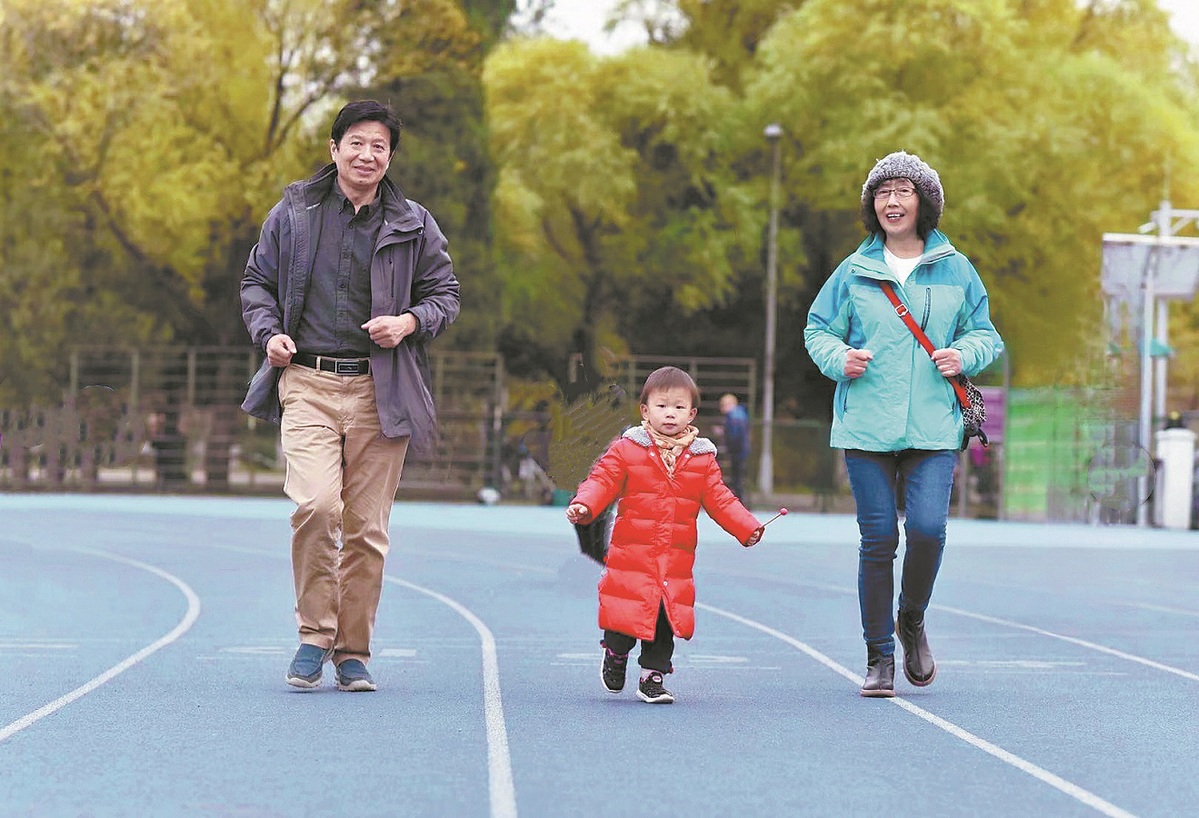
Xu and his wife do exercises with their granddaughter in Tsinghua University in Beijing in 2019. (Photo provided to China Daily)
Changing landscape
Yu Hai, a sociology professor at Fudan University, said the emergence of elderly drifters is closely linked to broader changes happening in society.
"In Chinese culture, it has long been a tradition for older generations to help raise the children of the young. This form of intergenerational support is not new, but the scale and visibility of today's elderly drifters make it a distinctive social phenomenon," Yu said.
"The expansion of higher education and large-scale urbanization has drawn young people from all over the country into cities — especially major and supersized ones — in search of employment and opportunity. Under the combined influence of tradition, education, industrialization and urbanization, a unique 'elderly drifter landscape' has taken shape in China's largest cities."
The exact number of elderly drifters is hard to quantify.
The population aged 60 and above in China reached 264 million, accounting for approximately 18.70 percent of the national population, according to the Seventh National Population Census conducted by the National Bureau of Statistics conducted in late 2020.
The total number of people living separately from their household registration (hukou) was 493 million, an increase of 88.52 percent compared with the previous census. The migrant population reached 375 million, a year-on-year increase of 69.73 percent. Among this vast mobile population, elderly drifters formed a significant group, the census said.
A 2023 study by Donghua University in Shanghai found that from 2017 to 2020,Shanghai had approximately 610,000 to 650,000 non-local elderly residents, accounting for 8 to 12 percent of both the city's migrant population and registered elderly population.
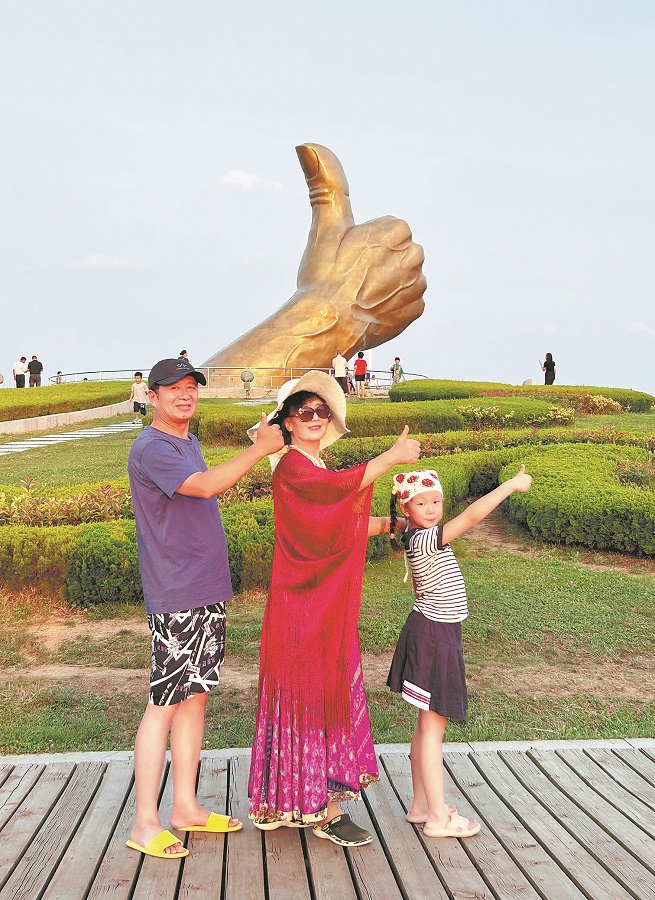
Xu Jingzhou and his wife travel with their granddaughter in Weihai, Shandong province, in 2023. (Photo provided to China Daily)
New chapter
In 2017, retired journalist Xu Jingzhou, 69, left his hometown of Pizhou, Jiangsu province, to move to Beijing and help care for his newborn granddaughter.
The former senior editor of Pizhou Daily newspaper, spent decades living and working in the county seat before moving. Leaving behind his old courtyard house and the familiar rhythm of retirement was not easy, Xu said.
"I had many reservations as childcare is physically demanding, and I knew adapting to a small apartment in Beijing would be completely different," he said.
His wife, holding a senior position at a large enterprise, initially hesitated. In the first year, she commuted back and forth while most of the caregiving duties fell on Xu.
The couple also debated whether to sell their Pizhou home, aware that some of their acquaintances later regretted making such a decision.
Despite these concerns, Xu and his wife were charmed by Beijing's cultural life. Living near Tsinghua and Peking universities, they were surrounded by exhibitions, lecture sessions, and libraries. "We were drawn to the cultural atmosphere of the capital, and that part of the experience proved unexpectedly enriching," said Xu.
Yet family remained the core motivation for moving, even though the child's early years were exhausting. Over time, the experience brought unexpected rewards.
Xu and his wife documented their granddaughter's growth, opening a QQ account called "XuXuErXiao" and keeping a diary on Sina Weibo. These posts were accumulated into a manuscript Grandpa's Notes on Raising a Child in Beijing, which attracted provincial and national media attention.
Xu also wrote over 200 nursery rhymes that were compiled into two books.
Childcare did not halt Xu's intellectual pursuits. Between the child's naps and feeding times, he continued research on Chinese classic novels such as Jin Ping Mei (The Plum in the Golden Vase) and Dream of the Red Chamber, producing hundreds of essays and adapting quickly to digital platforms, running social media accounts, recording lectures, and producing educational videos.
"Learning kept me alive, guiding me through challenges and giving each day deeper meaning," he said. His dedication earned him recognition as a local "learning model", and he was invited to teach online senior education courses.
"I came here out of love, but what I discovered was a whole new world of learning. I wanted to give my granddaughter a home woven from family memories and culture — and to me, that is everything," said Xu.
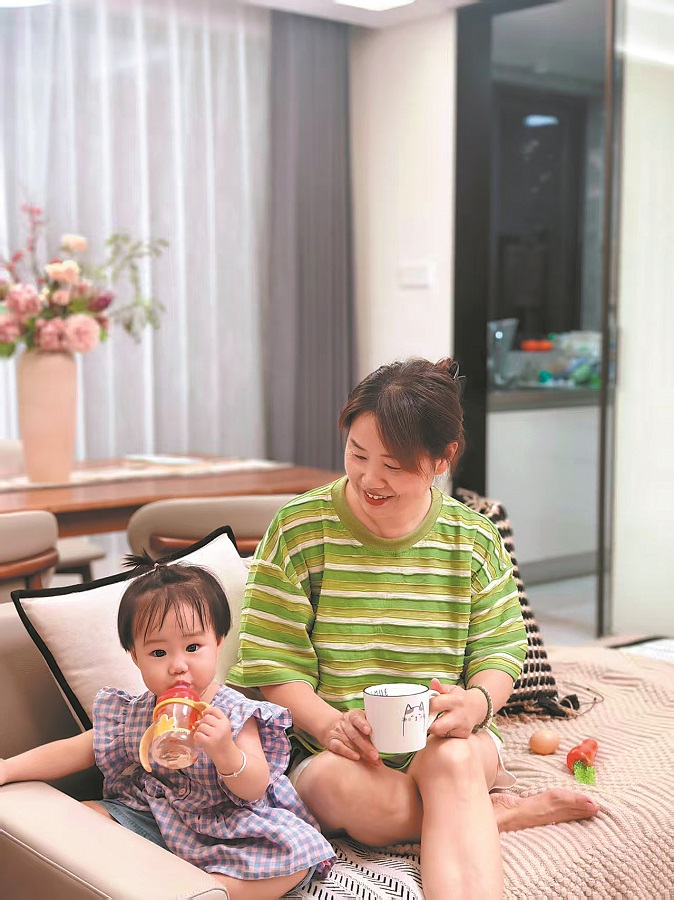
Fang accompanies her granddaughter during a family trip to Anji, Zhejiang province, in September. (Photo provided to China Daily)
Teething problems
Retired civil servant, Fang Mozhi, 56, came to Shanghai in 2023 to take care of her pregnant daughter. After her granddaughter was born in 2024, she began to take care of the baby full-time.
"I didn't think too much about it at the time. Pregnancy is a sensitive stage, and I was worried she might feel stressed or anxious. I just felt I had to be there with her," said Fang.
Daily life now revolves almost entirely around the child. Fang's schedule is shaped by feeding times, naps and play.
"Every tiny change feels like a victory. Yet the responsibility also comes with constant pressure. I'm always worried about her getting sick or getting hurt. You can never really relax," said Fang.
Living in a big city far from home has not been easy. Fang admits that she often misses her old friends, familiar streets and the taste of local food. In the community where she now lives, most residents speak the Shanghai dialect, which she does not understand.
"At the beginning, I felt very lonely. There was no one to chat with in my own dialect," she said. At times, she feels more like a temporary visitor than a true resident, even though her days are filled with purpose.
Differences in parenting ideas have also emerged between Fang and her daughter and son-in-law, particularly over issues of cleanliness and the family's decision to keep pets. While she initially found it hard to accept, she gradually learned to compromise.
Her husband remained in Yangzhou and their main form of connection is through phone and video calls. Despite this, she believes they share a common understanding.
"We both know we are doing this for the next generation. Everything we endure, every sacrifice we make, is so that they can grow up with more choices, more opportunities, and a better life than we ever had," she said.
Reflecting on the growing number of elderly people like herself who move to big cities to support their children, Fang sees deeper forces at work. Rising living costs, childcare expenses and financial pressures on households have made such arrangements almost inevitable.
"We rely on each other and sacrifice for each other. That's just the reality of many families today, where everyone carries a part of the burden in their own way," she said.
Around 320 million women were employed in 2022, accounting for 43.2 percent of the country's workforce, the National Bureau of Statistics' Statistical Monitoring Report of China National Program for Women's Development (2021-2030) showed.
This trend has created new demands among young couples for childcare, often relying on older family members to step in, sometimes moving from their hometowns to help.
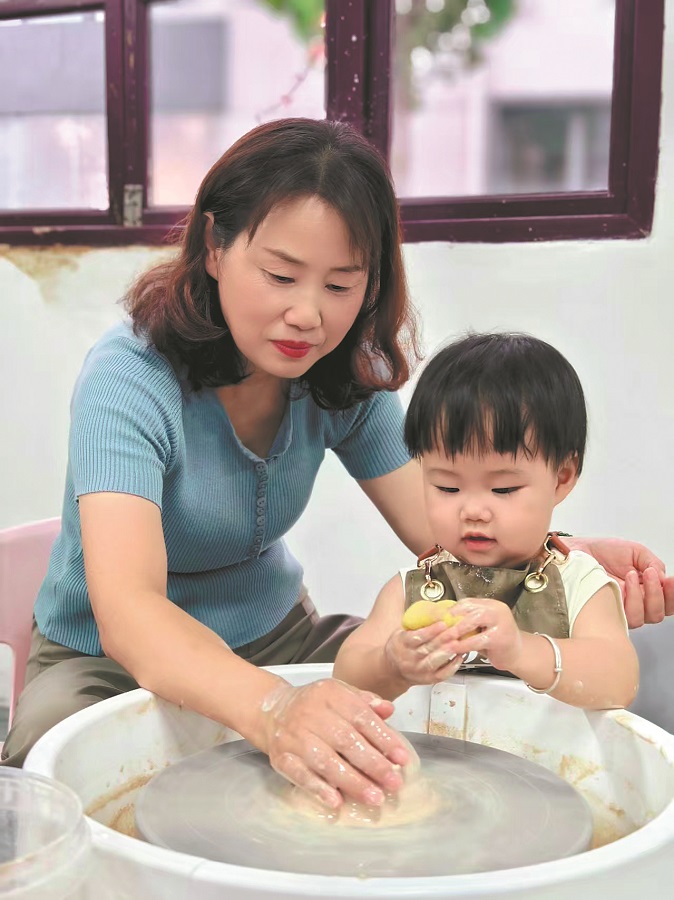
Fang Mozhi takes her granddaughter to experience pottery-making in Yixing, Jiangsu province, in August. (Photo provided to China Daily)
Staying put
While some elderly people have moved to cities, many of their partners have stayed behind in rural homes, where they face the vicissitudes of aging alone.
The fifth sample survey on the living conditions of urban and rural senior residents in China reported that 59.7 percent of elderly people in China lived in empty-nest households, with 13 percent living alone in 2021.
Zhou Baoguo, 67, from a small town in Anhui province, faced this reality. Two years ago, when his son and daughter-in-law secured jobs in Beijing and had their first child, the family assumed both grandparents would move. Only Zhou's wife went, while he stayed behind.
The decision seemed practical. His legs tire easily, and long distances and crowded trains leave him aching. The vegetable plot behind the house still needs tending, and his 80-year-old mother depends on him.
"Someone has to stay. If I don't water them, they'll wither. Who will care for my mother?" he asked.
Outwardly, the house seems unchanged, but inwardly, everything feels different. Rooms that once echoed with chatter have fallen silent. His routine remains steady — waking early, sweeping, and going to the market. At night, he sometimes forgets he is alone by talking to an empty room, "Dinner's ready? Don't forget your jacket."
Zhou has learned to use a smartphone for video calls to watch his grandson smile and crawl. Each evening, he records short voice messages about the weather, crops, and seasons — small stories for a future reunion. "He doesn't know me yet, but I know him. Soon, we'll pick the corn together," he said.
Neighbors call him "understanding" and "selfless", but Zhou rarely frames it that way. He has never called himself an elderly drifter, yet in his stillness exists another kind of "drifting" that is rooted, quiet, and marked by distance.
"They survive in a big city while I survive in a small one. I stay, I wait, but sometimes it feels like I am already far away," said Zhou.
Over 30 percent of families with children under 3 years old have a need for childcare, but the actual enrollment rate in childcare facilities nationwide is only 7.86 percent, according to data released by the National Health Commission's Department of Population Surveillance and Family Development in 2024.
The idea that older people are a "resource" rather than a "burden" has also gained popularity in public discussions, but Yu, the professor, offers a more cautious interpretation.
"If the elderly are seen as resources only because they can provide childcare, this is ultimately a utilitarian view, one that reduces them to a form of labor," said Yu.
Despite losing their former central position in the family, many elderly drifters continue to accept — and even embrace — this role.
"Through caring for their grandchildren, they experience joy, emotional connection and a renewed sense of purpose, even if their status in the family has shifted and become closer to that of a caregiver or nanny," said Yu.
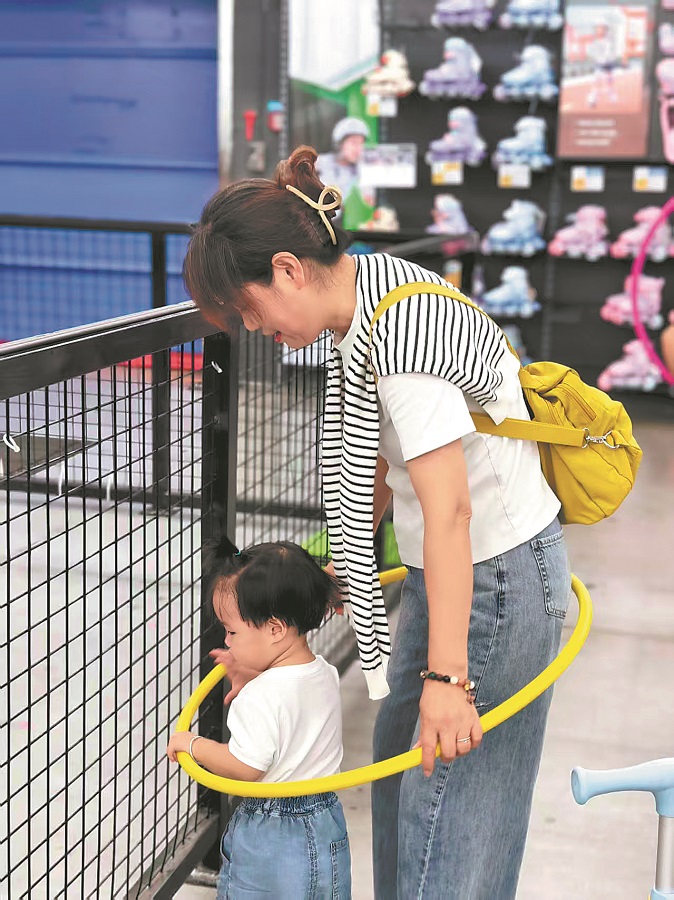
Fang plays with her granddaughter at a Decathlon store in Shanghai in July. (Photo provided to China Daily)