


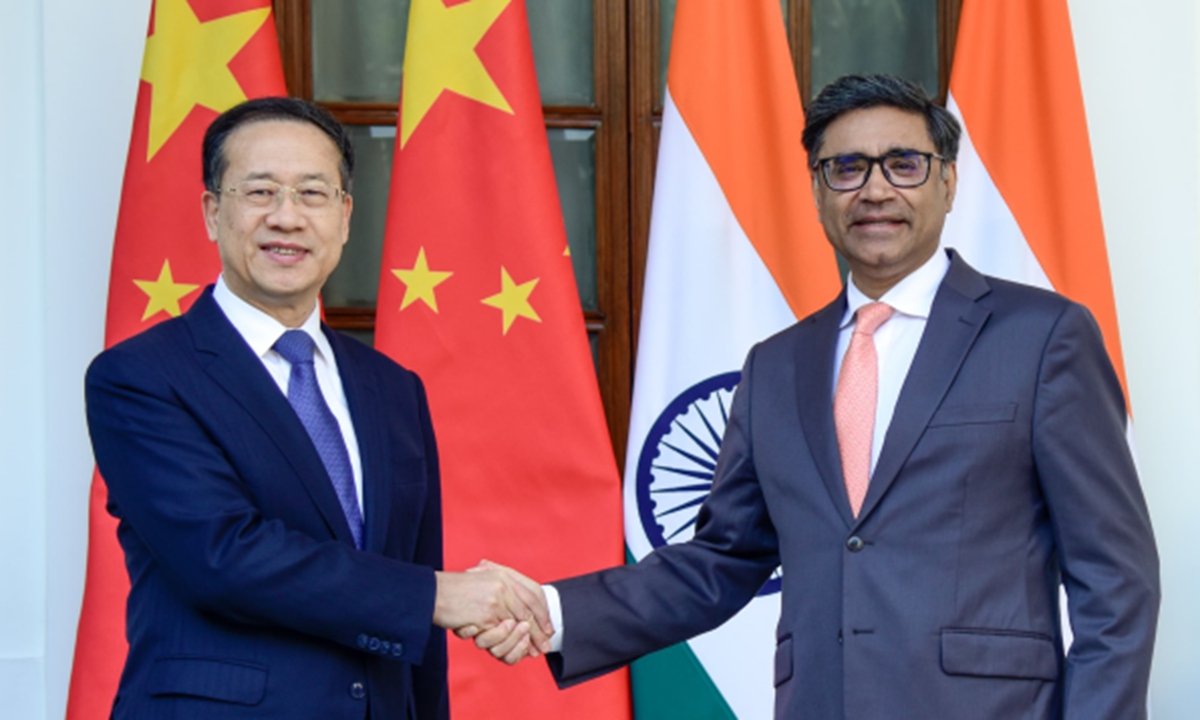
Ma Zhaoxu, Executive Vice Minister of Foreign Affairs of China holds a new round of China-India Strategic Dialogue with Vikram Misri, Foreign Secretary of India in New Delhi on February 10, 2026. (Photo: official website of Chinese Foreign Ministry)
Senior officials from China and India held a new round of China-India Strategic Dialogue in New Delhi on Tuesday, with both sides having friendly, candid and in-depth communication on the international and regional situation, respective internal and external policies, international and regional issues of shared interest, and China-India relations, according to a release by Chinese Foreign Ministry on late Tuesday. A Chinese expert say this signals that a momentum of thawing bilateral ties has continued.
The meeting, held on the sidelines of the BRICS Sherpa Meeting (February 8-10), involved Executive Vice Minister of Foreign Affairs of China Ma Zhaoxu and Indian Foreign Secretary Vikram Misri.
The Chinese Foreign Ministry stated that both sides emphasized the need to view and handle China-lndia relations from a strategic and long-term perspective, and uphold the strategic perception that China and India are cooperative partners instead of rivals, and the two countries are each other's development opportunity instead of threat.
On multilateral cooperation, the Chinese Foreign Ministry readout noted that both sides agreed to support each other's work as the BRICS Chair for 2026 and 2027. Both sides also agreed to support multilateralism and the central role of the United Nations, strengthen unity and cooperation among the Global South, safeguard international fairness and justice, work together for a multipolar world.
India's Ministry of External Affairs spokesperson Randhir Jaiswal posted on X on Tuesday, accompanied by photos that included a handshake of Ma and Misri, saying: "Both sides reviewed the positive momentum in bilateral relations and discussed ways to further advance ties by enhancing people-to-people exchanges and addressing concerns on sensitive issues."
Cited by Indian media The Print, a person familiar with the matter described the strategic dialogue as a part of another step toward "gradual normalization" of ties
Qian Feng, director of the Research Department at Tsinghua University's National Strategy Institute, told the Global Times on Wednesday that the strategic dialogue held at the beginning of 2026 marks the continuation of the ongoing thaw in China-India ties. The process is characterized by sustained high-level communication and coordination, as well as mutual engagement in moving toward each other, consistent with the strategic consensus reached by the leaders of the two countries.
He noted that such interactions help build political trust and deepen mutual understanding between the two nations.
Qian further noted that, in today's international environment characterized by profound and intertwined transformations as well as turbulence, it is equally crucial for China and India—prominent voices of the Global South—to intensify communication and cooperation on regional and global issues, thereby reinforcing the ongoing positive momentum in bilateral ties.
In terms of bilateral issues, according to the Times of India, the two countries have underscored the importance of peace and tranquility in border areas for overall progress in ties.
According to Millennium Post, both sides emphasized the need to conclude an updated Air Services Agreement shortly and to keep working toward taking further measures to facilitate visas and enhance people-to-people exchanges.
Although the specific concerns of both sides are not fully aligned, each has demonstrated a clear and positive willingness to effectively manage differences while expanding the overall scope of cooperation, thereby sending strong and encouraging signals of a continued improvement in bilateral relations, Qian said.
The expert added that as this positive momentum in China-India ties persists and strengthens, there is every likelihood that more proactive and tangible measures will be introduced in the coming period on issues such as visa facilitation, direct flight connectivity, and greater people-to-people exchanges.